Most startups do not fail because of a bad idea. They fail because the product never becomes something people actually want to use. Design is where that gap appears — and where it can be closed.
A 2023 CB Insights report found that 35% of startups cite “no market need” as the primary reason for failure. But dig deeper into those cases and you will almost always find the same root cause: the team built before they understood how users think, what they see, and what makes them stay.
The Three Design Mistakes That Kill Early-Stage Products
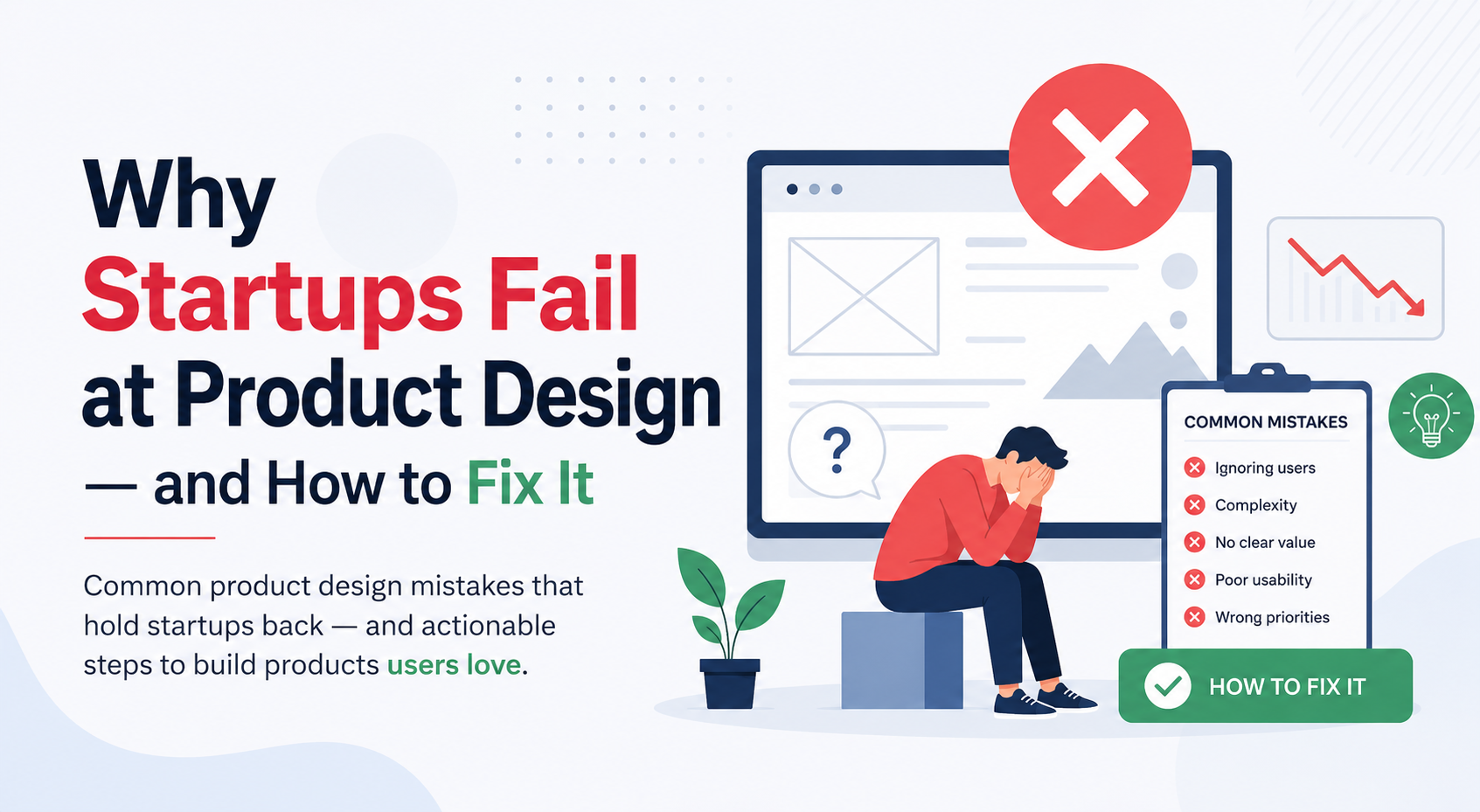
The first mistake is designing for the founder, not the user. Founders know their product intimately — which means they stop seeing it through a newcomer’s eyes. Navigation that feels obvious to you is invisible to someone opening the app for the first time. The mental model you built over six months does not transfer automatically.
The second mistake is treating UI as decoration. Buttons, typography, and color choices are not aesthetic decisions — they are functional ones. A poorly placed CTA loses conversions. Low-contrast text drives users away. Inconsistent component styles signal low quality before the user reads a single word of copy.
The third mistake is skipping validation. Startups in a hurry skip user research, skip prototype testing, and move straight to full development. This creates expensive rework cycles — and in many cases, products that work technically but fail commercially.
What High-Quality Product Design Actually Looks Like
Design in a serious product development context is not about making things look good. It is about making the right decisions at every step of product evolution: information architecture, user flow mapping, interaction design, accessibility, and consistency across platforms.
High-performing SaaS products share common design traits. They reduce cognitive load — users can complete core tasks without thinking hard. They build trust through visual consistency. They surface the right information at the right moment. And they evolve based on behavioral data, not assumptions.
This is why design decisions made in the first 90 days of a product’s life have disproportionate long-term impact. Technical debt is expensive. Design debt is often worse — because it shapes user expectations, onboarding conversion rates, and retention patterns in ways that are difficult to reverse.
When to Bring in External Design Expertise
The case for working with a specialized product design team becomes clear at a few inflection points: when your internal team lacks UI/UX depth, when you are entering a new market with unfamiliar user behavior, when you are redesigning a core product that already has users, or when design quality has become a competitive differentiator in your space.
B2B SaaS products, fintech platforms, and AI-powered tools face particularly high design standards because their users make professional decisions with them. A poorly designed dashboard in a financial product is not just frustrating — it creates genuine risk of errors.
Agencies that specialize in digital product design bring pattern recognition from working across multiple industries and product types. They have seen what works in onboarding flows, what conversion optimization looks like at different funnel stages, and how design systems scale as teams grow.
The Role of Design Systems in Scaling
One of the most undervalued investments a startup can make is a proper design system — a shared library of components, tokens, and usage rules that keeps the product visually and functionally consistent as the team grows.
Without a design system, every new screen becomes a negotiation. Developers make ad-hoc styling decisions. The product drifts visually. Onboarding new designers or developers takes longer. User experience degrades at the edges.
With a design system, teams ship faster, make fewer inconsistent decisions, and maintain quality at scale. This is not a luxury for large companies — it is infrastructure that pays back quickly for any product that intends to grow.
Closing Thoughts
Product design is not a phase you pass through — it is an ongoing function that shapes every product decision. Startups that treat it as foundational, not cosmetic, build products that users trust, recommend, and return to.
If your team is at a stage where design quality is limiting growth, or you are building a new product and want to get the architecture right from day one, it is worth looking at what specialized agencies bring to this work. For example, https://www.u1core.com/ operates as a full-cycle product development bureau, working with SaaS companies and startups globally on design, development, and AI integration from concept through launch.