For contractors working across agricultural, residential development, municipal, and utility corridors in the United States, the decision of which attachment to run on a skid steer is rarely straightforward. Terrain varies. Project timelines shift. Equipment downtime carries real cost. And choosing the wrong tool for a clearing job doesn’t just slow a crew down — it can damage equipment, compromise safety, and force a contractor to remobilize with different gear.
The skid steer has become one of the most widely used machines in land clearing precisely because of its adaptability. But that adaptability depends entirely on the attachment mounted to it. Understanding how different attachments perform under different site conditions, material types, and operational demands is what separates a smooth project from one that grinds to a halt halfway through.
This guide is written for contractors, site supervisors, and equipment managers who need a working understanding of how to align clearing attachment selection with actual field conditions — not catalog specifications.
Understanding What Land Clearing Attachments Are Actually Designed to Do
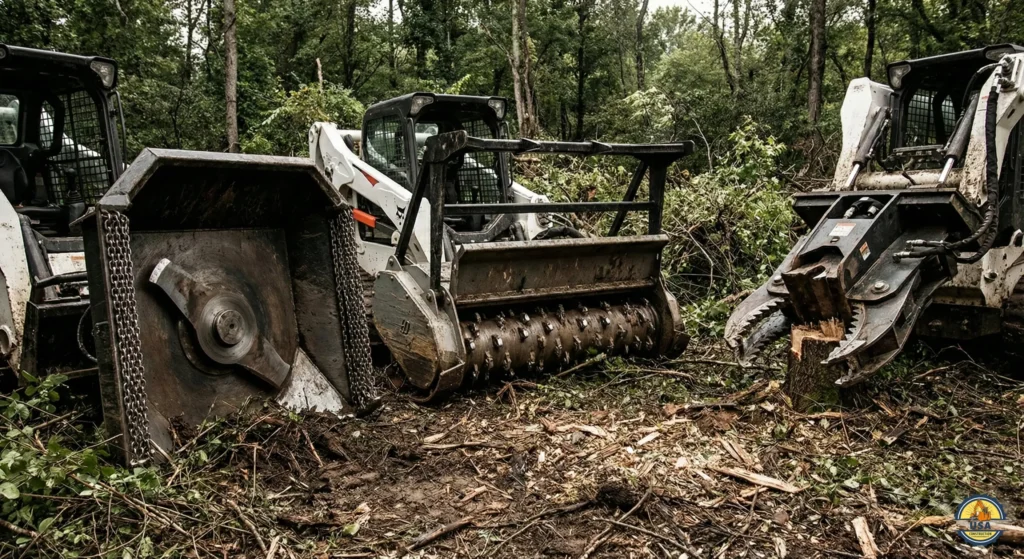
Land clearing is not a single task. It encompasses brush cutting, stump removal, mulching standing timber, grubbing root systems, and pushing accumulated debris. Each of these demands a different mechanical approach, and the range of land clearing attachments for skid steers available today reflects that operational diversity. Contractors who treat all clearing attachments as interchangeable will consistently underperform, either by overworking an attachment beyond its design limits or by deploying an overpowered tool where a lighter option would have been faster and cheaper to run.
The core design difference between clearing attachment types comes down to whether they cut, grind, or push. Cutting attachments use rotating blades or flails to sever vegetation at or near ground level. Grinding attachments process material into mulch, reducing it in place without removal. Pushing and raking attachments move debris without processing it. Each approach has downstream implications for site cleanup, material disposal, soil disturbance, and overall project efficiency.
You can review current categories of land clearing attachments for skid steers to get a clearer picture of what’s commercially available and how different designs are intended to perform across varying applications.
Why Attachment Design Affects Machine Stress
Every attachment transfers load back to the skid steer’s hydraulic system, frame, and drive components. Attachments that require sustained high hydraulic flow — such as mulchers processing dense hardwood — will push a machine harder than brush cutters working light vegetation. Running an attachment that consistently demands more than the host machine is rated to deliver creates cumulative wear that shortens equipment life and increases repair frequency.
This is not an abstract concern. It is one of the most common causes of premature hydraulic failures on contractor-owned skid steers. The attachment choice is inseparable from machine health, and both need to be considered together when planning a clearing project.
How Site Conditions Should Drive Attachment Selection
Site conditions are the first filter any experienced operator applies before selecting a clearing attachment. The density of vegetation, soil composition, presence of stumps and root systems, slope of the terrain, and proximity to structures or underground utilities all influence what an attachment can safely and efficiently accomplish on a given site.
A contractor clearing light brush from a residential lot in the Southeast is working in a fundamentally different environment than one clearing fire-damaged timber from a slope in the Mountain West. The scale of material, moisture content of vegetation, ground softness, and site access will each affect how an attachment performs — and how long it lasts under those conditions.
Vegetation Density and Material Type
Flail mowers and rotary cutters are well-matched to light-to-medium brush applications where vegetation is relatively consistent and stems are manageable in diameter. They move quickly across open ground and process material efficiently. However, when material shifts to thick-stemmed shrubs, saplings, or standing timber of meaningful diameter, these attachments reach their limits. Attempting to push them beyond that threshold results in blade damage, reduced productivity, and elevated maintenance costs.
Mulcher heads, by contrast, are purpose-built for heavier material. They grind standing trees, stumps, and dense brush into manageable chips that can remain on-site as ground cover. The tradeoff is speed and operating cost — mulchers require more hydraulic power, move more slowly, and represent a higher equipment investment. On a heavy vegetation site, that tradeoff is usually justified. On a light brush clearing job, it may not be.
Ground Conditions and Soil Sensitivity
Wet or unstable ground changes the calculus considerably. Skid steers are compact machines and, under the right conditions, can leave significant track impressions in soft soil. When site restoration or seeding is planned after clearing, minimizing ground disturbance becomes an operational priority. This favors attachments that process material in place — such as mulchers — over those that require the machine to make multiple passes pushing debris.
Conversely, sites with compacted, rocky, or root-dense soil may require a more aggressive grubbing or root rake approach before a mulcher or cutter can operate efficiently. Understanding the ground profile before mobilizing is part of responsible project planning, not optional preparation.
The Role of Hydraulic Compatibility in Attachment Performance
Hydraulic compatibility between a skid steer and its attachment is a technical constraint that cannot be ignored. Skid steers are manufactured with defined hydraulic flow and pressure output ratings, and clearing attachments are designed to operate within specific hydraulic ranges. When an attachment’s requirements exceed the machine’s rated output, the attachment will underperform. When a high-output machine runs an attachment rated for lower flow, the attachment may be damaged by excess pressure.
This compatibility issue becomes particularly relevant when contractors rent attachments for specific projects or run mixed fleets where different skid steer models are in rotation. An attachment that runs correctly on one machine may run poorly — or not at all — on another with different hydraulic specifications. Confirming compatibility before mobilizing saves significant time and avoids the frustration of equipment arriving on-site and failing to function as expected.
High-Flow vs. Standard-Flow Configurations
Many modern skid steers are available in both standard-flow and high-flow hydraulic configurations. High-flow machines deliver substantially more hydraulic output and are designed specifically to run demanding attachments like forestry mulchers and heavy-duty brush cutters. Standard-flow machines are appropriate for lighter attachments but are not designed to handle the sustained demand of high-output clearing tools.
Contractors building out their equipment fleet should account for this distinction early. A standard-flow machine limits future attachment options. A high-flow machine provides flexibility but represents a higher capital cost. For contractors who regularly work clearing and land preparation projects, the high-flow configuration is typically the more practical long-term choice, as noted by the Occupational Safety and Health Administration’s guidance on skid steer loader operations, which also addresses the importance of matching equipment capabilities to task demands in field conditions.
Matching Attachment Type to Project Scope and Frequency
Not every contractor needs every type of clearing attachment. The right decision depends on the volume and type of clearing work a contractor regularly takes on, not on acquiring the most capable attachment available.
A contractor who primarily handles residential site preparation for builders will have different equipment priorities than one who works utility right-of-way maintenance or forestry applications. Investing in a heavy forestry mulcher for a contractor doing mostly light residential clearing creates a cost burden without a corresponding return. Conversely, running residential-grade brush cutters on commercial or timber clearing jobs creates productivity limitations and accelerates wear.
Rental vs. Ownership Decisions
For contractors who encounter specialized clearing requirements occasionally rather than regularly, attachment rental is a legitimate and often overlooked option. Renting allows access to the right tool for a specific job without committing capital to equipment that will sit unused between projects. The key to making rental work is confirming hydraulic compatibility in advance and building rental cost into project bids from the outset.
Owned attachments are justified when clearing work is a consistent part of a contractor’s workload, when the volume of projects supports depreciation over time, and when attachment availability is critical to scheduling. Contractors who depend on subcontractors or rental for clearing work create scheduling vulnerabilities that owned equipment can eliminate.
Maintenance Planning as Part of Attachment Selection
Clearing attachments operate in demanding conditions. They encounter rocks, embedded debris, wire, and hard stumps on virtually every site. Wear is inevitable, and the ease and cost of maintaining an attachment is a legitimate factor in the selection decision.
Attachments with accessible wear parts — replaceable blades, carbide teeth, or bolt-on cutting edges — are generally lower cost to maintain over time than those requiring specialized service. When evaluating attachment options, contractors should ask how frequently wear components need replacement under normal operating conditions, what those components cost, and whether they can be sourced reliably through standard supply channels.
Attachments that are built for serviceability reduce the time a machine spends out of service and lower the total cost of ownership over a project season. This consideration is often underweighted during the initial purchase decision and becomes more relevant after the first major repair bill.
Closing Thoughts for Contractors Making This Decision
Choosing a clearing attachment for a skid steer is a procurement decision with real operational consequences. The right attachment, matched to the right machine and the right site conditions, produces consistent results and manageable maintenance costs. The wrong combination creates compounding problems — underperformance, equipment stress, increased downtime, and project delays that affect a contractor’s ability to move from one job to the next.
The framework for making this decision well is not complicated, but it does require working through each variable deliberately: What material and vegetation density does the site contain? What are the ground conditions? What hydraulic output does the host machine deliver? How frequently will this type of work occur? What are the realistic maintenance demands of each attachment option?
Contractors who take time to answer these questions before selecting skid steer land clearing attachments for a project typically report fewer equipment-related problems and more predictable project timelines. Those who treat attachment selection as a secondary concern tend to discover why it matters at the worst possible moment — partway through a job with a crew standing idle and a machine that isn’t performing as expected.
Informed selection, grounded in actual site conditions and equipment compatibility, is the most reliable way to keep clearing operations running efficiently and cost-effectively across a full project season.