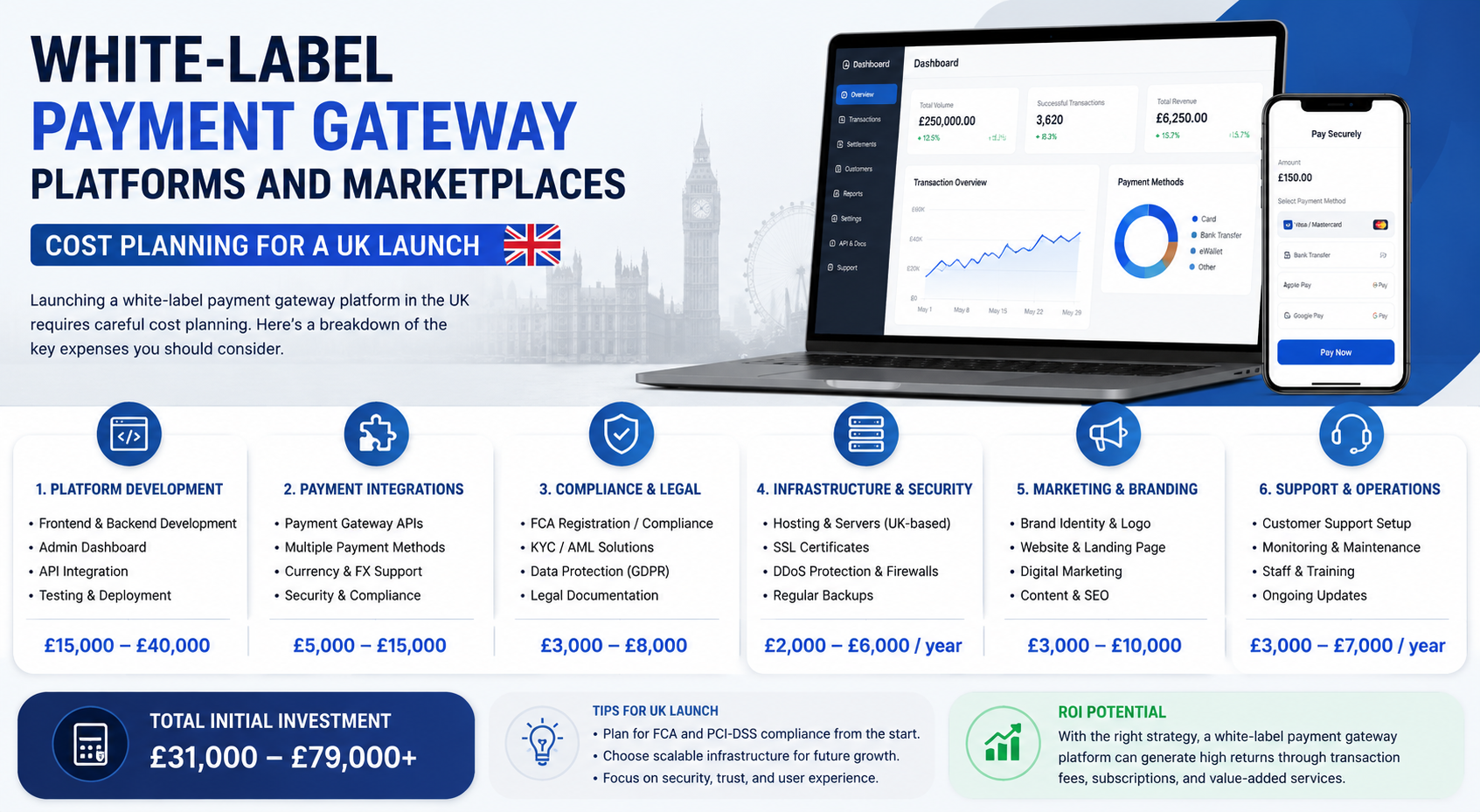
Most of the UK’s fintech, SaaS and merchant services brand teams consider white-label payment platform budgeting far too late in the day – typically only after the first quotation has been received and reframed the whole discussion. White label products aren’t priced like software; there is no one-off license fee that tells you what the year will cost.
It is based on launch efforts, integration costs, compliance requirements, usage fees, and the operational cost of running the platform once merchants are signed up. This article explains how to calculate a sensible budget before requesting quotes, so you can compare them fairly.
Choosing a White-Label Payment Gateway: Define the Launch Scope Before You Price It
Two vendors may provide very dissimilar quotes for the same product because of scope. The scope helps narrow down the payment gateway service to something different from that of an integrated platform of processing, merchant account, risk, and reporting. Clarify this aspect of the payment options before speaking with the vendor: control over pricing.
- Should we choose a payment gateway or a full-service payment facilitator? Is there provision for brand processing and acquiring, or does it presume you will have your own payment service providers for both?
- Who are your merchants? Merchant size, industry, and risk profile affect costs and risk management tools, and brand platforms and marketplaces carry heavier onboarding obligations than a single retailer.
- UK alone or multiple markets? Each additional market brings its own challenges: different currencies, brand local payments, and compliance issues.
- What payment methods will you use from day one? Cards, Open Banking, wallets, and direct debit each require their own implementation and clearing, so map online payment demand before pricing anything.
- Who provides which operational services? Responsibilities for onboarding, KYC, reporting, routing, payouts, and brand support can be yours or the provider’s, which affects costs on both sides.
Answer these questions before choosing a provider for our payment gateway to avoid drop-offs. White-label payment platform launch: The timeline is agreed for the implementation of the payment gateway from scratch. The benefits of white-label payment models depend entirely on where these lines fall, and selecting a white-label payment gateway without them settled means comparing quotes built on different assumptions.
Map the Full Cost Stack of a White-Label Payment Gateway
A white-label payment platform cost exercise breaks into nine categories. Each needs a question to the provider and an internal resource estimate, since the parts your own team delivers never appear in a vendor quote.
- Setup & Licensing. Find out what the setup cost includes and does not include. Internal requirement: a commercial owner who reviews the exclusion list.
- Branding & Configuration. Find out what is configurable in the website or app, what is done by the provider, and the cost for that. Internal requirement: Design capability and sign-off owner.
- API Integration & Testing. Find out if API documentation is available, and whether an SDK and sandbox are available before signing contracts. Internal requirement: Engineering hours and testing for failure paths, not only happy paths.
- Provider and Acquirer connections. Find out which connections are live and the cost in fees and weeks to implement the new connection. Internal requirement: Acquirer onboarding management, a process that can take longer than the implementation itself.
- Compliance and Security. Ask about the most recent attestation to PCI DSS compliance and how their coverage of the certificate overlaps with yours. Internal need: Compliance owner and outside guidance.
- Fraud & Chargeback tools. Ask whether there’s any screening and how the settings/rules are configured and managed. Internal need: Risk owner and setting maintenance.
- Platform & support subscription per month. Ask what this subscription includes and what services belong to higher tiers, especially regarding tokenization. Internal need: Operations person tracking actual usage of payment options.
- Payment fees (transaction/payout). Ask about pricing by method/transaction tier/market. Internal need: Finance person modeling this against your mix for the payment gateway supports.
- Reporting & premium add-ons. Ask what reports are included with the subscription, what needs to be paid separately, and whether raw data exporting is available. Internal need: Reconciliation person.
Commercial terms depend on volume, scope, and provider, so no universal range is meaningful. With scope defined, it is worth reviewing what a ready-made payment gateway can help with. white-label payment platform already includes, since the boundary between platform features and your own build moves several categories at once.
Separate One-Off Costs from Ongoing White-Label Payment Costs
Divide the budget into two. Treating them as one is why a low headline cost becomes more expensive over three years than a higher one, and it is the most common error in white-label payment gateway pricing comparisons.
One-time costs cover discovery, platform implementation, branding and configuration, integration development and testing, data migration from other systems, and training for operations and support teams. This falls in the first two quarters and is predictable once scope is known. A maintenance transition needs to be added when an outside party builds it.
Ongoing costs determine whether this is viable: the monthly charge or subscription, minimum volume guarantees, transaction costs, payout costs, monitoring and infrastructure, support level, recurring compliance including annual certification, reconciliation, and regular maintenance as APIs and schemes evolve. Understanding how a payment gateway works at this level matters more than the license line.
The trap is simple. A provider offering less setup cost but charging more per transaction, plus a monthly minimum, beats rivals out of the gate and fails badly eighteen months later if volume arrives. The converse holds too: with high volume and low variable rates, a large setup fee becomes the better deal.
Build both scenarios over three years before comparing white-label gateways. Any minimum commitment is a fixed cost, not a target. Choosing a white-label payment gateway means pricing the solution across its full life, not just the first invoice.
Model Volume, Revenue and Break-Even Scenarios for White-Label Payment
The payment platform cost model should include insights on credit card networks. We should consider three scenarios rather than one forecast for our payment processing solutions. Each needs the same inputs: onboarded merchant count, transaction count and value, your pricing tier with the provider, processing margin after their costs, support workload, and expected revenue.
- Conservative assumes a slower rate of merchant acquisition and a lower transaction volume than you anticipate, which affects payment gateway support. This is the scenario that must meet your minimum requirements for the payment gateway to start accepting payments.
- Base shows your real plan, using your payment methods and currency mix rather than what you would like to have.
- Growth tries to see what will happen if there is an increase in volume that occurs faster than you had expected.
Break-even needs no complex formula. Add launch cost to the yearly cost of running the backend, then divide by contribution margin per transaction or merchant. That is your break-even volume.
Run a sensitivity test on two variables: volume and take rate. A 20 percent deviation in either invalidates the model, meaning the pricing structure is wrong for your business. Test upward too, since some providers charge unreasonably more at higher tiers.
Model each white-label solution separately. Transaction data volume, redirect versus end-to-end flows, digital wallet acceptance, and issuer decline rates all shift margin, as does whether a facilitator, third-party provider, or in-house solution handles settlement and how customers choose a payment method.
Budget for Risks and Hidden Dependencies of White Label Payment Gateway Providers
Contingency should cover the factors outside your control. White label payment launch risks overrun budgets for a predictable list of reasons. Bank approval from acquirers always takes longer than implementation, and you don’t control the schedule. API integration grows complex as new scenarios surface in testing. PCI DSS certification may cover wider areas than expected, especially around card data capture and authorization. A startup discovers this later than an established merchant.
Scheme rules operate on their own timeline, and adjustments are unbudgeted activity. Operationally, fraud losses, chargebacks, and provider reserves are tangible expenses, as is FX risk on cross-currency settlement. Credit cards carry higher dispute exposure than local payment options. Data migration to the new payment platform will take longer than anticipated, particularly integration with your accounting software and dashboard reporting.
Budget for visibility work too: real-time monitoring, customer experience tracking, and checkout experience analytics rarely arrive configured. If you plan to rebrand or customize color and layout, confirm what SaaS providers allow before committing.
Headcount follows uptime promises and support commitments, while vendor dependence is itself a risk, since the price of exit is never apparent at the start. None of this is legal advice. Data ownership, liability, certification duties, and exit clauses are contract questions, and answers depend on your business and your negotiation.
Questions to Ask Before Approving the White-Label Payment Gateway Budget
Send the same list to every vendor. Choosing a white-label payment processing platform is crucial for our strategy. Comparable information is the point of the exercise:
- What exactly does the setup fee include, and what is billed separately?
- What minimum commitments apply with the payment facilitator, and what happens if we miss them?
- Which variable fees apply per transaction, payout, refund, and chargeback?
- Who pays for integration work, and at what rate for post-go-live changes?
- Which markets, currencies, and payment methods are live versus on a roadmap?
- Where do compliance boundaries sit, including PCI DSS scope and certification duties?
- What does the support tier cover, and what are the SLA terms and remedies?
- Can we embed our own logo and checkout on the website or app, and which layers cannot be customized?
- How does pricing change as volume grows with the payment processing solutions, and are tiers automatic or renegotiated?
- Who controls routing between each payment provider and payment processor?
- Which functions are in-house and which run through a third-party system, including CRM?
- What are the exit terms: notice period, data portability, token migration, and support?
Ask each gateway provider to answer in writing. Verbal assurances during a sales process are not a basis for a payment processing platform budget.
Build a Payment Process Budget That Can Survive the Launch
An effective payment facilitator can streamline our operations. A white-label payment platform budget covers your entire business model, not the supplier quote at its heart. Infrastructure, compliance, and support costs of running the payment process will outstrip the license fee within the first year, and the same holds whether you buy a white-label payment gateway or a broader white-label payment solution.
Four items must be sorted before signing: the scope document; three volume scenarios; a contingency budget with an explicit trigger; and an identified owner for every revenue and cost item related to the payment gateway processes. Confirm which payment services each merchant tier includes, since white-label payment gateway providers price payment experience and payment solution modules separately, and how the provider manages these services. A budget without owners is a forecast for payment revenue.