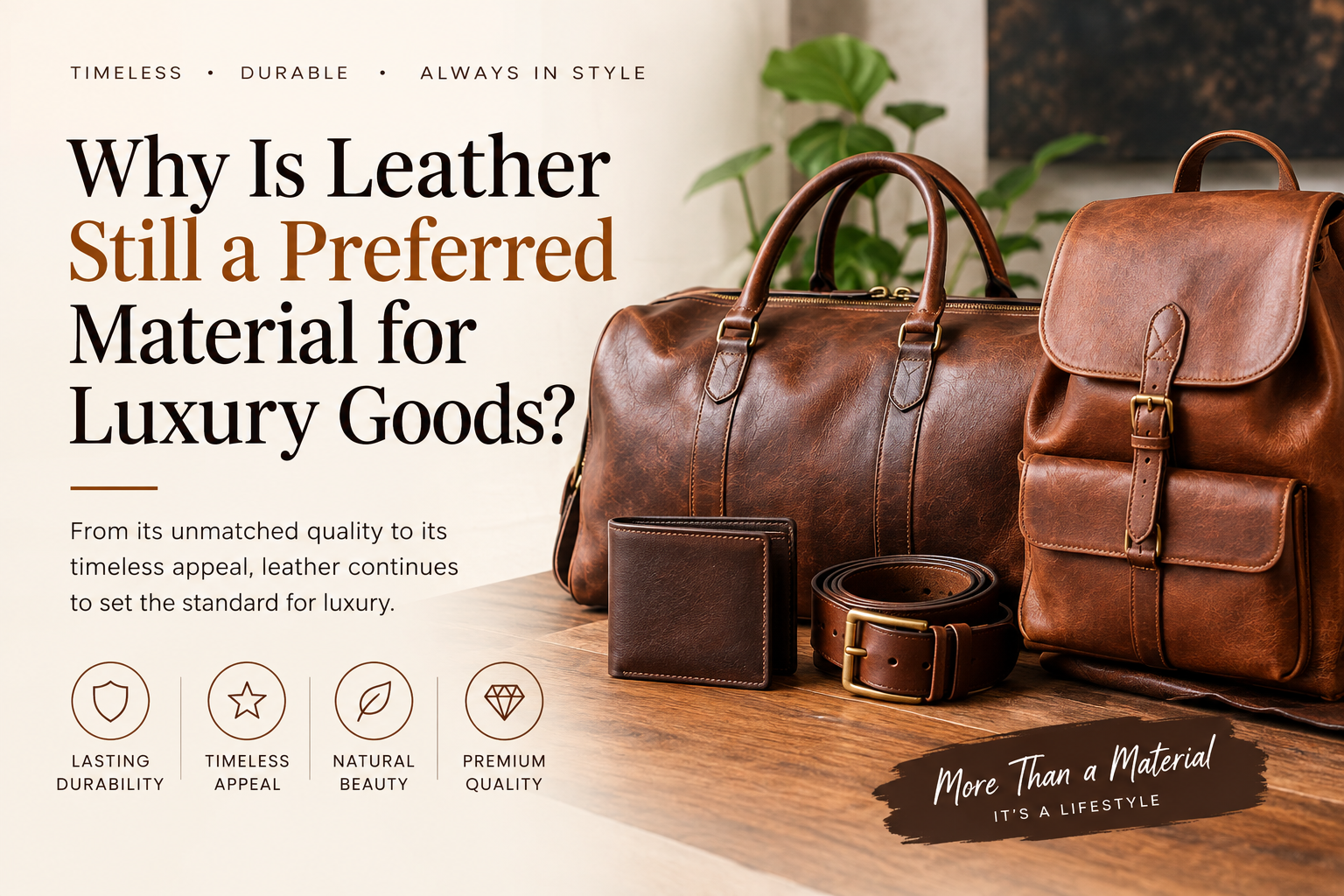
Every few years, some new material gets announced as leather’s replacement in the luxury world, a synthetic alternative promising the same look with none of the drawbacks. And every few years, leather quietly remains the standard the entire industry still measures itself against. This is not about being ‘stubborn’ tradition! It’s because leather performs and no other option can come close to it: leather earns its position by virtue of what it does and not just by its brand.
Luxury Has Always Been About What Improves With Time
Real glory is not about looking perfect on day one, it’s about looking great as you get older. The only material that really gets better with use is leather, it acquires a richer patina and softer touch the longer it is owned. The one thing that matches perfectly with what luxury has always stood for – something that can last generations and not be designed to look good for merely one season before it becomes of no use. Unlike many fashionable luxury products, leather items grow more and more unique the older they get, as fashion changes every year.
Craftsmanship Is Still the Ultimate Status Symbol
When everything seems to be able to be manufactured – really – in a convincing way, there is hardly anything that is truly difficult to fake these days. Finishing with hand-sewn seams, careful detail work and natural hide imperfections, all engineered by human hands, is a feat that no machine can achieve. Today luxury consumers appreciate that touch as much as the materials themselves, it’s a sign that someone did something with the time and know-how that went into what they’re holding.
Scarcity Still Matters, even in a Mass-Production World
Genuine leather is naturally scarce and can’t be made endlessly and exactly like synthetic leather. That innate constraint is one of the reasons why leather continues to hold a place at the “top” of the luxury scale: true rarity is hard to replicate, and leather still has some of it that the mass-produced versions just don’t have.
The Sensory Experience Can’t Be Replicated Digitally or Synthetically
Luxury has always relied heavily on sensory experience, how something feels, smells, and sounds. Leather has all these attributes: it has a very unique smell, a subtle variation of texture across each piece, and has such a feeling and weight in the hands that buyers know it when they feel it. While synthetic materials come close to the visual aspect, leather’s sensory attributes are unparalleled, and that is what luxury shoppers are investing in.
Heritage and Storytelling Still Sell, and Leather Has Both
Luxury brands built around leather goods often lean heavily into heritage, origin stories, traditional tanning methods, generational technique passed down through established workshops. This storytelling aspect is more important than people realize: buyers aren’t just buying a material, they’re buying into an authentic and continuous narrative. Synthetic replacements, which are in their early stages and manufactured, don’t have the same history just yet, and may never attain the same history.
Resale and Investment Value Reinforce the Preference
Genuine leather goods, especially from trusted, well-regarded makers, often retain resale value in a way synthetic luxury goods rarely do. A good leather can be sold or be passed down years later and still have value. That investment quality further reinforces leather’s role in the luxury conversation as it’s not a product that simply devalues on the day it comes out of the store, it’s an asset that ages with grace.
Sourcing Is Becoming the New Luxury Signal
As mass production has made “leather” a less meaningful label on its own, buyers have shifted attention toward specifically where and how it’s sourced. An Alaskan leather wallets collection built from responsibly tanned, traceable hide signals something a generic “genuine leather” tag simply can’t, a specific origin, a specific standard, a maker willing to be named and held accountable for the material’s quality.
Personalization Has Become the New Marker of True Luxury
Off-the-shelf luxury is losing ground to made-to-order and personalized options, and leather is particularly well suited to this shift because it takes customization beautifully, embossing, monogramming, custom hardware, tailored dimensions. A custom backpack USA artisans build to individual specification represents exactly where luxury expectations have moved: not a fixed product everyone owns identically, but something shaped specifically around the person buying it.
Luxury Doesn’t Have to Mean Inaccessible Pricing
Here’s where the definition of luxury is quietly shifting. For a long time, “luxury leather” was synonymous with inflated markup tied almost entirely to a logo rather than the material or construction behind it. That’s starting to change as buyers grow more educated and brands compete on actual quality instead of prestige pricing alone. Genuinely premium leather, sourced and built properly, can be priced fairly without stripping away what makes it luxurious in the first place, the material, the craftsmanship, and the longevity remain intact even when the unnecessary markup doesn’t. Buyers are increasingly rewarding brands that make this trade honestly, rather than ones that simply raise prices and call it prestige.
The Bottom Line
Leather is not just a luxury in the past or because of its novelty. It’s earned that place because of its qualities that no synthetic has quite matched, the aging process, the craftsmanship it displays, its scarcity, the sensory experience it commands. While the leather industry has become more transparent and reasonably priced, leather’s benefits are becoming more important than ever as buyers become more discerning of what luxury means.