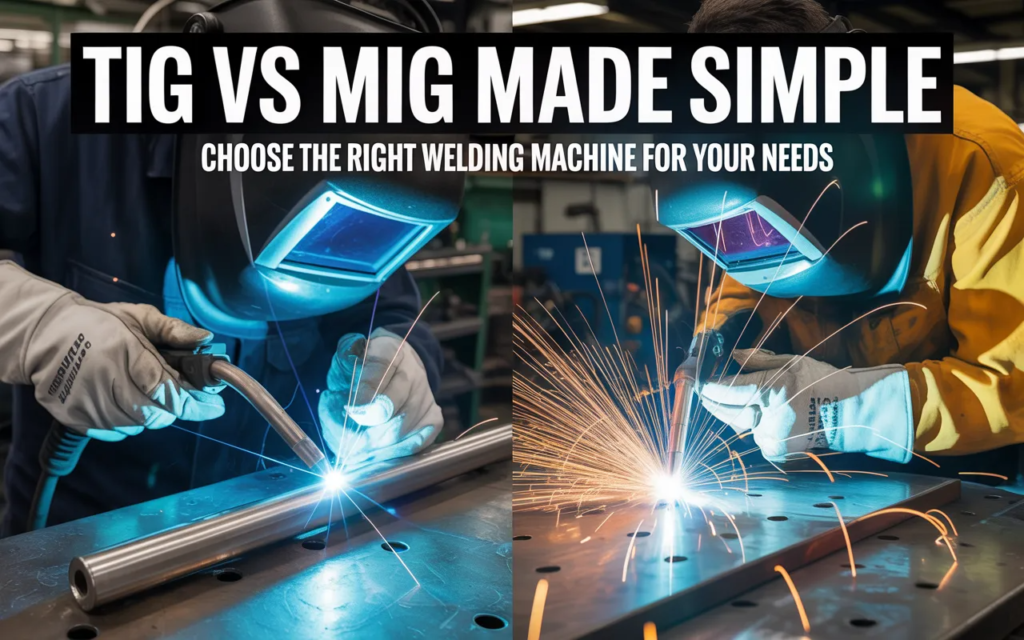
Choosing between TIG and MIG welding is one of the first real decisions every welder faces. At first, they might look similar—both join metal using heat and electricity—but the way they work is quite different. That difference affects everything: speed, precision, ease of use, and even the final appearance of your weld.
Understanding these differences helps you avoid frustration and choose the right tool for the job instead of forcing one machine to do everything.
Two Welding Styles, Two Different Goals
TIG and MIG welding are not competitors in the strict sense. They are tools designed for different situations.
MIG welding is built for speed and convenience. It’s often used in workshops, repairs, and production environments where efficiency matters.
TIG welding, on the other hand, is all about precision. It takes more time and skill, but it produces cleaner, more controlled welds.
Neither is “better.” They simply solve different problems.
MIG Welding: Fast, Simple, and Beginner-Friendly
MIG welding is often the first choice for beginners because it is easier to learn. The machine feeds wire automatically, which means you only need to control the torch and movement.
This makes the process smoother and faster, especially for larger projects or thicker materials.
A modern mig welding machine is designed to simplify this even further. With adjustable settings for wire feed speed and voltage, users can quickly adapt to different materials without deep technical adjustments.
This ease of use is what makes MIG welding so popular in automotive repair, home workshops, and light fabrication work.
The welds are usually strong, and with the right settings, they can also look clean. But MIG welding is not always the best option when extreme precision is required.
TIG Welding: Precision Over Speed
TIG welding works differently. Instead of automatically feeding wire, the welder controls everything manually. One hand holds the torch, and the other feeds filler material when needed.
This gives the user full control over heat, direction, and weld size.
A high-quality tig welding machine is built to support this level of precision. It allows fine adjustments in current control, stable arc performance, and smoother operation for detailed work.
TIG welding is slower, but the results are extremely clean. That’s why it is commonly used in stainless steel work, thin metals, and projects where appearance matters as much as strength.
The learning curve is steeper, but the control you gain is unmatched.
The Real Difference Between TIG and MIG
To understand the difference clearly, think of MIG welding as a “fast drawing tool” and TIG welding as a “fine pencil.”
MIG welding:
- Faster process
- Easier to learn
- Good for thicker materials
- Ideal for general fabrication
TIG welding:
- Slower but highly precise
- Requires more skill
- Best for thin or detailed work
- Produces cleaner finishes
The choice depends entirely on what you are trying to build.
When MIG Welding Is the Better Choice
MIG welding is ideal when speed and productivity matter more than perfect appearance.
It works well for:
- Car repairs
- Metal fabrication
- Home improvement projects
- Structural welding
Because the wire feeds automatically, users can cover long welds quickly without stopping frequently. This makes it efficient for repetitive or large-scale work.
It is also more forgiving. Small mistakes in hand movement are less noticeable compared to TIG welding.
When TIG Welding Becomes Essential
TIG welding is the preferred choice when precision is more important than speed.
It is commonly used for:
- Stainless steel fabrication
- Thin metal sheets
- Artistic metalwork
- Aerospace and high-detail industries
The ability to control heat exactly makes TIG welding perfect for delicate materials that could easily burn through with MIG.
It takes practice, but once mastered, it allows extremely clean and visually appealing welds.
Learning Curve: Easy Start vs Steady Mastery
One of the biggest differences between MIG and TIG welding is the learning curve.
MIG welding is easier to start with. Most beginners can produce usable welds within a short time. The machine handles much of the process automatically.
TIG welding requires coordination and patience. Both hands must work independently, and timing plays a major role in weld quality.
This does not mean TIG is harder in a negative way—it simply requires more practice before results become consistent.
Cost, Setup, and Maintenance Differences
MIG welding setups are generally simpler for beginners. The machine, wire, and shielding gas are the main components.
TIG welding setups are more detailed, often requiring additional control options and careful adjustment.
Maintenance also differs slightly. MIG systems require attention to wire feed mechanisms, while TIG systems focus more on electrode condition and gas flow consistency.
Both systems, when maintained properly, perform reliably over time.
How to Decide What You Actually Need
Instead of asking “Which one is better?” a better question is: “What kind of work will I do most often?”
If your projects involve speed, repairs, and general metal work, MIG welding is usually the practical choice.
If your work involves detail, clean finishes, or thin materials, TIG welding is worth the investment.
Many professionals actually use both, switching depending on the job.
Why Understanding Both Gives You an Advantage
Knowing both TIG and MIG welding makes you more flexible as a welder. You are not limited to one style or one type of project.
You can switch between speed and precision depending on what the job demands. That flexibility is valuable in both professional and personal projects.
Even if you start with one, learning the basics of the other expands your skills significantly.
Final Thoughts
TIG and MIG welding are not about competition—they are about choice.
MIG welding gives you speed and simplicity, especially with a reliable mig welding machine. TIG welding gives you precision and control, supported by a well-designed tig welding machine.
Once you understand what each method is designed for, the decision becomes much easier.
The right choice depends on your project, your skill level, and the results you want.
In the end, good welding is not just about technique—it’s about using the right tool at the right time.