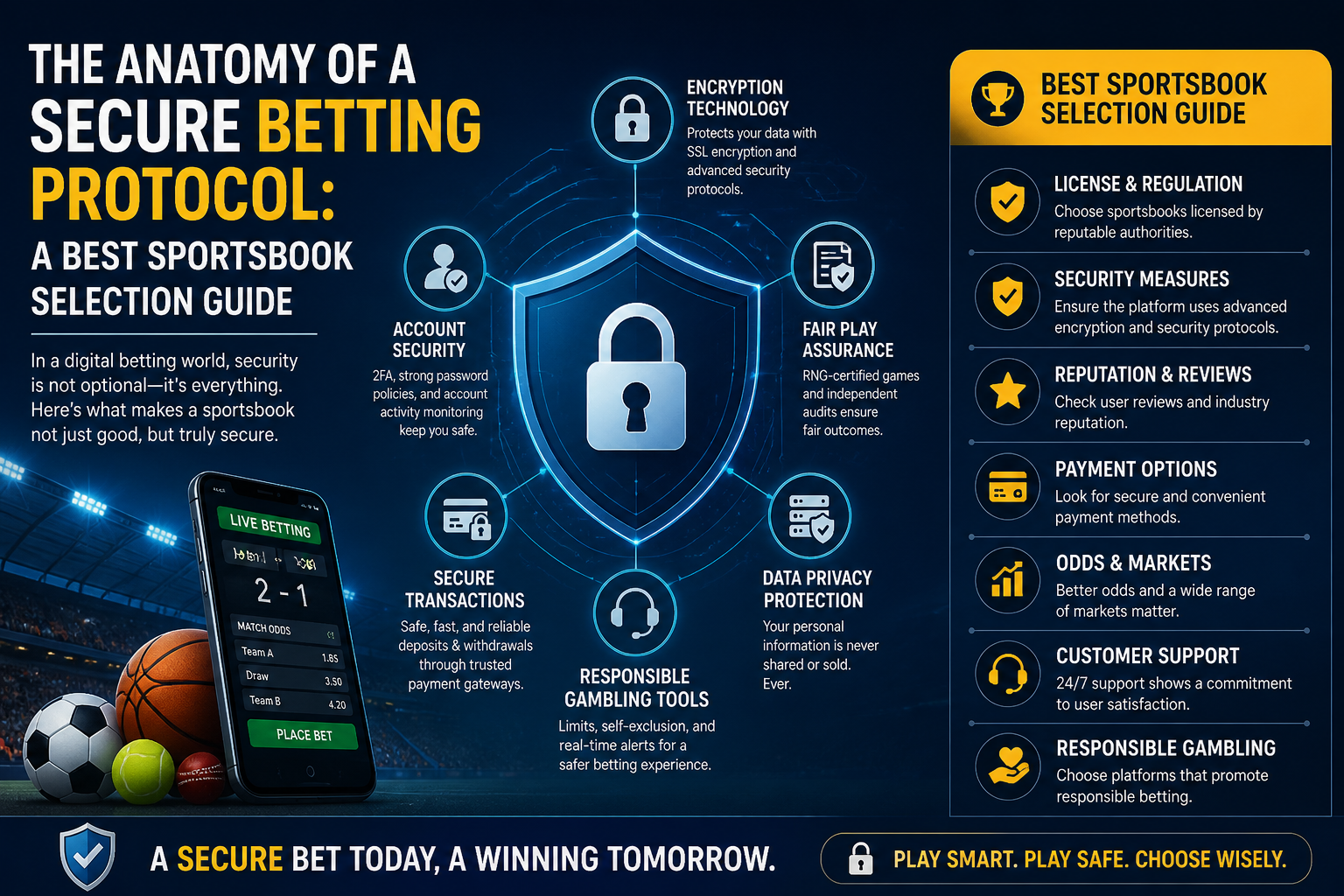
Online sports wagering has expanded to unimaginable levels. According to Statista, industry revenues are projected to reach $88.11 billion in 2026. Of course, this is great news, but for the end-user, this industry-wide expansion poses a critical challenge: how can we distinguish a reliable, world-class platform from one that poses operational or even ethical risks?
Nowadays, it’s not enough to offer the best odds or the widest variety of betting markets, which are both important aspects for the user experience. The true differentiators every bettor seeks are a foolproof security protocol and a sportsbook with a verified reputation and liquidity to protect our capital. In other words, users prefer to feel confident rather than overwhelmed when making a move. As obvious as that may seem, it is a principle that must always be kept front and center.
Having access to the best sportsbook selection guide has become a priority for the industry. Every dollar wagered must be backed by a transparent system that honors every winning bet without friction. And to achieve this, a shift in perspective is required, moving away from flashy marketing toward a rigorous audit of a platform’s structural integrity.
Reputation and Longevity: The Non-Negotiable Standards
In an industry where new service providers emerge every month, a sportsbook’s most valuable asset is its track record. From a bettor’s perspective, the primary evaluation criteria must be global market presence, reputation, and long-term industry tenure. A truly secure wagering environment is built through years of consistent performance rather than aggressive marketing campaigns.

During Super Bowl weekend, betting volume surges by 60%. (Picture: X / NFL)
While flashy advertisements can easily distort a platform’s perceived value, longevity remains the only authentic stress test. For the end-user, choosing an established provider over a newcomer is the first step in a strategic safety protocol. At the end of the day, remember that you are placing your capital in a company’s hands, which is why a solid reputation is everything.
The History of Payouts as a Trust Metric
If you want to gauge the true integrity of a sportsbook, look closely at its withdrawal process. The most attractive bonuses, competitive odds, and flashy promotions mean nothing if you’re met with an endless maze of red tape when trying to cash out. In an industry where liquidity is king, a consistent track record of honoring withdrawals, regardless of the amount, is the only way to prove operational solvency. For the end-user, an impeccable payout history is the most reliable insurance policy against financial volatility.
Regulatory Compliance and Global Licensing
It should come as no surprise that transparency and operating within a regulated legal framework must be a top priority for the industry. According to H2 Gambling Capital, regulated markets account for 85% of total revenue in the global betting landscape. Who would want to take an unnecessary risk when their own capital is on the line? Nowadays, verifying that your provider is audited and overseen by a recognized international authority is a non-negotiable step in the vetting process.
Liquidity and Financial Transparency: Can the House Pay?
Regulation 6.150 of the Nevada Gaming Commission mandates that Las Vegas casinos maintain sufficient cash reserves to guarantee that all players can cash out their chips at any time. In the world of online sportsbooks, this principle translates directly to financial transparency, and of course, it should be mandatory to comply.
A platform must maintain enough liquidity to cover all winning bets, regardless of the circumstances. According to SiGMA World, high-impact sporting events like the Super Bowl, the World Series, the Olympics, or the FIFA World Cup can trigger a 60% surge in betting volume. For bettors, it becomes vital to choose a platform with the proven capacity to honor payouts, even when the volume of winners far exceeds expectations.

The upcoming FIFA World Cup is set to provide a massive boost to the sports betting industry. (Picture: X / FIFAWorldCup)
Withdrawal Protocols and Processing Speeds
You’ve likely noticed that with some sportsbooks or online casinos, depositing funds is remarkably simple, yet the moment you try to make a withdrawal, the process becomes incredibly complex. This should be seen as a major red flag within the industry.
Nuvei, a Nasdaq-listed global leader in payment technology, emphasizes that a fast and simple payout experience is the primary driver of user loyalty. In fact, Nuvei’s data shows that for 70% of users, a frictionless payment process is the most important factor when choosing a sportsbook.
Providing a fast—or even instantaneous—payout process is more than a convenience; it is a clear statement of integrity and financial solvency.
Technological Integrity: Beyond the User Interface
A sportsbook’s real strength is in its invisible architecture, not just its polished interface. In this specific case, substance far outweighs style. Top-tier platforms use 256-bit SSL encryption and strong two-factor authentication (2FA) to protect user data and money. End-to-end security protocols that protect against both external threats and internal weaknesses define technological integrity in 2026. A platform’s promise of high-level cybersecurity is the only way for a smart bettor to know that their digital assets will stay safe from the changing risks of the global betting scene.
Data Encryption and Personal Privacy Protocols
We have discussed at length the financial solvency and regulations that must be considered, but the structural integrity of a sportsbook has another fundamental pillar: data privacy protocols.
In its most recent Cost of a Data Breach Report, IBM stated that the average cost of a security failure in highly regulated sectors is $4.88 million, with the theft of personal data being the primary motivation behind cyberattacks. The protection of personal information has never been as critical as it is today.
As previously mentioned, the industry’s minimum standardized measures must include 256-bit AES encryption and multi-factor authentication (MFA). These measures are essential to prevent account takeovers, which currently cost the global betting industry an estimated $2.3 billion annually, ensuring that user identity and capital remain shielded from evolving cyber threats.
Making an Informed Selection in a Digital World
In 2026, it’s no longer possible to be a passive consumer in the sports betting industry. We must become active auditors when making our spending decisions.
According to Goldman Sachs Equity Research, legal online sports betting in the U.S. alone reached $45 billion in 2025. As the industry continues to skyrocket, structural integrity becomes the defining factor that separates a top-tier sportsbook from the rest.
Ultimately, the user bears the sole responsibility for choosing their provider, but that decision is significantly safer when built on proven standards of longevity and regulatory compliance.
A final insight: Statista predicts that by 2030, the online sports betting market will reach 314.5 million unique users—representing just over 4% of the global population.