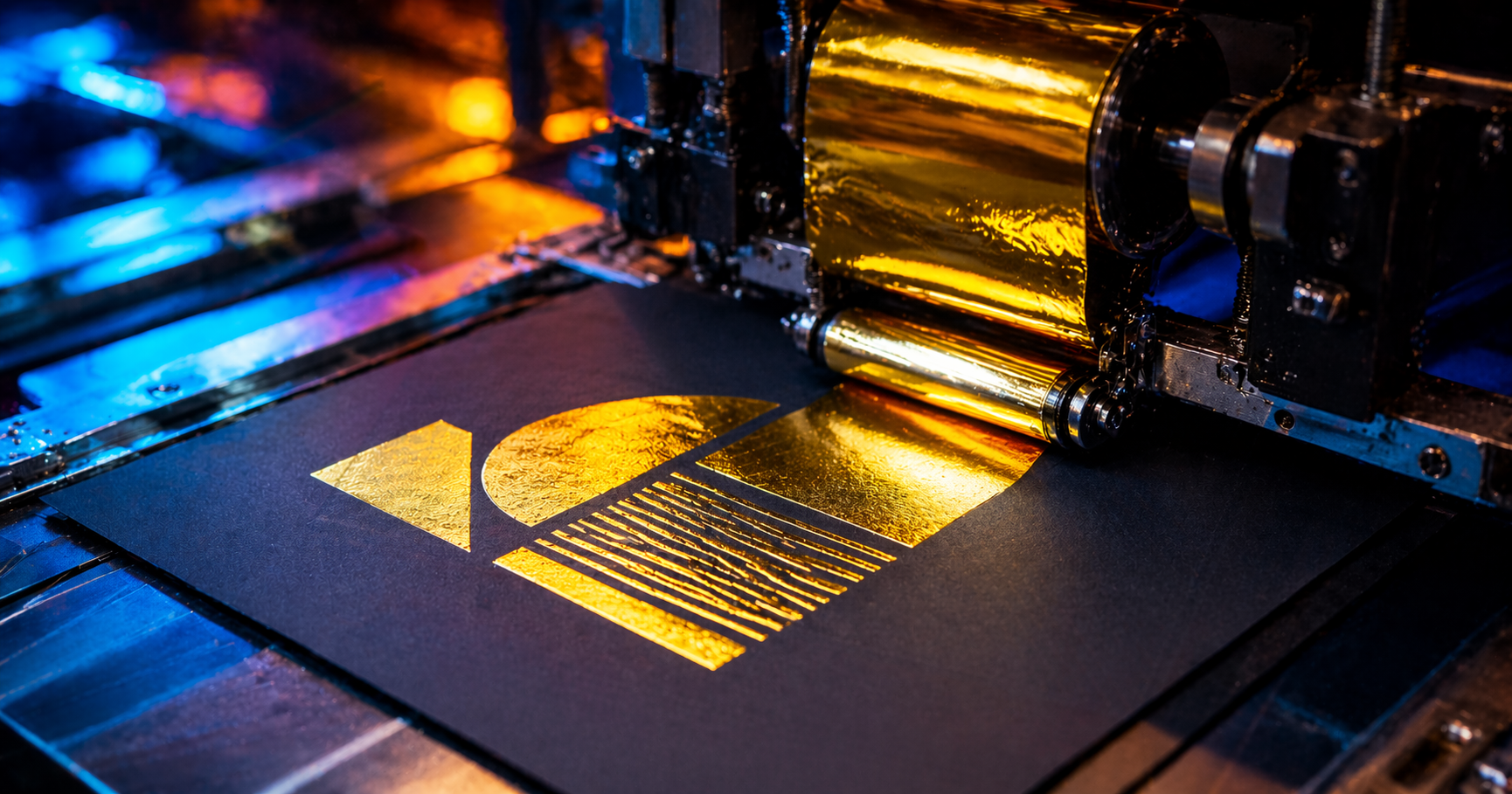
For decades, hot foil stamping was a privilege of scale. To give a business card, gift box, or book cover its dazzling metallic flair, it required metal dies, costly production of molds, and minimum order quantities that made small production economically untenable.
That limit is removed in 2026. The digital hot foil printer has essentially revolutionized who can enjoy high-quality foil finishing, and the data backs it up.
This goes beyond a better machine. It changes the economics of the entire finishing process. If you run a print shop, manage a packaging line, or work in branding and manufacturing, this shift affects how you compete, how you price your services, and how quickly you can deliver. Here is what is driving it, and what it means in practice.
The Market Is Already Moving: What the Data Shows
In 2025, the global embossing and foil stamping equipment market was estimated to be $5.39 billion and is expected to reach $7.51 billion in 2030 with a CAGR of 6.86% (Mordor Intelligence, 2025). The digital foil stamping market segment, within that larger market, is growing quicker than the rest by 8.13% CAGR, a very positive indication that the industry is moving towards the center of gravity to digital.
Asia-Pacific dominates the market with a 37 percent market share in 2024, with China producing packaging on a mass scale and India boosting its manufacturing with its Production-Linked Incentive program.
In the meantime, more than 47,000 hot foil stamping machines were installed around the world in 2024, which is a 12.6% increase compared to 2022, and about 61% of the luxury packaging uses foil stamping as a finishing technique (360 Research Reports, 2025).
The trend is obvious: foil finishing is not a luxury niche anymore. It is fast becoming a mainstream expectation.
What Makes a Digital Hot Foil Printer Fundamentally Different
Traditional hot stamping is performed through a mechanical die process: a custom metal plate is fabricated, mounted on a press, heated, and pressed onto the substrate to transfer foil. Each design update requires a new die. Every short run carries the full cost of plate-making. It is precise and beautiful but rigid, slow to set up, and expensive for anything below a high volume threshold.
A digital foil stamping machine eliminates the plate. The design lives on a computer. The machine reads it directly and transfers the foil via a high-precision thermal print head, no molds, no dies, no lead time for tooling. The result is a workflow that goes from digital file to finished foil impression in minutes.
The practical advantages cascade from that single change:
- No plate-making costs: short runs and single-unit personalization become economically viable
- Variable data printing: names, codes, and unique designs can change between each print
- Faster turnaround: setup time drops from hours to minutes
- OS-agnostic operation: no proprietary software required, compatible with any design tool
Examples of the shift in practice include machines such as the Masung MS-8025, a flatbed hot-foil digital printer.
It is powered by a Japanese ROHM thermal print head with 150,000 metres of life cycle, 300dpi output, 30mm thick materials, and gold, silver, and custom colour ribbon foils.
It works offline using an SD card and does not need any special software. It is that quality, flexibility, and accessibility that the traditional press cannot possibly compete with at the small to mid-scale.
Four Industry Forces Driving Adoption in 2026
The rise of the digital foil printer is not happening in isolation. Four converging forces are driving it:
1. Premiumisation of basic products. Foil finishing is now being embraced by brands that do not belong to the classic luxury segment to be competitive on the shelf and online. With increasing consumer demands on packaging quality, even mid-market manufacturers require access to metallic finishing cost-effectively.
2. The unboxing economy. Packaging has become a marketing channel due to e-commerce. Unboxing content is used to influence purchasers, and personalised foil details, custom names, event dates, and custom messages are precisely the type of detail that will gain a share on social media. The personalisation can be scaled with digital foil machines.
In 2024 alone, the demand for compact digital stamping machines among the SMEs increased by 27% (360 Research Reports, 2025).
3. Anti-counterfeiting requirements. The pharmaceutical, cosmetic, and banking industries are in growing demand to incorporate verifiable security features in packaging. Hot stamping foils, especially holographic versions, are hard to duplicate and are being implemented as a front-line anti-counterfeiting tool. These features can be incorporated into short-run compliance packaging in the digital format.
4. Sustainability mandates.EU and Asia-Pacific policies are driving manufacturers to use less energy-consuming and recyclable materials. Digital foil machines designed today have extremely low power consumption and are compatible with cold-foil variants to avoid heat-based processing, which is now a requirement of green procurement by many enterprise buyers.
Where Digital Foil Stamping Delivers the Most Value
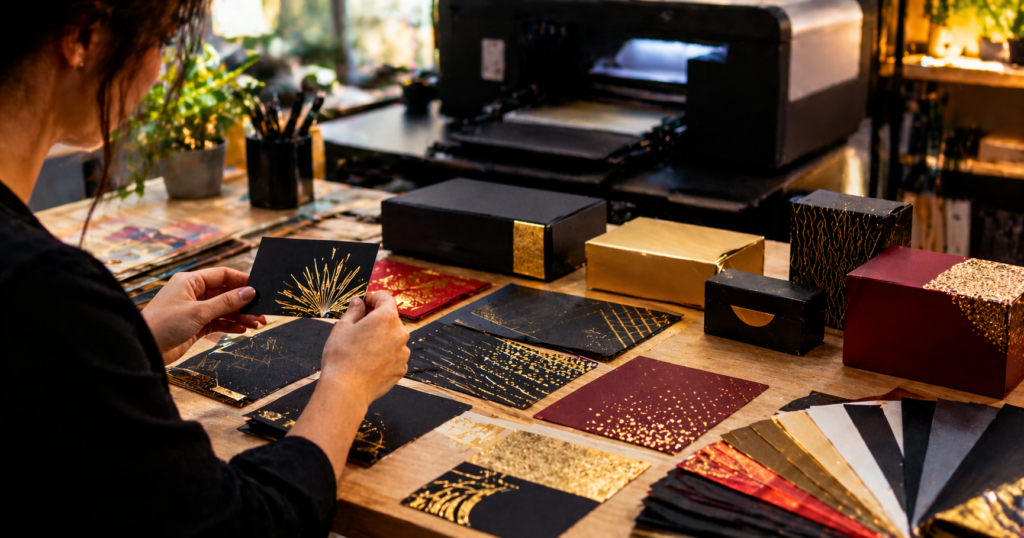
The range of materials and applications compatible with a modern digital hot foil printer is one of its most underappreciated advantages. Because the flatbed design accommodates substrates up to 30mm thick, it handles:
- Business cards and PVC cards
- Gift boxes and retail packaging
- Hardcover books and notebook covers
- Wedding invitations and greeting cards
- Leather products and PU/PVC
- Awards, certificates, and folders
- Labels, tags, and promotional materials
This breadth means a single machine can serve multiple revenue streams, providing a strong ROI for print shops, custom gift producers, and corporate stationery suppliers.
How to Select a Digital Foil Stamping Machine
Not every hot foil digital printer is the same. The quality range is increasing as the market expands. The following are the most important specifications:
Print head quality and lifespan: The thermal print head is the core of the machine. Find print heads of reputable Japanese makers like ROHM, which have a documented life of at least 150,000 metres.
Resolution: 300dpi is the current standard for professional-grade foil output. Below this, fine text and intricate logos lose definition on textured or uneven substrates.
Material thickness range: A maximum material thickness of 30mm opens up a far wider range of applications than machines limited to flat paper stock.
Software and OS independence: Machines that require proprietary software create long-term dependency costs. OS-agnostic machines with offline SD card capability offer greater operational flexibility and lower total cost of ownership.
Foil colour flexibility: Gold and silver are table stakes. Multi-colour ribbon support, including custom and specialty foils, considerably expands the creative and commercial range.
The Future of Foil Printing Is Plateless
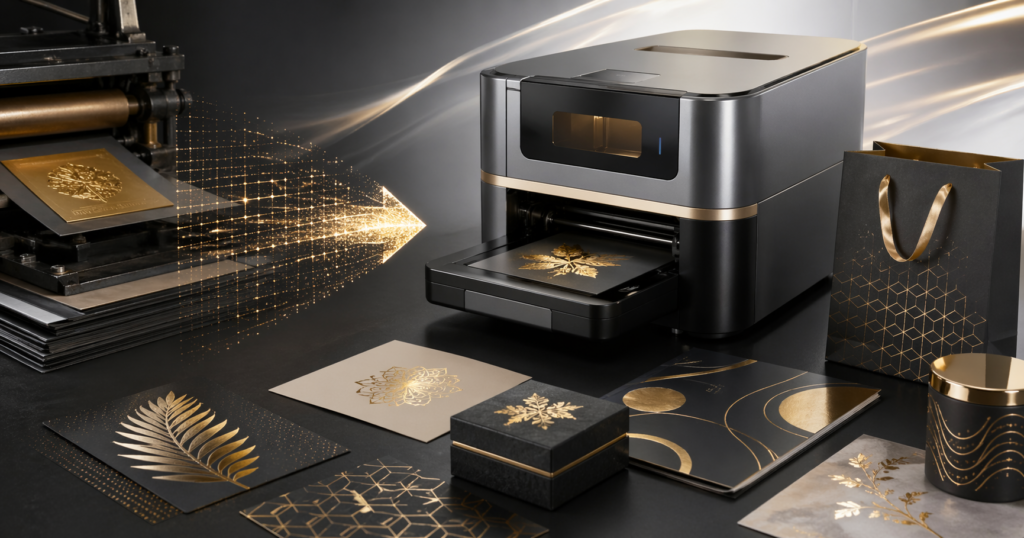
The shift from traditional to digital hot foil stamping is not a distant trend; it is already underway at scale. With the global market on track to surpass $7.5 billion by 2030, and the digital segment growing faster than any other category within it, the question for print businesses is no longer whether to adopt digital foil technology, but when.
Traditional stamping machines will continue to serve high-volume industrial applications where die investment is justified. But for the growing majority of jobs, short runs, personalised orders, on-demand finishing, and multi-material projects, the digital foil stamping machine has simply become the more intelligent choice. It is faster to establish, less costly to operate at low volume, more flexible in design, and more capable of achieving the output quality of press-based systems.
For businesses ready to bring premium foil finishing in-house, the Masung MS-8025 delivers exactly that, professional metallic results without the plates, the molds, or the costly minimum orders that made traditional stamping out of reach for most.
Frequently Asked Questions
What is digital foiling?
Digital foiling is a plateless process that transfers metallic or coloured foil onto a surface directly from a computer file, no dies, no molds, no minimum order. You design it, the machine prints it. It works on paper, card, leather, PVC, and more, making professional foil finishing accessible at any production volume.
How does hot foil printing work?
A heated print head presses a foil ribbon against your material, bonding the foil only where heat is applied. In traditional machines, a metal die determines the shape. A digital hot foil printer takes the design right out of your computer, and the same heat and pressure outcome, no tooling needed.
What are the disadvantages of hot foiling?
There are actual limitations with traditional hot foiling: it is costly to fabricate dies, requires a long setup time, is not flexible to design changes, and has minimum order quantities. Every new design means a new metal plate. It is a costly process unless you are running large volumes. The digital foil stamping machine solves all of these: no dies, no minimums, instant design changes.
What is the best printer for hot foiling?
For high-volume industrial work, press-based systems from BOBST or Heidelberg are the standard. For small to mid-size businesses, custom producers, and print shops, a flatbed digital hot foil printer like the Masung MS-8025 offers the best value, 300dpi quality, multi-colour foil support, 30mm material thickness range, and no proprietary software needed.
Is hot foiling permanent?
Yes. Hot foil bonding is very strong and resistant to peeling, fading, and moisture when properly applied. The foil bonds to the substrate with heat and pressure to form a permanent metallic finish. When applied to quality material at a correct temperature and pressure, the foil impression will last longer than most ink-based prints.
References
- Mordor Intelligence (2025). Embossing and Foil Stamping Equipment Market — Size, Share & Industry Trends. mordorintelligence.com
- 360 Research Reports (2025). Hot Foil Stamping Machine Market — Global Forecast to 2030. 360researchreports.com
- Technavio (2025). Hot Stamping Foils Market Growth Analysis — Size and Forecast 2025–2029. technavio.com
- Masung Group (2025). MS-8025 Flatbed Digital Hot Foil Printing Machine — Product Specifications. masung.group