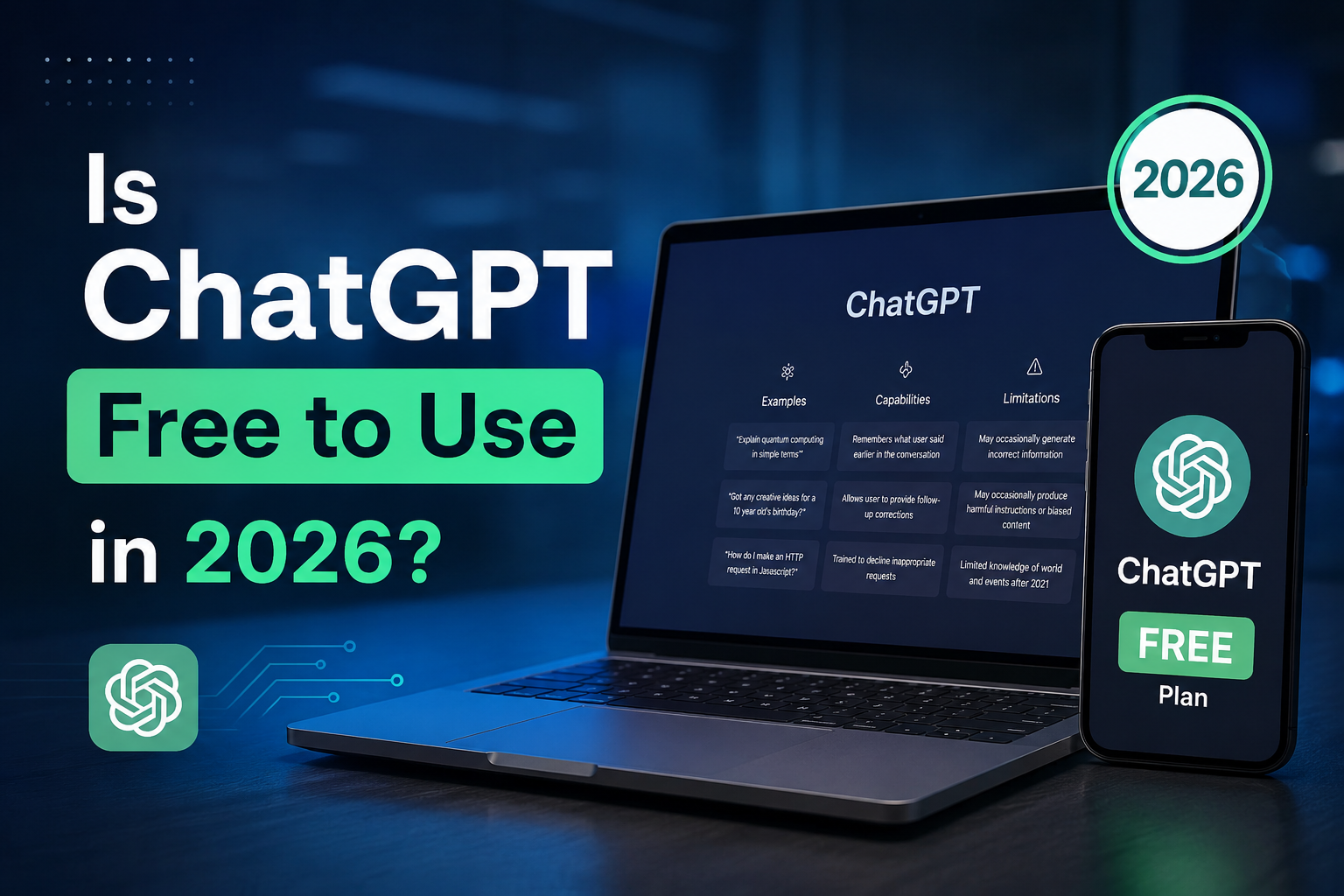
Yes, ChatGPT is still free in 2026. But if you think “free” means you get everything without any restrictions, that’s where most people get confused. The free plan exists, it works, and millions of people use it every single day. What changed is how free it feels compared to a couple of years ago.
Let me break it down honestly no fluff, no sales pitch.
What the Free Plan Actually Gives You?
When you sign up on chat.openai.com without spending a dollar, you get access to GPT-5.2 Instant OpenAI’s standard model. This is not some watered-down version built just for free users. It’s the same base model that paid subscribers use. But here’s the catch you can only send 10 messages every 5 hours.
After those 10 messages, ChatGPT doesn’t shut down completely. It quietly switches you over to GPT-5.2 Mini a lighter, faster model that handles basic questions fine but clearly struggles when things get complex. The quality drop is noticeable, and honestly, it can get frustrating right when you need it most.
So if you’re someone who uses ChatGPT regularly for writing, research, coding, or just daily questions that 10-message cap hits faster than you’d expect.
That’s exactly the problem we solved and introduced ChatGPT Free Online Tool where user can access Unlimted access for AI chat free, make Personal AI agents to perform their daily task and unlocked more features of ChatGPT with free version.
No message limits. No 5-hour cooldowns. No switching to a weaker model halfway through your work. Our platform gives you unlimited access to ChatGPT completely free so you can keep going without interruption. Whether you’re in the middle of a project at midnight or sending your 50th message of the day, nothing stops you.
The official free plan is a great starting point but if you’ve ever hit that wall and watched your workflow grind to a halt, you already know why unlimited access changes everything.
Here’s what free users get in 2026:
- GPT-5.2 Instant — 10 messages per 5-hour window
- GPT-5.2 Mini — unlimited after the cap is hit
- Web browsing — ChatGPT can search the internet for current information
- Image uploads — you can share screenshots, photos, documents for analysis
- GPT Store access — use custom GPTs built by developers
- File uploads — basic document reading and processing
What’s Locked Behind Paid Plans?
This is where free users feel the pinch. Some of ChatGPT’s most powerful features are completely unavailable on the free tier:
- Deep Research — multi-step research that digs through sources in depth
- Agent Mode — lets ChatGPT take actions and complete multi-step tasks autonomously
- Sora — AI video generation
- Advanced data analysis — uploading spreadsheets and getting real insights, charts, and formulas
- Extended thinking — where the model reasons through complex problems step by step before answering
- Ad-free experience — yes, free users in the US now see sponsored content in responses
That last point is worth mentioning. Since February 2026, OpenAI started showing ads to free and Go-tier users in the United States. The ads appear below responses and are labeled “Sponsored.” OpenAI says they don’t influence the answers — but not everyone believes that, and it’s a change that felt unwelcome to long-time users.
The New Plan Structure in 2026
OpenAI quietly made things more complicated. It’s no longer just “free or $20.” There are now multiple tiers:
Free — $0/month
Works for casual, light use. Good for students, curious people, and anyone who doesn’t need ChatGPT more than a few times a week. The 10-message limit is manageable if you’re not a heavy user.
ChatGPT Go — $8/month
Launched globally on January 15, 2026. It gives you more messages than the free plan and better file handling. But here’s the problem — Go still includes ads. You’re paying $8 and still seeing sponsored content. It also doesn’t include Deep Research, Agent Mode, or Sora. For most people, the $12 extra to jump to Plus makes more sense.
ChatGPT Plus — $20/month
This is the sweet spot for regular users. You get the full model suite, 10 Deep Research runs per month, no ads, access to Agent Mode, and significantly higher message limits. If ChatGPT is part of your actual work routine, this is the plan worth considering.
ChatGPT Pro — $200/month
Built for researchers, developers, and power users who need the absolute best. Includes GPT-5.4 Pro mode, 250 Deep Research runs, extended context window, and near-unlimited messaging. For most people, this is overkill. But if you’re doing serious analytical or technical work daily, it pays for itself.
Team and Enterprise
Team starts at $30/user/month and includes data privacy controls — your conversations aren’t used for model training by default. Enterprise is custom-priced for large organizations with 150+ users.
Who Should Stick With the Free Plan?
Honestly, a lot of people. Not every person who uses ChatGPT needs to pay for it.
If you use it a few times a week for writing help, quick questions, summarizing articles, or brainstorming the free plan handles all of that without any friction. Ten messages per 5-hour window is more than enough for light usage.
Students especially benefit here. You can get homework help, explain complex topics, practice writing, translate content, and even analyze images all for free. No credit card, no subscription needed.
The frustration kicks in when you start using it seriously. If you’re writing content professionally, debugging code, doing research, or relying on ChatGPT as a daily work tool you’ll hit the limit quickly and feel the quality drop when Mini takes over.
How to Get More Out of the Free Plan
Even on the free tier, there are smart ways to stretch your usage:
Use your best prompts first. Your first 10 messages go through the stronger model. Don’t waste them on casual warm-up questions. Start with your most important task.
Space out your sessions. The 5-hour window resets on a rolling basis. If you spread your sessions through the day, you can technically get 40+ quality messages in 24 hours.
Turn off data sharing. By default, your conversations may be used to train OpenAI’s models. Go to Settings → Data Controls → Improve the model for everyone and turn it off. It doesn’t affect your experience at all.
Try Microsoft Copilot as a backup. Copilot at copilot.microsoft.com runs on a similar model, is completely free, has a generous daily limit, and even includes free image generation. When ChatGPT bumps you to Mini, Copilot is a clean alternative.
Be specific in your prompts. Vague prompts get vague answers — and often lead to follow-up messages that eat into your limit. A clear, detailed prompt gets you a better answer in one shot.
Is ChatGPT Free in the UK?
Yes. ChatGPT’s free version is fully available in the UK. Anyone can access it by visiting ChatGPT, creating a free account, and starting instantly no credit card required. UK users can enjoy AI chatting, content writing, brainstorming, and productivity assistance with access to powerful GPT models on the free plan.
Should You Upgrade?
Only if you feel the friction. That’s the honest answer.
The free plan is not a broken product designed to push you into paying. It’s genuinely capable. But the moment you notice yourself hitting limits mid-project, switching to the weaker model at the worst time, or needing a feature that’s locked — that’s your signal.
At $8/month for Go, you get more breathing room but still face ads and missing features. At $20/month for Plus, you get a meaningfully different experience — ad-free, more powerful, more tools.
Start free. Use it. See how it fits into your routine. If the free version covers what you need, there’s no reason to pay. If it starts slowing you down, upgrading makes sense — and the jump isn’t dramatic.
Bottom Line
ChatGPT is free in 2026 and it’s still one of the best free AI tools available. The model is strong, the features are real, and you don’t need to pay anything to get genuine value out of it.
The limits exist, some features are gated, and ads are now part of the deal in some regions. But for most people especially casual and moderate users the free plan holds up well. Upgrade when your work demands it, not before.