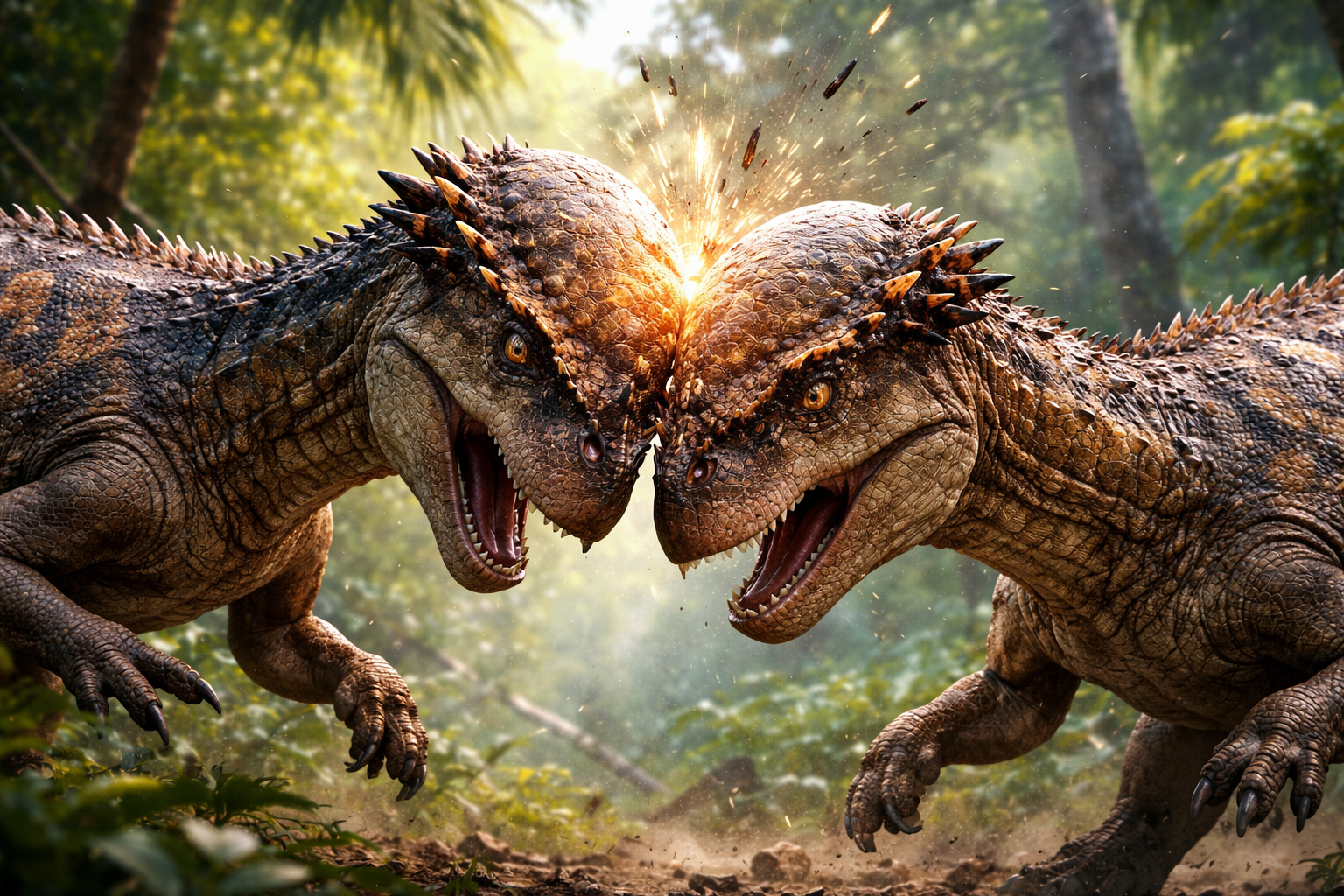
The idea of a head butting dinosaur instantly sparks dramatic imagery—massive prehistoric creatures lowering their skulls and charging into one another with bone-crushing force. For decades, this behavior has fascinated scientists and dinosaur enthusiasts alike. But how much of it is supported by fossil evidence, and how much is speculation shaped by movies and pop culture?
In this comprehensive guide, we’ll explore the real science behind head butting dinosaurs, examine fossil discoveries, analyze skull structures, and break down what paleontologists believe about prehistoric combat behavior. By the end, you’ll have a clear understanding of whether dinosaurs truly engaged in skull-to-skull battles and what that tells us about life millions of years ago.
What Is a Head Butting Dinosaur?
A head butting dinosaur refers to certain species believed to have used their skulls as weapons during combat, display rituals, or competition for mates. This idea is primarily associated with a group of plant-eating dinosaurs known as pachycephalosaurs, whose name literally means “thick-headed lizards.”
These dinosaurs lived during the Late Cretaceous period, roughly 85 to 66 million years ago. Their most defining feature was a dome-shaped skull roof that could reach several inches thick. The structure and density of these skulls sparked the long-standing theory that they engaged in head butting behavior similar to modern animals like bighorn sheep.
Meet the Most Famous Head Butting Dinosaur
The dinosaur most commonly associated with head butting is Pachycephalosaurus. This species is known for its massive, rounded skull dome, which could measure up to 10 inches thick in some specimens. The reinforced bone structure made it one of the most distinctive dinosaurs ever discovered.
Fossils of Pachycephalosaurus have been found primarily in North America. Its unique anatomy led researchers to propose that the dome functioned as a battering ram during intraspecies combat. While not all scientists fully agree on this interpretation, Pachycephalosaurus remains the poster child of the head butting dinosaur concept.
The Science Behind Thick Skull Domes
The skull dome of a head butting dinosaur wasn’t just thick—it was incredibly dense and reinforced with fibrous bone tissue. CT scans of fossilized skulls show complex internal structures that may have helped absorb shock during impact.
Bone histology studies reveal that these domes were not hollow. Instead, they were solid and reinforced in ways that suggest they were built to withstand stress. However, one major scientific question remains: were they designed specifically for head-on collisions, or did they serve another purpose?
Understanding bone microstructure has been key to interpreting the function of these domes. Some researchers argue the bone patterns resemble those found in modern animals that engage in combat, lending support to the head butting theory.
Fossil Evidence of Combat Injuries
One of the strongest arguments for the head butting dinosaur theory comes from fossil evidence showing healed injuries on skull domes. Some specimens display lesions or damage patterns consistent with trauma.
These injuries appear in areas most likely to experience impact if two dinosaurs collided head-first. The fact that some injuries healed indicates the animals survived these events, which aligns with behavior seen in modern head-butting species.
However, not all paleontologists agree that these marks are proof of combat. Some suggest they may result from infection, disease, or other environmental factors. Even so, the injury patterns continue to fuel the debate.
Comparing Dinosaurs to Modern Head-Butting Animals
To better understand the head butting dinosaur theory, scientists compare pachycephalosaurs to modern animals like bighorn sheep, musk oxen, and goats. These animals use reinforced skulls to compete for mates or dominance within their social groups.
Modern head-butting mammals have thick skulls, strong neck muscles, and shock-absorbing adaptations. Researchers examine whether pachycephalosaurs had similar anatomical traits, including robust neck vertebrae capable of supporting impact forces.
While there are similarities, there are also differences. For example, mammals that head butt often have sinus cavities that help absorb shock—something pachycephalosaurs lacked. This difference has led some researchers to question whether dinosaurs collided directly head-to-head or used different tactics.
Alternative Theories: Flank Butting Instead of Head-On Collisions
Not all scientists believe head butting dinosaurs smashed into each other skull-first. An alternative theory suggests they may have engaged in flank butting—striking each other’s sides rather than colliding head-on.
This theory is based on biomechanical modeling studies. Computer simulations indicate that direct head-to-head collisions might have generated forces too extreme, potentially causing catastrophic injury. Flank butting, on the other hand, would reduce the risk of brain trauma while still serving as a dominance display.
If this theory is correct, the head butting dinosaur image might need slight adjustment—not necessarily two dinosaurs charging face-first, but rather striking at angles or targeting the torso.
The Role of Sexual Selection
Another key explanation for the thick skull dome is sexual selection. In many animal species, exaggerated physical features evolve to attract mates or intimidate rivals. The dome may have functioned as a visual signal of strength and maturity.
In this view, the dome wasn’t just a weapon—it was also a display structure. Larger domes could signal dominance, reducing the need for actual combat. This pattern is common in nature, where the threat of confrontation can be as effective as the fight itself.
Sexual dimorphism, or differences between males and females, has been difficult to confirm in pachycephalosaur fossils. However, the display hypothesis remains a strong contender in explaining the evolution of the head butting dinosaur.
Brain Protection and Anatomy
One common question about head butting dinosaurs is whether their brains were protected during impact. The skull dome sat above the braincase, but the brain itself was relatively small and positioned lower in the skull.
The thick dome likely absorbed much of the force before it reached the brain. Additionally, the orientation of the braincase suggests it may have been shielded from direct impact stress. This anatomical positioning supports the idea that the dinosaurs were adapted for at least some level of forceful contact.
Still, without soft tissue preservation, it is impossible to know whether additional protective structures existed, such as thick cartilage or specialized neck ligaments.
Social Behavior and Herd Dynamics
If head butting dinosaurs engaged in combat, it likely occurred within social groups. Many herbivorous dinosaurs are believed to have lived in herds, where competition for mates or hierarchy would have been common.
Combat behavior often evolves in social species where ranking determines access to resources. A head butting dinosaur could establish dominance through controlled fights rather than lethal encounters.
Fossil sites containing multiple pachycephalosaur specimens suggest group living may have been possible, though evidence is not definitive.
Pop Culture vs. Paleontology
Movies and documentaries often portray head butting dinosaurs in dramatic, slow-motion collisions. While these scenes capture public imagination, they may oversimplify the science.
Paleontology relies on fossil evidence, biomechanics, and comparative anatomy—not cinematic spectacle. The reality of prehistoric behavior is usually more nuanced than pop culture depictions suggest.
Still, the popularity of these portrayals has helped generate public interest in dinosaur research and paleobiology.
Ongoing Research and Scientific Debate
The debate over head butting dinosaurs continues. Advances in 3D scanning, finite element analysis, and bone histology provide new tools for evaluating skull strength and stress distribution.
As more fossils are discovered and technology improves, scientists refine their understanding of how these dinosaurs lived and interacted. The head butting dinosaur theory remains plausible, but it is continually re-examined through new evidence.
Scientific consensus evolves over time, and what we know today may change with future discoveries.
What the Head Butting Dinosaur Teaches Us
Studying head butting dinosaurs gives insight into broader evolutionary principles. It highlights how anatomy reflects behavior, how competition shapes physical traits, and how fossil evidence can reveal social dynamics millions of years old.
Whether pachycephalosaurs engaged in full-force skull battles or more controlled displays, their thick domes represent one of the most intriguing adaptations in dinosaur evolution.
The head butting dinosaur stands as a powerful example of how prehistoric animals developed specialized features for survival and competition.
Conclusion
The concept of a head butting dinosaur is grounded in real fossil evidence and scientific analysis. Pachycephalosaurs, especially Pachycephalosaurus, possessed uniquely thick skull domes that likely played a role in social behavior—whether through combat, display, or both.
While debates continue about the exact mechanics of their interactions, fossil injuries, bone structure, and biomechanical studies support the idea that these dinosaurs engaged in some form of impact-based competition.
Far from being mere cinematic fantasy, the head butting dinosaur reflects a fascinating intersection of anatomy, evolution, and prehistoric behavior. As research advances, our understanding of these ancient skull battles will only grow stronger.