Industrial operations are built around motion: forklifts circulating through aisles, pallet traffic feeding production lines, and personnel moving between workstations, docks, and storage zones. When these flows intersect without physical control, minor contact events become routine—and routine incidents eventually become major disruptions.
For modern facilities, safety is not a poster on a wall. It is engineered into the layout through systems that separate movement types, manage impact energy, and preserve infrastructure integrity under continuous load.
To support this engineering approach, Raysan offers barrier solutions that combine visibility, durability, and practical workflow guidance—helping facilities reduce collision exposure without slowing throughput.
Why Barriers Are a Core Part of Operational Continuity
In warehouses, logistics halls, and production plants, the true cost of an incident is rarely limited to the point of impact. A single strike can damage floors, racks, equipment housings, or door infrastructure; interrupt routes; and create secondary risk as operators attempt to work around the disruption.
Barrier systems address this by establishing enforceable boundaries. They define where vehicles travel, where people walk, and which zones remain protected—even under peak workload conditions.
Safety Barrier: Physical Separation That Guides Behaviour
A safety barrier functions as more than a block. It is a control line that shapes traffic discipline. When installed in the right locations—along pedestrian corridors, around sensitive machinery, or at loading interfaces—it reduces the likelihood of vehicles drifting into restricted areas.
Effective safety barrier planning focuses on predictable conflict points: aisle transitions, blind corners, staging zones, and areas where pedestrian movement is unavoidable. With clear visual presence and consistent placement, barriers reinforce correct behaviour without requiring constant supervision.
Facilities typically deploy safety barriers to achieve outcomes such as:
- Segregation of forklift lanes from pedestrian routes and work areas
- Protection of machinery perimeters and production corridors
- Traffic guidance near docks, doors, and staging zones where movement density is highest
- A more orderly operating rhythm with fewer near-misses and less route improvisation
Polymer Barrier: Managing Impact Energy Through Flex and Recovery
Where impacts are frequent, the barrier’s behaviour under load becomes critical. Traditional rigid metal systems can transmit collision force into the floor or nearby structures, creating secondary damage even when the barrier itself remains in place.
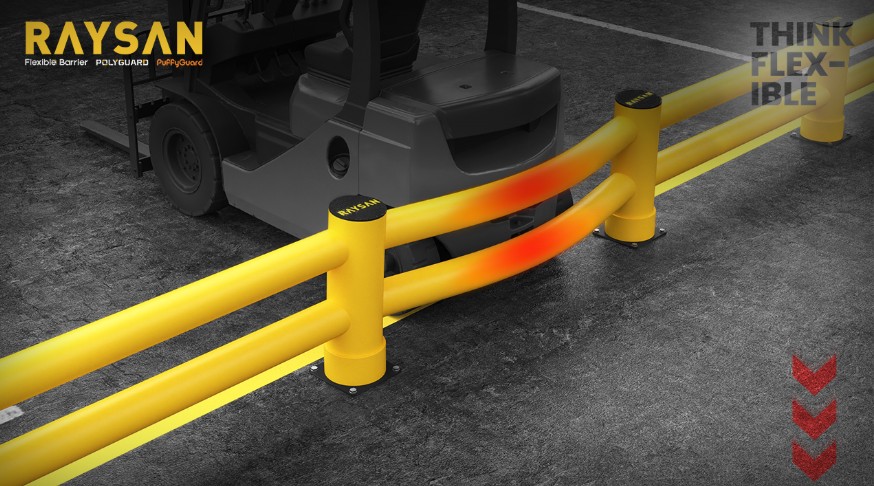
A polymer barrier system is engineered with a different objective: absorb and distribute kinetic energy rather than transferring it. By flexing under impact and recovering toward its original form, polymer-based protection can reduce the repair cycle commonly associated with rigid barriers.
This makes polymer barriers particularly suitable for high-traffic areas where repeated low-to-mid intensity contact is operationally realistic—such as busy aisles, pick faces, staging corridors, and perimeter zones around critical infrastructure.
Common performance advantages associated with polymer barrier systems include:
- High impact absorption and controlled deformation under collision load
- Reduced secondary damage to floors, racks, and surrounding structures
- Lower maintenance burden compared to systems that bend, rust, corrode, or require repainting
- Long service life characteristics in environments with continuous equipment movement
Sustainability and Lifecycle Economics
Modern safety investment is increasingly measured through lifecycle economics: how protection performs over years of operation, how often it requires intervention, and how much downtime it prevents. Systems that reduce replacement frequency and maintenance effort typically deliver stronger value than those that appear economical only at purchase.
In addition, facilities are paying closer attention to environmental responsibility. Recyclable materials and maintenance-light designs support waste reduction by limiting replacement cycles and avoiding repeated refinishing work.
Implementation Priorities: Where Barriers Deliver the Fastest Results
Most sites benefit from a structured rollout that starts with the highest-risk interfaces. A practical deployment sequence often includes:
- Pedestrian-adjacent routes where separation must remain enforceable
- Machinery perimeters and sensitive utility zones exposed to traffic
- Aisle intersections and turning corridors where visibility and clearance constraints elevate strike probability
- Loading and staging areas where speed and congestion increase contact risk
Once these zones are controlled, barrier coverage can be scaled with the facility—maintaining consistent protection as layouts, volumes, and routes evolve.
Conclusion: Safety Systems That Support Continuous Movement
Industrial facilities do not need barriers simply to meet safety expectations. They need protection systems that actively support continuous movement, reduce impact-related downtime, and safeguard people and infrastructure with measurable reliability.