For educators and school administrators, communicating student progress clearly and consistently is one of the more demanding aspects of the academic calendar. Progress reports are not simply summaries of grades — they are structured documents that inform parents, guide instructional decisions, and in many cases form the foundation of a student’s academic record. When these documents are inconsistent, vague, or poorly structured, the result is confusion at home, strained communication between teachers and families, and gaps in intervention planning.
The challenge is not usually a lack of effort. Teachers across grade levels often work without standardized templates, producing reports that vary significantly in tone, detail, and format from classroom to classroom — or even from one reporting period to the next within the same school. This inconsistency makes it difficult for administrators to assess patterns across grade levels and harder for parents to understand what a report actually means for their child’s development.
Having access to grade-appropriate report formats helps schools address this directly. A well-designed template anchored to the right developmental stage reduces the time teachers spend building reports from scratch, ensures that language aligns with what students are actually expected to demonstrate at each level, and creates a consistent standard across departments and reporting periods.
Why Grade-Level Formatting Matters More Than Most Schools Acknowledge
A student progress report sample does not work in the same way across all grade levels. What a kindergarten teacher needs to communicate about a five-year-old’s development looks almost nothing like what a high school teacher communicates about a tenth-grader’s performance in chemistry. Yet many schools operate with a single universal template applied across all grades, often because building separate formats for each level feels like an administrative burden. The result is a document that is either too abstract for early learners or too simplified for secondary students.
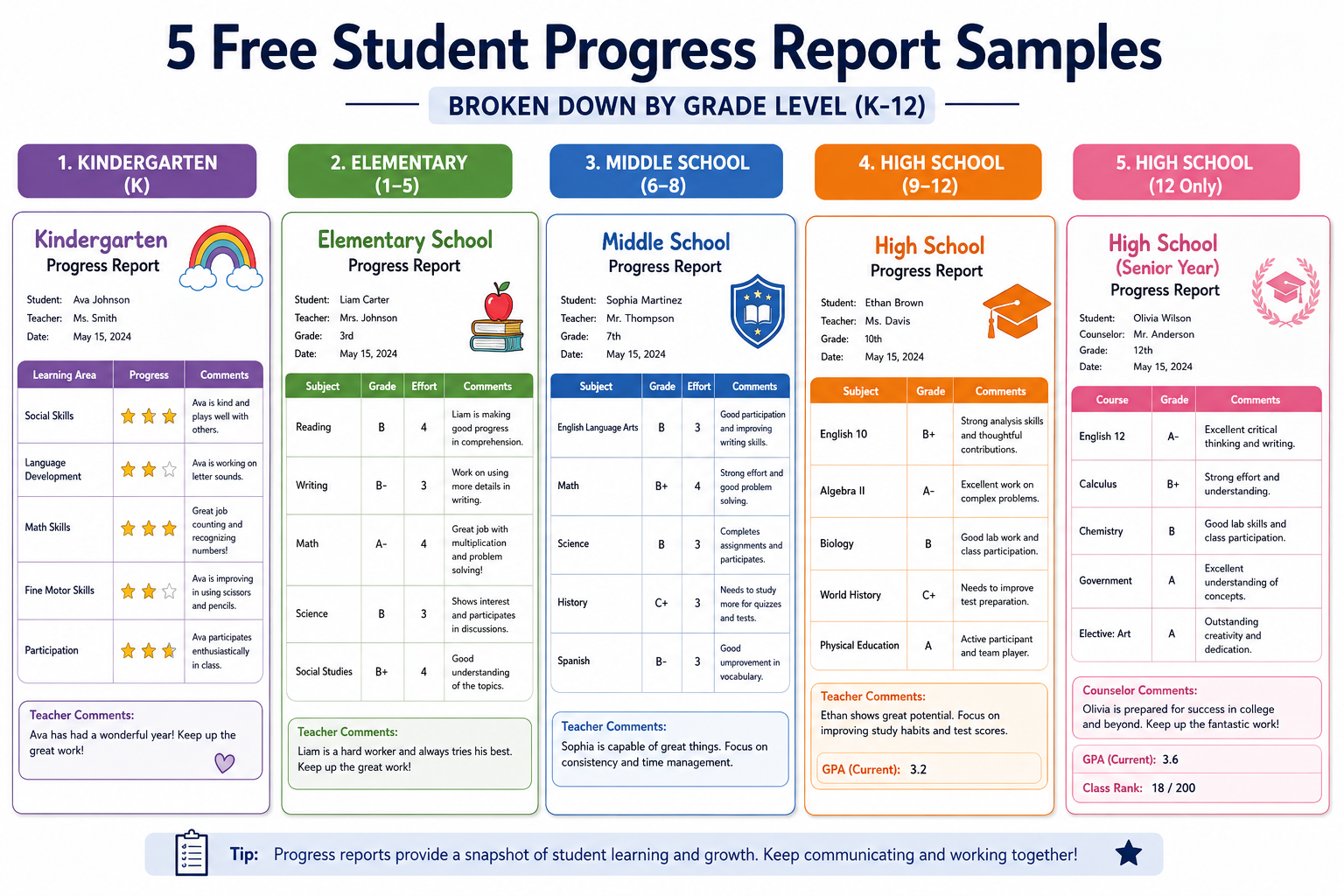
Reviewing a well-constructed student progress report sample structured by grade band gives educators something concrete to work from — not just an idea of what categories to include, but an understanding of how language, measurement scales, and reporting criteria shift as students move through the system. That shift matters because the expectations governing what a student should know at each stage are fundamentally different, and a report that fails to reflect those differences communicates less than it should.
Early Childhood Reporting Focuses on Developmental Milestones, Not Just Academics
At the kindergarten and early primary level, academic performance is only one part of what needs to be communicated. Social development, fine motor skills, the ability to follow multi-step instructions, and readiness behaviors such as listening and self-regulation are equally relevant at this stage. A report designed for this age group should reflect those dimensions rather than forcing early childhood data into a letter-grade format that was built for older students.
When early childhood reports are structured around milestone-based categories rather than numerical scores, parents receive information they can actually use. They understand whether their child is progressing at the expected rate, where they may need additional support, and what specific behaviors the school is tracking. This kind of reporting also aligns with how early childhood development is understood more broadly — the CDC’s guidelines on child developmental milestones confirm that growth in this period is multi-dimensional and does not reduce cleanly to academic grades alone.
Upper Elementary Reports Bridge Behavioral Observation and Academic Measurement
By grades three through five, students are transitioning from learning foundational skills to applying them across content areas. At this stage, a progress report needs to do two things simultaneously: reflect academic performance in subjects like mathematics and reading, and still provide some commentary on how the student engages with the learning environment. Work habits, organizational skills, and effort are still meaningful categories at this level and give parents context for understanding academic results.
A grade-level report for upper elementary students that separates academic performance from behavioral and effort-based observations tends to produce clearer conversations during parent-teacher conferences. When everything is compressed into a single score, parents may not understand whether a low grade reflects knowledge gaps, inconsistent effort, difficulty with the pace of instruction, or some combination of all three. Separating those threads makes the report more actionable.
Middle School Reports: The Shift Toward Subject-Specific Accountability
The transition into middle school introduces a structural change in how students experience their education. They now move between multiple teachers, each responsible for a specific subject area. Progress reports at this level must reflect that reality. A single-form document that treats a middle schooler’s experience as unified across subjects misses the fact that a student may be performing strongly in English while struggling significantly in mathematics — and that each of those situations calls for different responses from both parents and the school.
Effective middle school progress report formats include separate sections for each core subject, with space for teacher-specific comments that go beyond a score. The comments are where a subject-area teacher can flag specific patterns — consistent difficulty with written explanations in science, for instance, or strong conceptual understanding in algebra that does not transfer well to timed assessments. These observations help parents understand nuance that a number alone cannot convey.
Teacher Commentary in Middle School Reports Carries Disproportionate Weight
Parents of middle schoolers are often navigating a period where their child is less forthcoming about what is happening at school. A well-written teacher comment in a progress report may be one of the few direct windows a parent has into how their child is functioning in a specific class. This makes the quality and specificity of those comments operationally important — not just nice to have. Comments that are generic or overly positive without nuance leave parents without the information they need to follow up meaningfully at home or to request additional school-based support.
When schools provide teachers with structured comment prompts tied to grade-level expectations, the quality of reporting tends to improve. Teachers are guided toward specific, observable statements rather than general impressions. The report becomes less a summary of how the teacher feels about the student and more a structured account of what the student is demonstrating in relation to grade-level standards.
High School Progress Reports and the Weight of Academic Record
By the time a student reaches high school, progress reports begin to intersect with longer-term academic records. Performance in certain courses has implications for course selection in subsequent years, graduation requirements, and in some cases, post-secondary planning. This changes what a progress report needs to accomplish. It is no longer primarily a communication tool aimed at behavioral guidance or developmental reassurance — it is a structured academic document that carries administrative and sometimes consequential significance.
High school report formats need to reflect this weight. Categories should be clearly defined, grading criteria should be consistent and transparent, and any deviation from expected performance should be documented in a way that supports follow-up. An ambiguous or informal report at this level creates risk — for students who may need early intervention before end-of-term grades are finalized, and for schools that need documentation trails to support academic support decisions.
Interim Reports at the High School Level Serve a Distinct Function
Many high schools issue interim progress reports midway through each marking period, separate from official report cards. These documents are designed to give students and families an early warning before grades are finalized. For this to work in practice, the format of the interim report needs to be clear enough that a family can act on it — not so vague that the report reads as routine correspondence with no actionable content.
The most useful interim reports at the high school level identify specific assignments or assessment areas that are affecting a student’s standing, note whether attendance or participation is a contributing factor, and give teachers a structured space to indicate whether follow-up support has already been initiated. These details make the difference between a report that prompts a productive parent-school conversation and one that is noted, filed, and forgotten.
Applying Grade-Level Samples in Practice Across a School System
Having access to five distinct progress report samples — one for each grade band across K-12 — is a starting point, not a finished solution. Schools that use sample formats most effectively treat them as working documents that are reviewed and adjusted each academic year. As grade-level standards are updated, as the student population changes, or as patterns emerge in how parents respond to certain types of language, the format should evolve accordingly.
Consistency across a school system also matters. When different teachers in the same grade level are using different versions of a report, parents with multiple children in the school receive different levels of information depending on which classroom their child is placed in. Standardizing the format across a grade level — while still allowing space for teacher-specific commentary — addresses this without removing the human element that makes progress reports meaningful.
• Early childhood formats should track developmental milestones alongside academic readiness indicators, using language accessible to parents without an education background.
• Elementary formats should separate academic performance from effort and behavioral observations to give parents clearer, more actionable information.
• Middle school formats should be organized by subject, with structured space for subject-specific teacher comments that go beyond scores.
• High school formats should reflect the increased stakes of academic records and include fields that support documentation of intervention or follow-up.
• Interim reports at any level should be formatted specifically to prompt action, not simply to report status.
Conclusion
Progress reporting is one of the most consistent and high-frequency communication responsibilities in K-12 education. When it is done well, it creates trust between schools and families, supports early identification of students who need additional help, and gives teachers a structured way to communicate what they observe every day in the classroom. When it is done inconsistently — with formats that do not match the developmental stage of students, or reports that rely too heavily on scores without supporting context — the communication breaks down, and the opportunity to intervene early is often lost.
Grade-level specificity is not a refinement. It is a functional requirement for a document that is supposed to reflect where a real student stands relative to real expectations at a particular point in their development. Schools that invest in building or adopting the right format for each grade band tend to see stronger parent engagement, more consistent teacher reporting, and clearer pathways for academic support. The format shapes the conversation — and the conversation shapes what happens next for students.