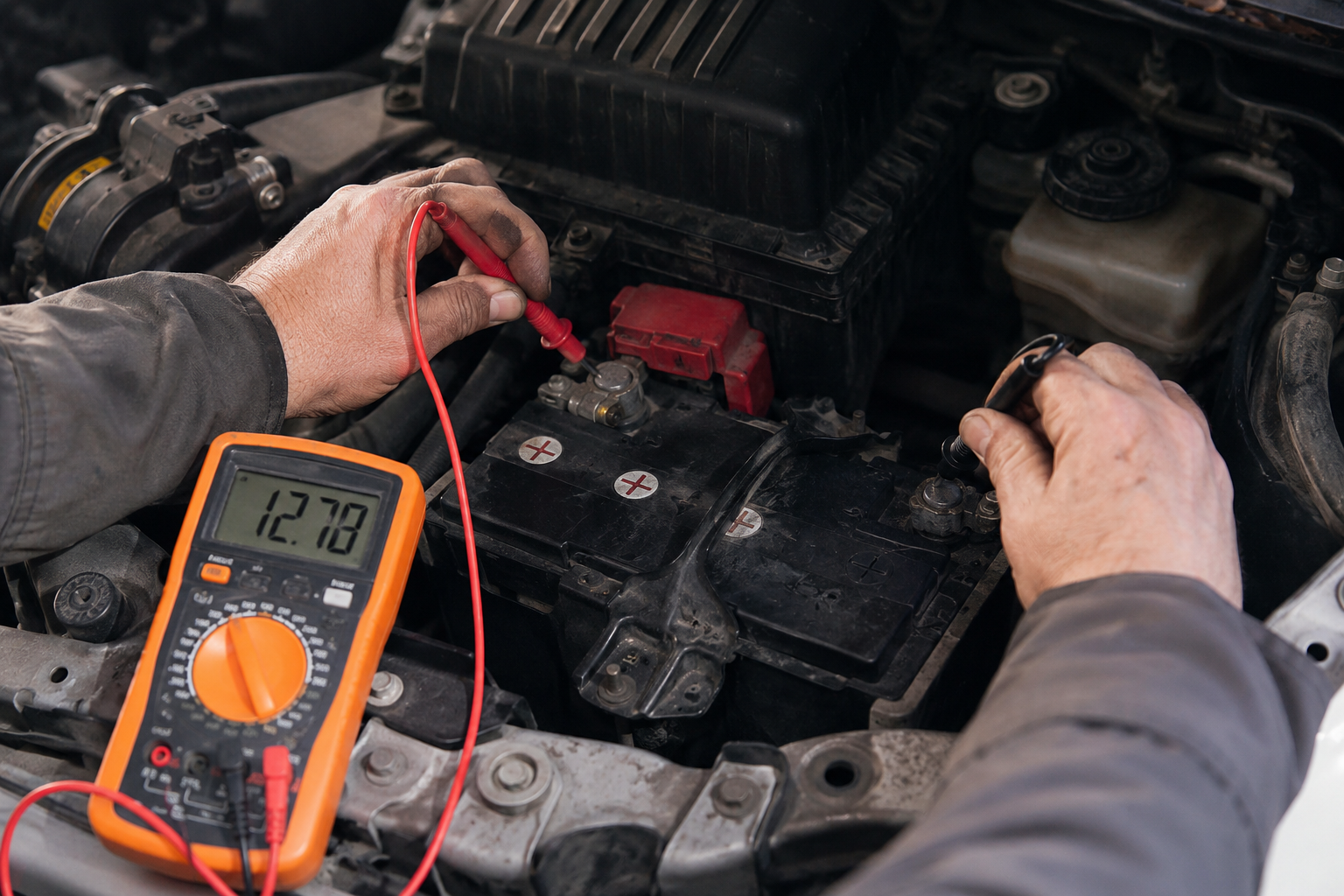
Is your car struggling to start? Here are 8 warning signs your battery is dying and what to do before you get stranded on the road.
There is nothing quite like turning your key on a cold Aldershot morning, hearing a sluggish groan from the engine, and realising your day has taken a very unwelcome turn. A dead car battery is one of the most common causes of vehicle breakdowns across the UK, and the frustrating part is that it rarely happens without warning. The signs are there, quietly building for weeks or even months before the battery finally gives up.
The problem is that most drivers do not know what to look for until it is too late. A battery does not switch from perfectly healthy to completely dead overnight. It fades, and along the way it sends you signals that something is wrong. Learning to read those signals can save you from a breakdown, a missed appointment, or worse, being stranded somewhere you really do not want to be.
If your car has been feeling slightly off lately, whether that is a slow start, flickering lights, or something you cannot quite put your finger on, this guide is for you. If your vehicle is already due a check, it is worth booking a car service in Aldershot sooner rather than later.
How Long Does a Car Battery Actually Last?
Most car batteries in the UK last between three and five years. That is the general rule, but it is not a guarantee. A battery in a car used mainly for short school-run trips around Fleet or Farnham may struggle to reach three years, while a vehicle doing regular longer journeys might still be going strong past the five-year mark.
The reason short trips are so damaging is straightforward. Every time you start your engine, your battery uses a significant burst of power. It relies on the alternator, which runs while the engine is on, to recharge itself. If your journeys are too short, the alternator never has enough time to fully top the battery back up. Over weeks and months, this repeated partial charging quietly degrades the battery’s capacity until one day it simply does not have enough left to start the car.
UK weather plays its part too. Cold temperatures slow down the chemical reactions inside a battery, reducing its ability to deliver power. That is why so many battery failures happen on cold winter mornings, often catching drivers completely off guard.
| Driving Habit or Condition | Impact on Battery Life |
| Frequent short trips under 20 minutes | Reduces lifespan significantly, battery never fully recharges |
| Regular motorway or longer drives | Supports healthy recharging, extends battery life |
| Leaving lights or accessories on with engine off | Drains battery, causes repeated deep discharges |
| Cold weather and freezing temperatures | Reduces power output, increases strain on starting |
| Letting the car sit unused for long periods | Battery self-discharges, can cause permanent damage |
| Battery older than three years with no testing | Higher risk of sudden failure without warning |
Why Your Battery Gives You Warning Signs First
Batteries do not tend to fail in a single dramatic moment. They weaken gradually, and as they do, your car begins to show small, easy-to-miss symptoms. These symptoms often appear weeks before a full failure, which means you have a window to act if you pay attention.
The key is knowing what normal feels like for your car. Most drivers develop an instinct for how their vehicle sounds and feels during a normal start. When something changes, even slightly, that instinct often picks up on it before conscious thought does. Trust that feeling. A car that feels even a little different in how it starts or how its lights behave is worth a closer look.
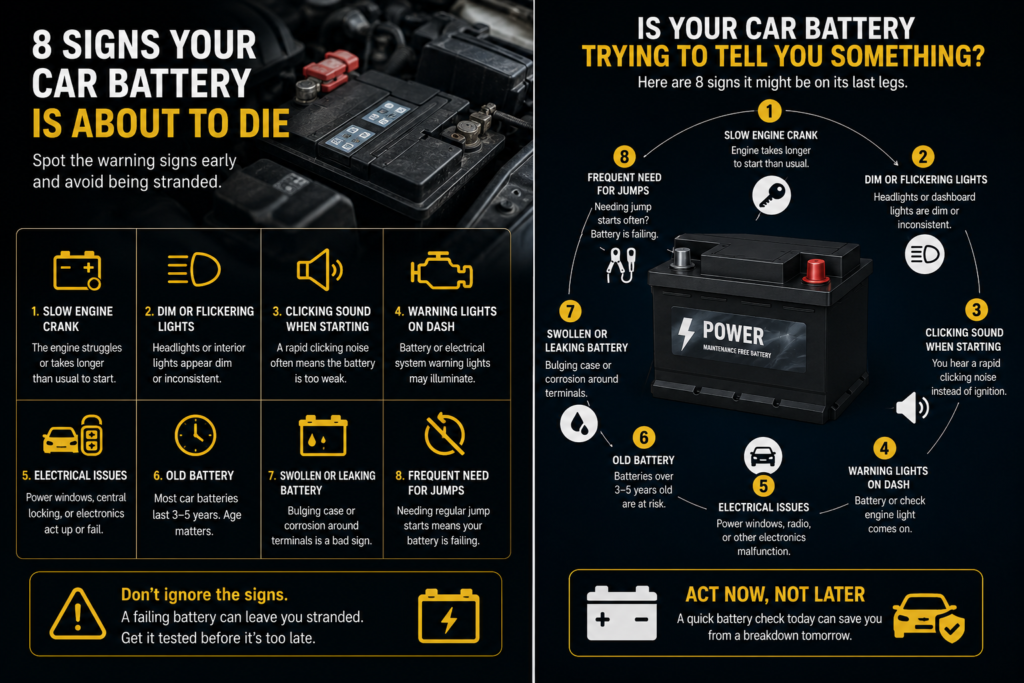
The 8 Signs Your Car Battery Is About to Die
1. Your Engine Is Cranking Slowly
This is the most recognisable warning sign and one of the earliest. When you turn the key or press the start button, the battery sends power to the starter motor to crank the engine. A healthy battery does this quickly and confidently. A weakening battery struggles, and that struggle sounds like a slow, laboured turn of the engine, almost as if it is wading through treacle.
You might notice it only on colder mornings at first, which can make it easy to dismiss as just the weather. But if slow cranking becomes a regular occurrence regardless of temperature, the battery is telling you something important. Do not ignore it.
2. You Hear a Clicking Sound When You Turn the Key
A rapid clicking noise when you turn the key is a very telling sound. It means the battery is sending electrical current to the starter solenoid, but there is not enough power to actually engage the starter motor and turn the engine over. The result is that rapid, frantic clicking that many drivers recognise as the sound of a car that simply will not start.
A single loud click, rather than rapid clicks, can point to a starter motor issue rather than the battery. However, a series of quick clicks almost always suggests the battery does not have the charge it needs. A jump start may get you going temporarily, but it is not a fix. The underlying problem still needs to be addressed.
3. Your Headlights Are Dimmer Than Usual
Your headlights draw power directly from the battery, particularly when the engine is idling and the alternator is producing less charge. If your headlights look noticeably dimmer than they used to, or if they brighten slightly when you rev the engine and then fade again at idle, the battery is struggling to maintain a steady supply of power.
This can be subtle enough that you only notice it at night or in low-light conditions around areas like Ash Road or during an evening commute. Interior lights and dashboard illumination can also appear duller than normal for the same reason. If your car suddenly feels like driving with a slightly underlit interior, the battery is worth investigating.
4. The Battery Warning Light Has Come On
Most cars have a battery-shaped warning light on the dashboard, usually displaying a rectangle with a plus and minus symbol. When this light illuminates, it is telling you there is a problem with the vehicle’s charging system, which includes the battery, the alternator, and the connections between them.
It is important not to assume that this light only indicates a problem with the alternator. A failing battery that is no longer holding a charge can trigger it just as easily. In some vehicles, a weak battery can also cause the check engine light to appear. If you notice either of these lights alongside any of the other symptoms listed here, do not delay in getting the car checked. You can read more about what dashboard warning lights mean and what your car could be trying to communicate in this guide to warning signs your car needs immediate repairs.
5. Electrical Accessories Are Acting Up
Modern cars rely on the battery to power a surprisingly wide range of systems, not just the engine. Power windows, heated seats, the infotainment screen, central locking, sat nav, and even the radio all draw from the same source. When the battery starts to weaken, it struggles to distribute power evenly across all of these demands at once.
You might notice:
- Power windows moving more slowly than usual, or hesitating mid-travel
- The radio cutting out or resetting unexpectedly
- Heated seats taking longer to warm up or not working at all
- Dashboard displays flickering or behaving erratically
- Your phone charging more slowly than normal through the car’s USB port
Each of these alone might have a simple explanation. But if two or more are happening at the same time, the battery is the most likely common cause and deserves a proper test.
6. There Is Corrosion Around the Battery Terminals
Open the bonnet and take a look at your battery. The terminals are the metal connections at the top, one marked positive and one negative. If you see a white, powdery substance, or anything with a blue or green tint crusted around those terminals, that is corrosion caused by sulphuric acid escaping from the battery.
Corrosion creates resistance in the electrical connection between the battery and the rest of the car. That resistance reduces the battery’s ability to deliver current efficiently, which means the car is essentially running on less power than the battery should be capable of providing. Mild corrosion can sometimes be cleaned away, but significant build-up is usually a sign that the battery itself has started to degrade and is approaching the end of its useful life.
7. Your Battery Case Looks Swollen or Misshapen
A healthy car battery is a neat, rectangular block. If you look at it and notice that the sides appear to be bulging outward, the top looks raised, or the casing looks warped in any way, that is a serious warning sign. Swelling is caused by the battery overheating, often as a result of being overcharged or exposed to extreme temperatures, which causes gases to build up inside the sealed casing.
A swollen battery should be treated as urgent. It is not safe to continue driving with one, and it should be replaced immediately. Do not attempt to charge or jump-start a battery that is visibly swollen or cracked, as there is a risk of leaking acid, which can damage surrounding components and is hazardous to handle.
8. You Keep Needing Jump Starts
Needing a jump start once in a while after leaving a light on overnight is not unusual. Needing one regularly, or finding that your car struggles to hold a charge for more than a day or two, is a different matter entirely. If you have become accustomed to relying on jump starts to get going, the battery is no longer able to do its job reliably.
Repeated jump-starting can also create stress on the alternator and other electrical components, meaning that ignoring the battery for too long can cause secondary problems that are more expensive to fix. If you are regularly reaching for the jump leads, the battery has already told you everything you need to know.
| Warning Sign | What It Means | What to Do |
| Slow engine crank | Battery lacks power to start efficiently | Get the battery tested immediately |
| Clicking sound on start | Insufficient charge reaching starter motor | Test battery, consider replacement |
| Dim headlights | Battery struggling to maintain steady power | Check battery and alternator |
| Battery warning light | Charging system fault detected | Book a diagnostic check |
| Electrical accessories failing | Battery cannot distribute power evenly | Have battery tested |
| Terminal corrosion | Acid leakage reducing electrical connection | Inspect and replace if needed |
| Swollen battery case | Overheating causing internal gas build-up | Replace immediately, do not delay |
| Frequent jump starts needed | Battery no longer holding a reliable charge | Replace the battery |
What Shortens a Car Battery’s Life?
Beyond age and driving habits, several other factors can quietly chip away at a battery’s lifespan without drivers realising it.
Extreme temperature is one of the biggest. Cold weather, which is a regular feature of winters across Hampshire and Surrey, reduces the battery’s ability to deliver power just when the engine demands it most. Summer heat, on the other hand, accelerates the evaporation of the battery’s internal fluid and speeds up internal corrosion. UK drivers get both extremes across the year, which is why battery testing from around the three-year mark is particularly worthwhile.
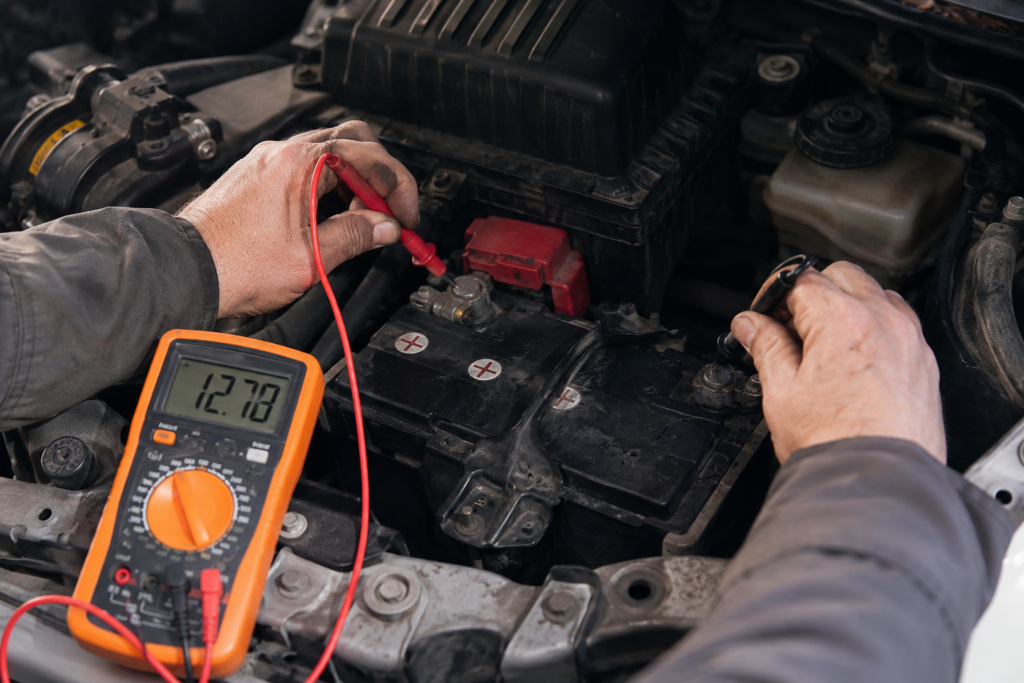
Leaving the car sitting unused for long periods is another common cause of early failure. A battery slowly discharges even when the engine is off, as modern cars draw a small but constant current to power alarm systems, clocks, and computer memory. Leave a car parked for several weeks without use and you may return to find the battery has discharged too deeply to recover fully.
Finally, a faulty alternator can shorten battery life dramatically. The alternator is responsible for recharging the battery while the engine runs. If it is not doing its job properly, the battery never gets the charge it needs and deteriorates far faster than it should. If your battery warning light comes on and the battery tests as healthy, an alternator check is the logical next step. If you have noticed your check engine light appearing alongside any electrical symptoms, it is worth reading up on what your car is trying to tell you before assuming the worst.
What Should You Do If You Spot These Signs?
The single most useful thing you can do when you notice any of these symptoms is to get the battery tested. A professional battery test takes only a few minutes and gives a clear picture of the battery’s current state of charge, its capacity to hold that charge, and whether it is likely to fail soon. This is far better than guessing and hoping.
If the battery tests as weak or degraded, replacing it promptly is almost always the right call. Waiting until it fails completely rarely saves money and often costs more, both in terms of inconvenience and the potential knock-on effect on other electrical components.
Here is a simple checklist of what to do if you suspect your battery is struggling:
- Book a battery test at a trusted local garage as soon as possible, ideally before the next cold snap
- Mention all the symptoms you have noticed, including when they started and whether they are getting worse
- Ask for the alternator to be checked at the same time, since battery and charging system faults often go hand in hand
- If the battery is more than three years old, ask whether replacement is advisable even if the current test shows it is borderline
- Avoid repeated jump-starting as a long-term strategy, as it adds wear to other electrical systems
Drivers in and around Aldershot, Farnborough, and Fleet can book an MOT in Aldershot which includes a vehicle health check and gives technicians the opportunity to identify any developing issues, including battery condition, before they become roadside emergencies. According to GOV.UK guidance on keeping your vehicle safe to drive, drivers are responsible for ensuring their vehicle is in a roadworthy condition before setting off, which includes the electrical systems that keep it running reliably.
Conclusion
Your car battery is one of those components that tends to be forgotten until the moment it causes a problem. The good news is that it almost always gives you fair warning before that happens. Slow starts, clicking sounds, dim lights, dashboard alerts, and electrical gremlins are not random inconveniences. They are your car communicating clearly that something needs attention.
The key is to act on those signals rather than dismiss them. A battery test is quick, straightforward, and far less disruptive than a breakdown at the worst possible moment. If your battery is approaching three years old, or if you have recognised any of the signs above, do not wait. Get it checked, get it tested, and drive with confidence knowing your car is ready for whatever the road ahead brings.
Frequently Asked Questions
How do I know if my car battery is dying? The most common signs are a slow or sluggish engine crank when starting, a clicking sound when you turn the key, dimmer than usual headlights, the battery warning light appearing on the dashboard, and electrical accessories such as windows or the radio behaving erratically. If you notice more than one of these at the same time, the battery is very likely the cause.
How long does a car battery last in the UK? Most car batteries in the UK last between three and five years. Factors including cold winters, frequent short trips, and leaving the car unused for extended periods can shorten that lifespan considerably. From the three-year mark onwards, annual battery testing is a sensible habit.
Can a dying battery affect my car’s electrical systems? Yes. A weakening battery struggles to distribute power evenly, which can affect power windows, heated seats, the infotainment system, central locking, and dashboard displays. If multiple electrical features start misbehaving at the same time, the battery is the most likely cause.
What does a clicking sound when starting my car mean? A rapid clicking noise when you turn the key usually means the battery does not have enough charge to engage the starter motor. The battery is sending current, but not enough to do the job. A jump start may work temporarily, but the battery should be tested and likely replaced.
Will a failing battery cause my car to fail an MOT? A battery itself is not directly tested during an MOT, but the electrical systems it powers are. Dim or non-functioning lights, dashboard warning lights left illuminated, or other electrical faults caused by a failing battery can result in an MOT failure. Keeping the battery in good health helps ensure those systems perform as they should.
What causes a car battery to die faster? The most common causes are frequent short journeys that do not allow the battery to recharge fully, leaving lights or accessories on with the engine off, extreme cold or heat, a faulty alternator that is not charging the battery properly, and leaving the car unused for long periods. Regular servicing helps catch these issues before they cause a failure.