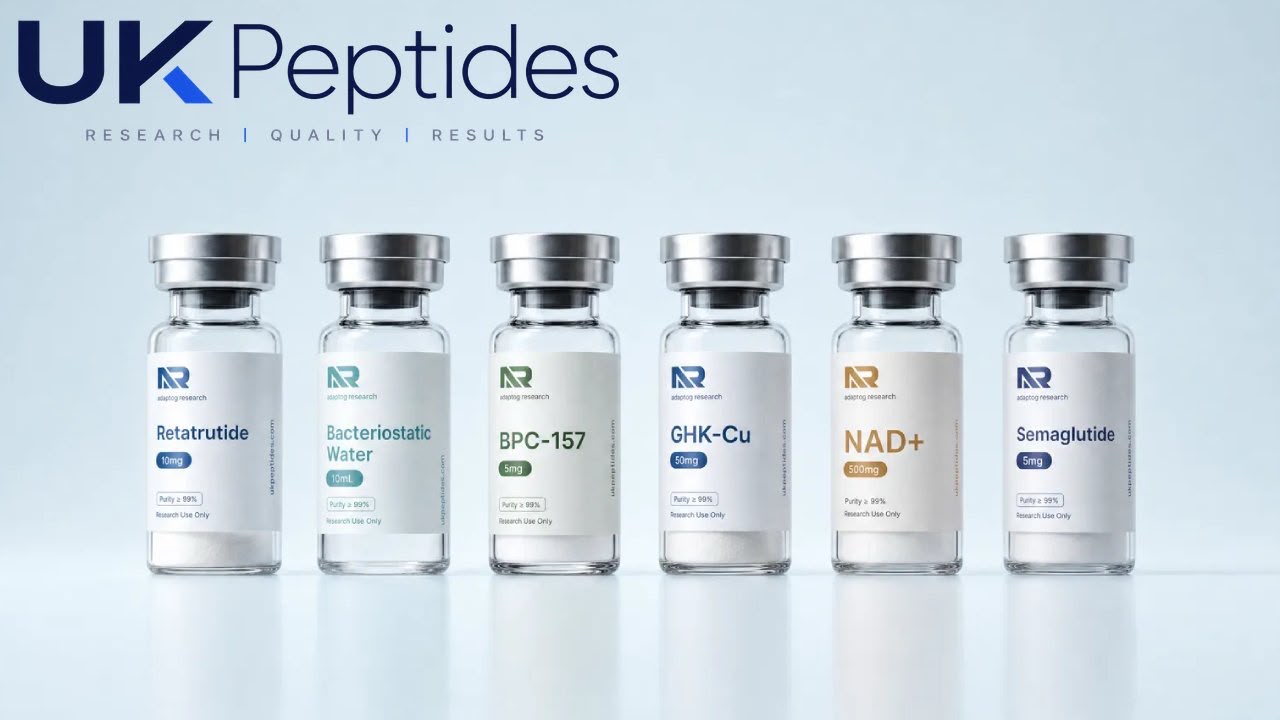
Retatrutide occupies a distinct place among modern research peptides, defined by a single molecule engaging three separate receptor pathways. UKPeptides supplies Retatrutide as a laboratory research material presented in a 5 mg lyophilised vial, intended strictly for in-vitro and laboratory research use. The compound is characterised as a GIP, GLP-1 and glucagon tri-agonist, a structural profile that draws sustained interest across peptide pharmacology.
Understanding what this molecule is, and how a supplier confirms its identity, matters before any laboratory acquires it. The focus here rests on the compound itself, its classification, the research models where it appears, and the analytical documentation UKPeptides ties to every lot. Retatrutide is not a medicine, supplement or weight-loss product, and it is not intended for human or animal use.
Each specification below reflects data published through PubChem and PubMed, alongside the verification workflow UKPeptides applies to every 5 mg vial it dispatches. Research supply begins with knowing precisely what sits inside the vial.
What Is Retatrutide As A Research Compound?
Retatrutide is a synthetic peptide studied for its unusual capacity to act on three receptor systems at once. The abbreviation GIP stands for glucose-dependent insulinotropic polypeptide, while GLP-1 refers to glucagon-like peptide-1. Combined with glucagon-receptor engagement, these three targets give the molecule its tri-agonist designation.
Within peptide pharmacology, the molecule serves as a reference tool for probing how a single sequence can coordinate multiple incretin-pathway signals. The incretin-pathway describes the gut-derived hormone cascade that researchers model in laboratory settings. Retatrutide is examined as a structural template rather than as an outcome-driven agent.
Common characteristics that define the research compound include the following.
- A single synthetic peptide engaging GIP, GLP-1 and glucagon receptors
- Classified as a tri-agonist within incretin-pathway peptide pharmacology
- Supplied as a 5 mg lyophilised powder in a sealed vial
- Studied as a structural reference template, not an outcome-driven agent
How Does UKPeptides Verify Retatrutide Identity And Purity?
Verification defines the difference between a labelled vial and a confirmed one. Every Retatrutide lot from UKPeptides is analysed by reverse-phase High-Performance Liquid Chromatography, abbreviated HPLC, which separates the peptide and measures its purity fraction. This analysis verifies the material to 99.0% purity.
Identity is then confirmed by Liquid Chromatography-Mass Spectrometry, abbreviated LC-MS, which matches the measured mass against the expected molecular weight. The pairing of HPLC and LC-MS gives both a purity value and a molecular fingerprint. Laboratories relying on reproducibility can trace each result to a specific lot.
Every 5 mg vial ships with a batch-specific Certificate of Analysis, abbreviated COA, tied directly to the lot number. Researchers who want documented provenance can review these records before they choose to buy retatrutide from a verified laboratory source. The COA links analytical evidence to the exact material in hand.
The verification chain rests on three connected steps.
- Reverse-phase HPLC separates the peptide and measures its purity fraction
- LC-MS confirms molecular identity against the expected molecular weight
- A batch-specific COA ties both results to the lot number
Retatrutide Compound Specification
The specification table below consolidates the identity, classification and handling parameters UKPeptides assigns to the Retatrutide 5 mg vial. Each field reflects the documented profile rather than any functional claim.
| Parameter | Specification |
|---|---|
| Compound | Retatrutide |
| Class | GIP, GLP-1 and glucagon tri-agonist peptide |
| Purity | Verified to 99.0% |
| Verification | HPLC analysis, LC-MS confirmation, batch COA |
| Vial | 5 mg lyophilised |
| Storage | Sealed at -20C, reconstituted 2-8C |
Handling notes that accompany the lyophilised material are summarised here.
- Store the sealed lyophilised vial frozen at minus 20 degrees Celsius
- Keep any reconstituted material refrigerated between 2 and 8 degrees Celsius
- Protect the powder from light, moisture and repeated freeze-thaw cycles
Which Research Models Study Retatrutide?
Retatrutide appears across several laboratory research contexts, each keyed to one of its receptor targets. Glucagon-receptor signalling studies use the molecule to observe how tri-agonist binding interacts with that pathway. These models remain confined to in-vitro and laboratory research settings.
Incretin-pathway models form a second area of interest, where the compound helps map GIP and GLP-1 receptor behaviour. Peptide pharmacology research treats Retatrutide as a structural example of multi-receptor design. None of these models imply any human or therapeutic outcome.
The principal research contexts include the following.
- Glucagon-receptor signalling studies observing how tri-agonist binding interacts with that pathway
- Incretin-pathway models mapping GIP and GLP-1 receptor behaviour in vitro
- Peptide pharmacology work treating the sequence as a multi-receptor structural example
Why Does Documentation Matter When You Buy Retatrutide?
Documentation converts a supplied peptide into a traceable research input. A batch-specific COA lets a laboratory tie every reported observation back to a verified lot of Retatrutide. Without that link, purity and identity remain assumptions rather than confirmed facts.
UKPeptides pairs the lyophilised 5 mg vial with HPLC and LC-MS records so provenance travels with the material. Same-day UK dispatch before 3pm GMT and cold-chain packaging support integrity in transit, though the analytical file remains the core reference. Compound data drawn from PubChem and PubMed complements the supplier documentation.
The complete analytical specification for the 5 mg research vial is published at https://ukpeptides.com/catalog/retatrutide
Frequently Asked Questions
What Does The Tri-Agonist Label Mean For Retatrutide?
The tri-agonist label indicates that Retatrutide engages three receptor systems, GIP, GLP-1 and glucagon, within a single peptide sequence. Researchers study this multi-target structure in peptide pharmacology as a template for incretin-pathway signalling. It stays within laboratory research contexts and never applies to any human use.
How Is The 99 Percent Purity Figure Established?
UKPeptides determines the 99.0% purity figure using reverse-phase HPLC, which separates the peptide and measures its main fraction. LC-MS then confirms molecular identity against the expected mass. Both results are recorded on a batch-specific COA that ties each 5 mg lyophilised vial to its lot number.
What Information Does The Certificate Of Analysis Contain?
The Certificate of Analysis, or COA, records the lot number, the HPLC purity result and the LC-MS identity confirmation for a specific Retatrutide batch. This document gives laboratories traceable provenance, linking the analytical evidence directly to the vial supplied so observations remain reproducible and verifiable.
Is Retatrutide From UKPeptides Intended For Personal Use?
No. Retatrutide is supplied solely as a laboratory research material for in-vitro and laboratory research use. It is not a medicine, supplement, food or cosmetic, and it is not intended for human or animal consumption. Purchasers must be age 21 or older and use it accordingly.