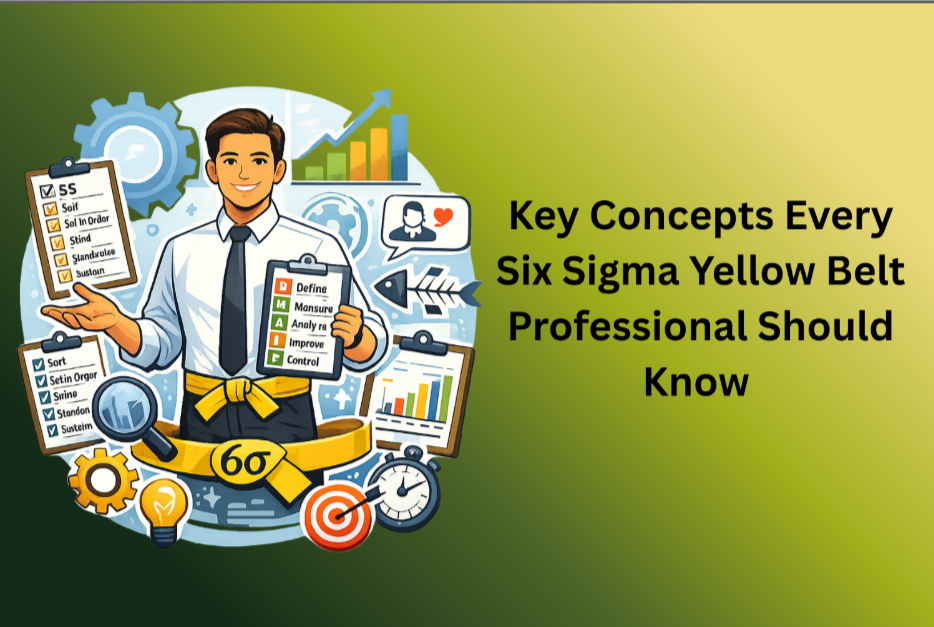
What helps some professionals spot process issues on time while others find it difficult to identify where things are going wrong? Often, it comes down to having the right improvement knowledge and a structured approach to problem solving. Six Sigma Yellow Belt Training introduces practical concepts that help professionals improve efficiency and support better outcomes across different industries. From manufacturing and healthcare to finance and IT, these skills can make a noticeable difference in everyday operations. They also help individuals contribute more effectively to improvement projects and organisational goals.
In this blog, we will explore the key concepts every Six Sigma Yellow Belt professional should know.
Essential Six Sigma Yellow Belt Concepts That Drive Better Results
Below are the key concepts every Yellow Belt professional should understand to support process improvement initiatives and contribute effectively to organisational success:
Understanding the DMAIC Methodology
The DMAIC approach is at the core of Six Sigma. It offers an organised method for resolving issues.
Define
Finding the issue and comprehending client expectations are the main goals of the first step. Teams draft a project charter outlining their goals in detail.
Measure
Accurate data collection comes next when the problem has been identified. Teams can better understand existing workflow and potential problem areas by using process mapping.
Analyse
The goal of this phase is to identify the underlying causes of issues. Teams use data and facts to determine what is causing errors or inefficiency rather than speculating.
Improve
Practical solutions are created and tested following the identification of the reasons. Making significant advancements that deal with the real issue is the aim.
Control
The last stage guarantees that advancements continue to be beneficial over time. Standard operating procedures and monitoring systems aid in sustaining the project’s gains.
After completing Six Sigma Yellow Belt Training, professionals get a thorough understanding of how each DMAIC process contributes to successful improvement initiatives. Many organisations also encourage Lean and Six Sigma Training to strengthen these problem solving capabilities across teams.
Learning the Core Lean Principles
Lean and Six Sigma collaborate closely. Lean focuses on cutting waste and boosting customer value, whereas Six Sigma focuses on lowering variance.
Value
Knowing what clients actually value is the first step in any improvement endeavour. Businesses should concentrate on initiatives that directly improve consumer happiness.
Value Stream
Every stage of providing a good or service is included in a value stream. Identifying actions that bring value and those that don’t is made easier by mapping these phases.
Flow
Efficiency is increased by streamlined procedures. The goal of flow is to eliminate bottlenecks and interruptions that impede productivity.
Pull
Organisations react to real client demand rather than providing work before it is needed. This lessens waste and needless work.
Perfection
One of the main tenets of Lean is continuous improvement. Teams constantly search for ways to enhance procedures and provide more value.
These guidelines aid experts in comprehending how businesses might enhance consumer experiences and run more effectively. Professionals can apply the concepts taught in Lean and Six Sigma training to actual workplace scenarios.
Using Essential Process and Quality Tools
Practical tools that assist teams in problem analysis and decision-making are essential for successful process improvement.
SIPOC Diagram
A high-level overview of a process is given by a SIPOC diagram. Suppliers, Inputs, Process, Outputs, and Customers are all identified. Teams are better able to comprehend how work proceeds from beginning to end as a result.
5 Whys Technique
The Five Whys approach is a straightforward yet powerful tool for solving problems. Teams can find the true cause of an issue by continuously questioning why it happens.
Fishbone Diagram
Also known as a Cause and Effect Diagram, this tool helps teams explore all possible causes of a problem. It offers a methodical approach to arranging concepts and conducting in-depth research.
Pareto Chart
Teams can concentrate on the most important issues by using a Pareto chart. It is easier to determine where improvement efforts will have the biggest impact when issues are displayed by frequency.
5S Methodology
The 5S method focuses on efficiency and organisation in the workplace.
- Sort removes unnecessary items
- Set in Order organises essential resources
- Shine keeps the workplace clean
- Standardising establishes consistent practices
- Sustain ensures long term maintenance
These resources are essential to Six Sigma Yellow Belt Training and enable professionals to engage with assurance.
Conclusion
A strong understanding of DMAIC, Lean principles and the Voice of the Customer forms the foundation of successful Six Sigma practice. These concepts help professionals identify opportunities and contribute to meaningful improvements. As organisations continue to focus on efficiency and quality, building these skills becomes increasingly valuable.
For professionals seeking to strengthen their improvement capabilities, Lean and Six Sigma Training provides practical knowledge that supports long term career growth and organisational success.