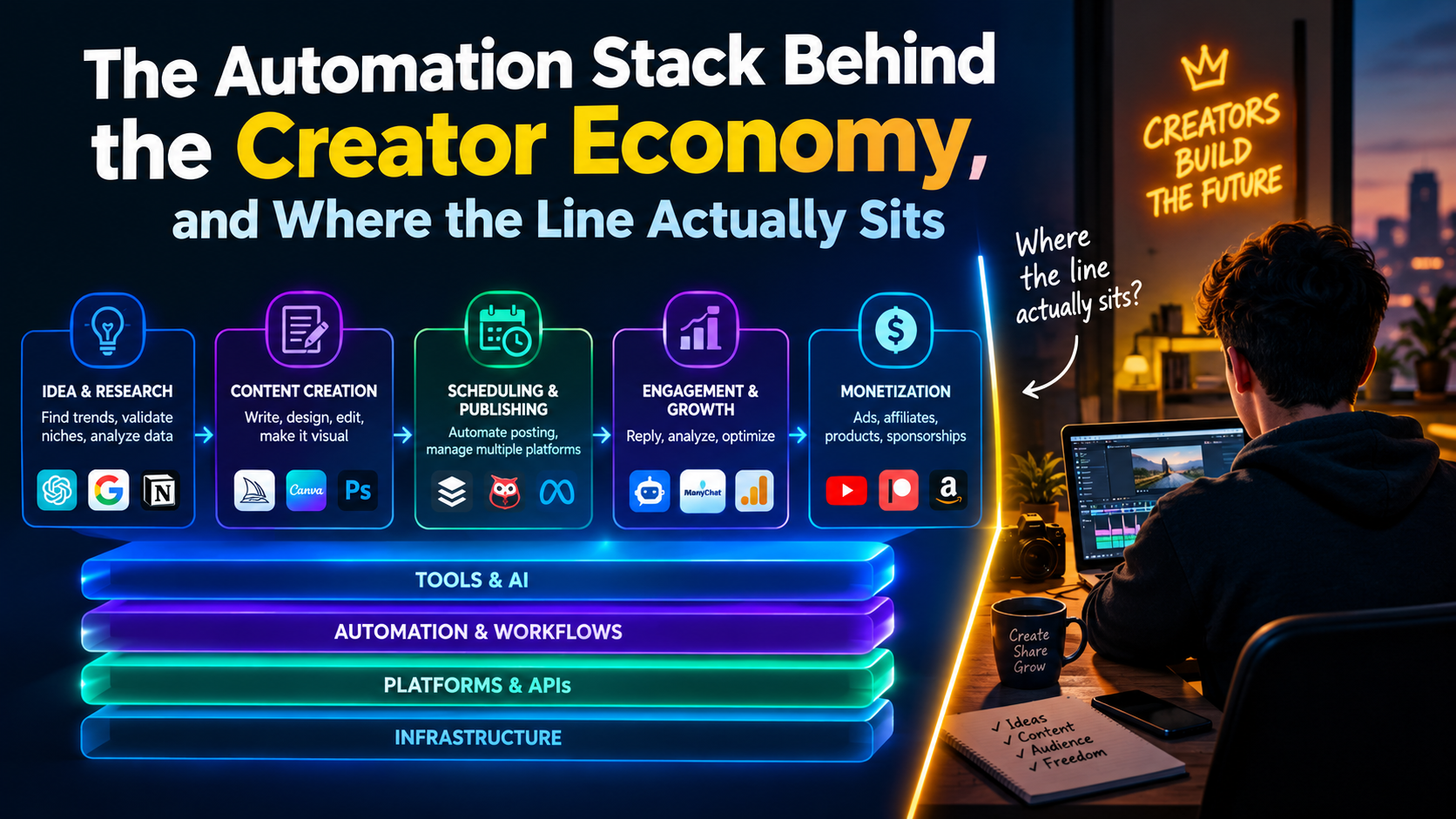
A full-time streamer or video creator today is running a small media operation with one member of staff. The output looks like one person talking to a camera. Behind it sits a stack of automated systems doing work that a broadcaster would once have hired a team for, and that stack keeps growing as the tooling gets cheaper.
What interests me is not the tooling itself but the ethics gradient running through it. Some of this automation is uncontroversial. Some of it is explicitly banned. The interesting part is the wide, badly signposted middle, and the question of who gets to decide where the boundary falls.
The uncontroversial layer
Start with the parts nobody argues about.
Scheduling and publishing. Queueing videos, staggering releases across platforms, auto-posting a go-live notice. This is calendar software with an API attached and no one has ever seriously objected to it.
Encoding and delivery. Local encoders, cloud transcoding, automated archiving of past broadcasts. Pure infrastructure.
Clipping. Systems that watch a stream, detect a spike in chat velocity or audio volume, and cut a short vertical clip around it. This replaces the job of a human editor scrubbing through six hours of footage looking for the good bit. It is now standard, and the platforms build their own versions.
AI editing. Automatic silence removal, subtitle generation, punch-in cuts, colour matching, thumbnail variants. Faster than a person and, for routine work, often as good.
Moderation. Automated chat filtering has been part of live streaming since the beginning, and both Twitch and Kick ship first-party tools for it. Nobody thinks a creator should read every message manually before deciding whether it breaches their rules.
Analytics. Dashboards that pull retention curves, chat activity, follower conversion and revenue into one place, sometimes with a language model writing a summary on top.
Everything above shares a property: it automates the creator’s own labour on their own material. That is the cleanest version of the rule, and it holds up well as a first test.
Where it starts getting complicated
Now the middle.
Automated engagement in other people’s spaces. Tools that post on a creator’s behalf in Discord servers, subreddits or reply threads, timed to catch traffic. The content is theirs, but the labour being simulated is participation in a community, and communities have their own expectations about whether a human is present.
Synthetic presence. AI co-hosts, generated voices reading donations, avatar streams that run without anyone at the desk. Platform policy here has been reactive rather than principled, and disclosure norms are still forming.
Cross-posting at scale. One clip auto-published to six networks with generated captions tuned per platform. Efficient, entirely permitted, and yet it produces the flood of near-identical content that recommendation systems then have to filter.
Purchased amplification. Paid promotion is legitimate and long-established when it runs through an advertising product. It becomes something else when the same effect is bought outside the ad system, through services that manufacture the engagement signals directly.
The gradient is not really about how much technology is involved. It is about who is being deceived, and about whether the automation acts on the creator’s own work or on the platform’s measurement of an audience.
Follower growth is where the line is clearest
Follower-count automation is the point at which the ambiguity mostly disappears, and it is worth spelling out why.
Follower counts are not decorative. They feed recommendation systems, they gate partner and affiliate programmes, they influence how a directory ranks a channel, and they are the number brands look at when pricing a sponsorship. A follower is meant to represent a person who opted in and might come back. Manufacture that number and you are not automating your own work, you are corrupting a measurement that other parties rely on when making decisions.
The mechanics are straightforward. Accounts are created or acquired in bulk, distributed across a pool of residential or mobile IP addresses so they do not cluster obviously, and instructed to follow a target channel on a drip schedule designed to resemble organic growth. The market has settled into a recognisable shape, with a typical twitch follow bot competing on how plausible the account histories look and how gradually the followers can be delivered rather than on raw volume.
This is unambiguously against Twitch’s terms of service, and against Kick’s, and channels caught doing it risk suspension or permanent removal. That is not a caveat buried in a subclause; it is one of the few things every major platform has been consistent about since the beginning. Anyone weighing the tactic up should treat the risk to the account as real rather than notional.
The pull is easy to understand, and worth stating honestly rather than moralising about. Discovery on live platforms is close to winner-takes-most. A channel with forty followers surfaces to almost nobody, and the recommendation systems reward channels that already look established, which creates a genuine cold start problem. A large share of new streamers hit it, conclude that the system is rigged against them, and start looking for a lever. That is the demand this market serves.
The trouble is that the lever moves the wrong number. Inflated followers do not watch. Retention, chat rate and average view duration stay flat or drop, and those are increasingly the signals recommendation systems weight, because they are the ones that are hardest to fake convincingly at scale. The result is a channel that looks bigger and performs worse against the metrics that decide whether it gets shown to anyone.
Who actually draws the line
There is no external regulator here. The rules come from three sources, and they do not agree with each other.
The platforms, through terms of service and enforcement. Their authority is unambiguous and their reasoning is commercial: fake engagement corrupts the ad inventory and the recommendation systems that keep real users watching. Their enforcement is inconsistent, opaque and occasionally catches innocent channels, which does real damage to the legitimacy of the rule.
Advertisers and agencies, through their own verification. This is now the harder constraint for anyone at a professional level. Brands run audience quality checks, and a channel with a follower count that does not match its engagement gets quietly dropped from consideration rather than confronted.
The creator community itself, through norms. This is weaker than the other two and moves faster. Clipping bots were once regarded as cheating and are now standard. AI voice-overs are somewhere mid-argument. Norms tend to follow whichever way the tooling has already gone.
Notice that the technology itself never draws the line, and the pace of tooling means the line is always being redrawn behind the practice.
A test that survives the next tool
Given all of that, here is the working test I would offer anyone assembling a stack, and it is deliberately not about technology.
Does the automation act on your own work, or on someone else’s perception of your audience? Editing your footage, scheduling your posts, filtering your chat: your work. Manufacturing followers, viewers or watch time: someone else’s perception.
Would you be comfortable if the automation were visible on your channel page? Not everyone needs to know your editing pipeline, but there is a clear difference between a tool you would happily explain in a stream and one you would need to hide from your own audience.
Does it break if everyone does it? Clipping tools scale fine. Engagement inflation does not; it just resets the baseline and makes the next creator’s cold start worse.
The stack will keep growing. Most of what arrives next will be genuinely useful, and the same test will keep working, because it was never really about the automation.