Persistent humidity is rarely limited to one uncomfortable afternoon. In basements, laundry rooms, garages, storage areas and open living spaces, moisture can return every day through outdoor air, wet materials, cooking, washing and normal household activity. The practical goal is not simply to remove water once. It is to keep relative humidity within a stable range without demanding constant attention.
That is where an energy efficient dehumidifier can make a meaningful difference. A properly sized unit can bring humidity down after a wet period, then cycle as needed to maintain the selected target. This approach is more useful for a large home than relying on a compact machine that must run continuously at its limit.
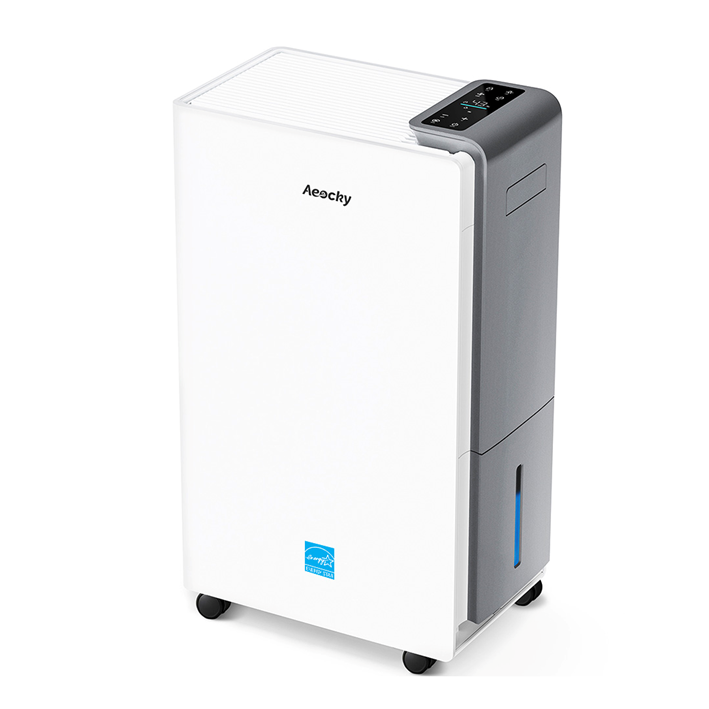
The AEOCKY RHEA-001 is designed for sustained humidity control in larger residential spaces.
Start With Moisture Load, Not Square Footage Alone
Coverage figures are useful, but they are only a starting point. A 1,000-square-foot basement with recurring seepage can be harder to manage than a much larger room with moderate seasonal humidity. Ceiling height, air leakage, temperature, room layout and the source of moisture all influence how quickly dampness returns.
The AEOCKY RHEA-001 is rated to remove up to 80 pints of moisture per day and cover spaces up to 5,500 square feet. That capacity positions the model for larger basements, connected rooms, garages, storage areas and utility spaces where a small bedroom unit may not provide enough headroom. In any installation, active leaks and standing water should be repaired first; a dehumidifier manages water vapor in the air rather than replacing drainage or building repairs.
Automatic Control Reduces Daily Adjustments
A large-space dehumidifier becomes more practical when it can maintain a target automatically. The RHEA-001 allows users to select relative humidity from 40% to 80% in 5% increments. Its humidity sensor responds as room conditions change, while the front indicator offers a quick visual reference without requiring repeated checks.
Five operating modes support different household routines: automatic, constant, continuous, smart drying and sleep. Auto restart and power-loss memory are useful in utility rooms and basements, where an unnoticed outage could otherwise leave the machine inactive. Automatic defrost also helps the system continue operating when cooler conditions encourage frost to form on the coils.
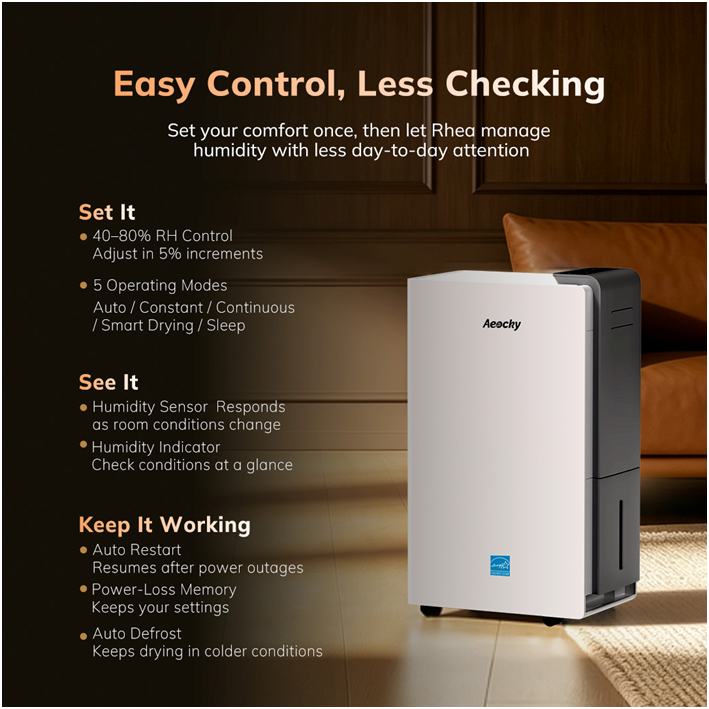
Adjustable humidity targets, five operating modes and automatic restart reduce routine monitoring.
Drainage Planning Determines How Convenient the System Feels
The amount of water removed from a damp room can surprise first-time users. A removable tank works well for occasional use, but regular emptying becomes inconvenient when the machine operates for long periods. The RHEA-001 includes a 1.45-gallon tank and supports continuous gravity drainage through its supplied 6.6-foot dehumidifier drain hose. A compatible garden-hose connection provides another option for longer routes.
Gravity drainage requires a continuous downward path to an outlet below the drain port. Kinks, upward loops and long flat sections can interrupt water flow. Before choosing the final position, homeowners should consider both airflow and the route to a floor drain, sink or other suitable outlet. Where gravity drainage is not possible, the internal tank remains the straightforward option.
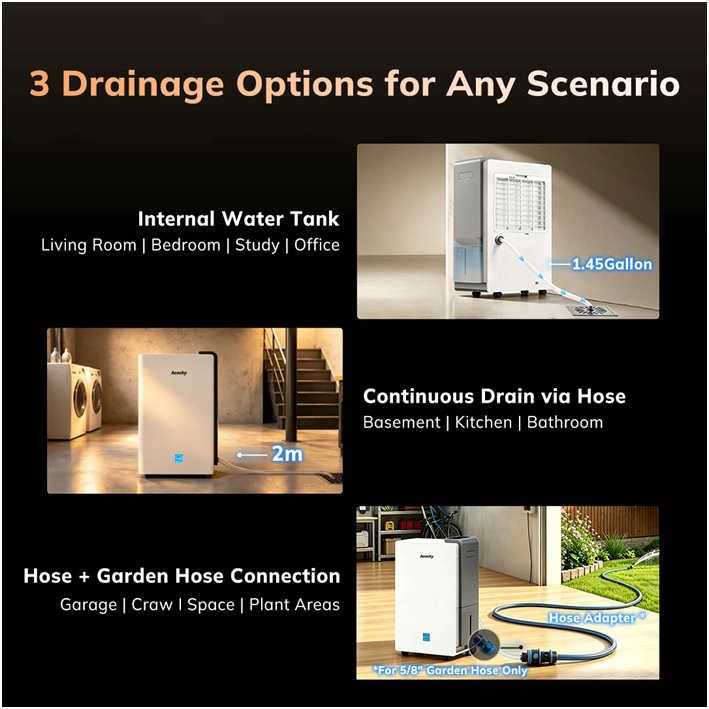
Tank collection and continuous gravity drainage give households flexibility when planning long-term operation.
Efficiency Depends on the Room as Well as the Machine
The RHEA-001 carries the ENERGY STAR Most Efficient 2025 designation. The recognition identifies models that meet elevated efficiency criteria within their product category, but real-world electricity use still depends on moisture load, temperature, set point and runtime. A machine in a very wet basement will naturally work harder than the same unit maintaining a room after the initial drying period.
Several habits help an ENERGY STAR dehumidifier work more effectively: close exterior doors and windows, keep the air filter clean, avoid blocking the intake or outlet, correct obvious water intrusion and select a realistic humidity target. For many occupied spaces, a moderate target is more practical than trying to make the air as dry as possible. Once the target is reached, automatic cycling can reduce unnecessary runtime while maintaining comfort.
Where a Large House Dehumidifier Fits Best
· Basements with seasonal humidity, condensation, musty odors or stored belongings.
· Laundry and utility rooms where washing, drying and plumbing add moisture.
· Garages and workshops where humid air can affect tools, boxes and equipment.
· Large open living areas or connected rooms that exceed the practical reach of a compact unit.
A smaller room with only occasional moisture may be better served by a compact model. The best choice is the one that matches the actual moisture source, room arrangement and drainage plan rather than the largest specification on the shelf.
A Product Built Around Long Term Humidity Management
AEOCKY has developed the RHEA series around sustained household humidity control. The brand was ranked the No.1 dehumidifier brand on Amazon U.S. for the full 2025 sales year, based on Stackline’s comprehensive Amazon U.S. retail modeled sales data. This is a brand-level sales ranking and provides context for AEOCKY’s continued investment in larger-capacity residential systems.
For households comparing a whole house dehumidifier for large open areas, the RHEA-001 combines up to 80-pint daily moisture removal, coverage up to 5,500 square feet, automatic humidity management, flexible gravity drainage and ENERGY STAR Most Efficient 2025 recognition. Its strongest use case is not occasional spot drying, but steady control in spaces where moisture repeatedly returns.
Product details: AEOCKY RHEA-001 official product page
Current availability: AEOCKY RHEA-001 on Amazon