
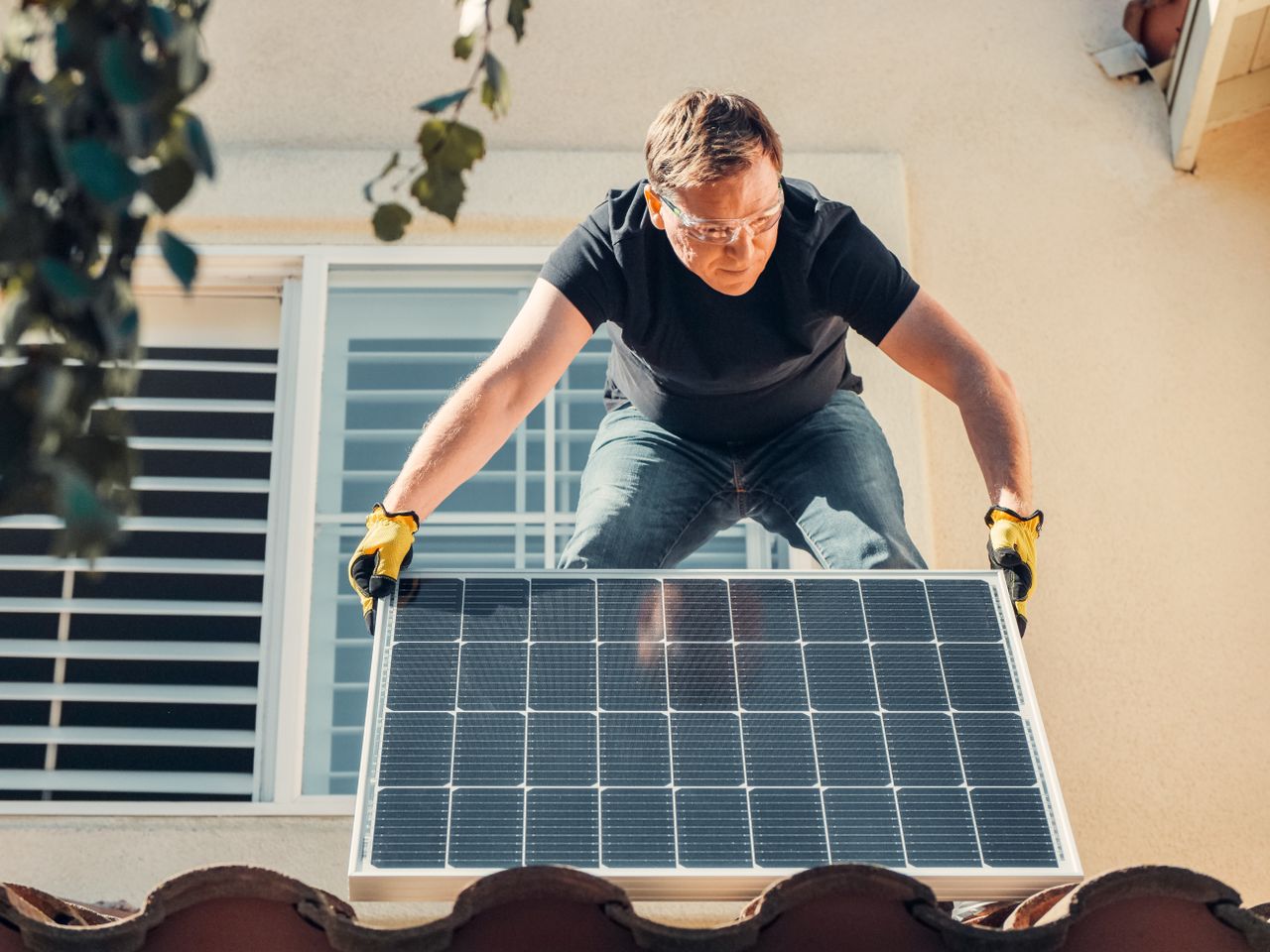
Residential solar is one of the last large consumer purchases that almost nobody buys the way they buy everything else. You do not browse it, compare it and check out. You book a survey, wait for a quote, and hope the number is fair.
That is starting to loosen. Hardware is more standardised than it was, smaller systems are appearing at the bottom of the market, and buyers who research everything online are no longer willing to start the
process by letting a salesperson into the house.
Why has residential solar always been sold through installers?
Because for most of its history solar was a construction job wearing a product’s clothes. Every roof is different, every consumer unit is different, and the work needs a qualified electrician. The installer held the survey, the design, the pricing and the warranty, so the installer held the customer.
That made sense while panels, inverters and mounting systems varied widely between suppliers. A homeowner could not meaningfully compare two quotes, because the two quotes were not describing the same thing. Different panel count, different inverter topology, different approach to roof fixing. The only way to decide was to trust a person.
The consequence is a channel built on relationships and site visits rather than information. It also attracted door-to-door selling, which did long-term damage to how the category is perceived. Plenty of good installers are still cleaning up after conversations their customers had on a doorstep years earlier.
What does installer-led selling do to the price a homeowner pays?
It loads a significant share of the cost onto getting the customer rather than onto the equipment. Surveys, quotes that never convert, commission, lead fees and the sheer time between first contact and signature all sit inside the final price, whatever the panels themselves cost.
This is the part people outside the industry underestimate. Where a visit is required to produce a quote, every unconverted visit has to be paid for by someone who does convert. The longer and more manual the sales process, the more of the price is sales process.
Three things follow from that:
- Price is hard to compare, because what is being priced includes acquisition cost that varies enormously between firms.
- Smaller, cheaper systems are often uneconomic to sell, because the cost of selling them does not shrink in proportion.
- Moving specification and comparison earlier, before anyone is dispatched, takes cost out of the channel rather than out of the installer’s margin.
None of this means installers are overcharging. It means the channel itself is expensive, and that is a different problem.
What changes when the hardware becomes standardised?
Standardisation turns a bespoke design into a configuration. When panels share common physical formats, when inverters and batteries speak common protocols, and when mounting systems are designed for repeatable roof types, a system can be specified from data rather than from a visit.
That is the quiet precondition for direct-to-consumer solar. You cannot sell a product online that cannot be described online. Once a panel is a product with a datasheet rather than a component in a one-off design, it can carry a specification, a price and a comparison the way any other considered purchase does.
The solar supply chain has shifted in the same direction. Module manufacturing consolidated around a smaller number of formats and cell technologies, which means distributors and resellers are handling fewer genuinely incompatible variants than they once were. Inverter and battery vendors increasingly publish compatibility matrices rather than requiring a designer to work it out.
What has not standardised is the roof. Orientation, pitch, shading, structural condition and the state of the existing electrics are all specific to the property, and no configurator fixes that. Standardisation moves the uncertainty rather than removing it.
Do balcony and plug-in systems really open a direct channel?
They open part of one. Small plug-in arrays, often mounted on balconies or walls, are genuinely product-like. They ship in a box, they are installed by the buyer in some markets, and they behave much more like consumer electronics than like a roof project.
This is where the clearest version of buying solar online already exists. The product has a wattage, a size, a price and a delivery date. There is no survey. For a household in a flat or a rented property, it is often the only form of generation available to them at all.
The regulatory position is the important caveat, and it differs a great deal by country, and within the UK by region and network operator. Some markets allow small plug-in generation with simplified notification. Others treat any grid-connected generation as work requiring a qualified electrician and formal notification. Rules change, and they are not uniform.
The honest summary is that these systems have lowered the installation barrier in some places and not in others, and anyone selling them has to be specific about which rules apply where the customer lives rather than generalising from another market.
Why is home battery storage the product that shifts household economics?
Because generation alone only pays when the household is using power at the moment the sun is producing it. Home battery storage decouples those two things, and it also lets a household respond to time-of-use tariffs. That changes the shape of the proposition rather than just its size.
It also changes who the customer is. A battery is relevant to households that already have panels, a group reachable without any roof work at all. That is a retrofit market, and retrofit markets are easier to sell into directly because the hardest part, the original installation decision, has already been made.
Batteries carry their own complications. They are heavy, they have siting requirements, they interact with the existing inverter, and their warranty terms are more complex than a panel’s. But the specification is closer to a product specification. Capacity, usable capacity, power rating, cycle warranty and compatibility can all be published and compared before anyone visits.
Whether a battery makes financial sense in a given household depends entirely on that household’s consumption pattern, tariff and existing system. That is a question for a qualified assessor, not for a product page.
What actually stops people from buying solar online?
Four things, and none of them are solved by better web design. Finance has to be available at the point of decision. Warranty has to be clear across several manufacturers. Installation has to be scheduled, not just promised. And nobody impulse-buys work that is attached to their roof.
Finance is the largest of these. A system is a capital purchase, and the decision is frequently a decision about monthly cost rather than about total cost. If the finance conversation happens after the product conversation, as it usually does in a checkout flow, the buyer stalls.
Warranty is the second. An installation involves a panel warranty, an inverter warranty, a battery warranty and a workmanship warranty, often from four parties. Buyers reasonably want to know who they call when something stops working. In the installer-led channel the answer is obvious. In a direct channel it has to be constructed and stated.
Scheduling is the third and it is badly underrated. An ecommerce checkout that cannot tell a customer when the work happens is not a checkout, it is an enquiry form with extra steps. The install date is the delivery date.
And the fourth is simply duration. This is a considered purchase with a long research period and a household decision behind it. Sessions are measured in weeks, not minutes, which means the experience has to support returning, saving and sharing rather than converting on first visit.
What does a credible online solar buying experience need?
Clear specification data, output estimates that are honest about their assumptions, total cost shown without obligation, and finance presented at the point of decision rather than after it. Everything else is secondary. The job is to let a careful buyer get far enough to know whether to proceed.
In practice that means a few concrete things:
- Full datasheets, not marketing summaries. People spending this much read the specification.
- Output estimates presented as ranges with their inputs visible, labelled as estimates, and paired with the statement that actual output depends on the property.
- Total installed cost, including what commonly gets added later, such as scaffolding or consumer unit work.
- A real availability signal for installation, even if it is a lead time rather than a date.
- A single named route for warranty and support.
- Saved configurations and emailed quotes, because this decision gets discussed at home.
The underlying principle applies across high-consideration retail generally. Do not use the website to close the sale. Use it to remove every reason the customer cannot make a decision, and let the site visit confirm rather than discover.
Where does the channel go next?
Most likely towards a split. Small, standardised products will be sold directly and shipped like any other hardware. Large roof systems will keep a qualified survey in the middle, but the specification, comparison and finance will move online ahead of it, which shrinks the expensive part of the process.
The firms that handle this well will not look like traditional installers or like pure retailers. They will look like product companies with an installation network attached, a model consumer appliances have used for a long time.
The solar supply chain will keep pushing in the same direction, because standardised components are cheaper to stock and easier to describe. And direct-to-consumer solar will keep growing at the small end first, because that is where the regulatory and installation friction is lowest.
Key takeaways
- The installer-led channel is expensive because acquisition cost, not hardware cost, drives much of what a homeowner pays.
- Component standardisation makes online specification possible, because a product that cannot be described cannot be sold remotely.
- Balcony and plug-in systems are the clearest existing case of solar sold as a product, subject to rules that vary by country and region.
- A battery is easier to sell directly than a full roof system, because it reaches households that have already made the harder decision.
- Finance, warranty clarity and installation scheduling matter more to online conversion than anything on the product page.
FAQ
Can a homeowner install solar themselves?
It depends entirely on the system and the jurisdiction. Small plug-in units are designed for buyer installation in some markets and are not permitted in others. Anything that involves the consumer unit, roof fixings or grid notification requires a qualified electrician and the correct paperwork. The rules vary by country and by network operator, so check locally before buying anything.
How accurate are online solar output estimates?
They are useful for narrowing options and unreliable as a prediction for a specific house. Online tools work from location, roof orientation and pitch, but they cannot see shading, roof condition or how the household actually uses electricity. Treat them as a filter rather than a forecast, and get a site-specific assessment before committing to anything.
Is it cheaper to buy solar components separately?
Sometimes on paper, rarely in practice. Buying separately shifts compatibility checking, warranty coordination and installation sourcing onto the buyer, and installers are often reluctant to fit hardware they did not supply. It can work for experienced buyers adding to an existing system. For a first installation, the coordination cost usually outweighs the component saving.
Does adding a battery later cost more than buying one upfront?
Often, though not always. Retrofitting may require additional electrical work or a different inverter arrangement depending on the original installation. Some systems are specified to accept a battery later at low cost. Whether that applies to a particular property depends on the existing equipment, so it is worth asking the question at the original installation stage.
Solar is following the path of other high-value considered purchases. The research, specification and financing move online first, and the physical work stays physical. The brands that do well will treat the website as the place where the decision becomes possible, not the place where it is closed. None of this replaces a qualified, site-specific assessment, and any claim about what a particular roof will produce deserves caution until somebody has looked at it.
About the author
This piece was written by the ecommerce team at TheGenieLab, a UK-based Shopify Plus partner trading since 2011 and working with brands between $2M and $50M GMV across the UK, US and Australia. More of their writing on high-consideration online retail is at TheGenieLab.
READ ALSO: Investment Tax Credit for Commercial Solar: A Building Owner’s Walkthrough From Install to Filing