Technology leaders are expected to control costs, maintain reliable services, strengthen cybersecurity and support business innovation while managing increasingly complex technology environments. Measuring IT Performance helps organizations understand whether technology resources, processes and investments are delivering the expected operational and business outcomes. Generative AI in IT is creating new opportunities to improve that performance by automating knowledge-intensive work, accelerating software development and improving technology service delivery.
The opportunity extends beyond individual productivity tools. When generative AI is integrated with IT service management, development environments, enterprise knowledge and operational workflows, organizations can redesign how technology work is performed.
This article explores how Generative AI in IT can strengthen IT Performance, the metrics organizations should consider, key applications, business benefits and priorities for building intelligent technology operations.
What is Generative AI in IT?
Generative AI in IT refers to the application of generative artificial intelligence across technology processes, services and workflows. These capabilities can understand and generate natural language, software code, technical documentation and other forms of technology content.
IT professionals can use generative AI to summarize incidents, create code, retrieve technical knowledge, prepare documentation and support troubleshooting.
Unlike traditional automation, which generally follows predefined rules, Generative AI in IT can assist with activities that require interpretation, synthesis and contextual understanding. This expands the range of technology work that can be augmented by AI.
What is IT Performance?
IT Performance refers to how effectively a technology organization delivers services, manages resources and supports enterprise priorities. It can be evaluated across cost, productivity, service quality, reliability, security, project delivery and business value.
Traditional technology measurement often emphasizes operational measures such as uptime, ticket volumes or infrastructure utilization. These remain important but provide only part of the performance picture.
A broader approach considers whether IT is operating efficiently while enabling business productivity, transformation and innovation.
Why IT Performance matters
Technology now supports nearly every major business process. Poor IT Performance can affect employee productivity, customer experience, operational continuity and the organization’s ability to execute strategic initiatives.
Performance measurement helps technology leaders understand where resources are being consumed, where service gaps exist and which investments require greater attention.
For example, IT costs may remain stable while application complexity increases or service resolution slows. Similarly, high system availability does not necessarily mean technology investments are creating sufficient business value.
Organizations therefore need a balanced set of measures that connects operational performance with broader enterprise outcomes.
How Generative AI in IT can improve performance
Technology professionals frequently spend significant time searching for information, documenting issues, handling repetitive service requests and completing routine development activities.
Generative AI in IT can reduce this workload by summarizing technical information, retrieving relevant knowledge and assisting with code and documentation.
This can release capacity for higher-value activities such as architecture, cybersecurity, modernization and business engagement.
Generative AI can also help technology leaders interpret operational information more efficiently, making it easier to identify performance issues and understand potential causes.
Key metrics for measuring IT Performance
Organizations should select metrics according to their technology strategy and operating model. Several categories can provide a balanced view.
IT cost
Measures such as technology cost as a percentage of revenue or cost per user can help leaders understand overall resource efficiency.
IT productivity
Workload, staffing and automation measures can show how effectively technology resources support business demand.
Service performance
Incident resolution time, service availability and service-level achievement can provide insight into the quality of technology services.
Application performance
Organizations can evaluate application reliability, maintenance requirements and technical complexity to identify modernization opportunities.
Cybersecurity performance
Measures related to incident response, vulnerabilities and security operations can help leaders understand technology risk.
Project and delivery performance
Delivery cycle time, project outcomes and development productivity can show how effectively IT converts investment into new business capabilities.
Together, these measures provide a more comprehensive view of IT Performance.
Key use cases of Generative AI in IT
Organizations can apply generative AI across multiple technology functions.
IT service management
Generative AI can summarize service tickets, categorize incidents, retrieve relevant knowledge and recommend potential resolutions. This can reduce investigation time and improve service productivity.
Software development
AI can assist developers with code generation, testing, debugging and documentation, potentially reducing time spent on repetitive development work.
Knowledge management
Generative AI can summarize technical documentation, create knowledge articles and improve enterprise search capabilities.
Infrastructure operations
AI can synthesize infrastructure information and help technology teams understand complex operational issues more quickly.
Cybersecurity
Generative AI can summarize security alerts, explain threat information and support investigations while security specialists retain accountability for critical decisions.
IT reporting
AI can consolidate operational information and create performance summaries for technology leaders and business stakeholders.
These applications demonstrate how Generative AI in IT can influence multiple dimensions of technology performance.
Business benefits of Generative AI in IT
When connected with clearly defined technology priorities, generative AI can create several benefits.
Greater technology productivity
AI can reduce time spent on documentation, information retrieval, coding and routine service activities.
Faster incident resolution
Intelligent knowledge retrieval and incident summarization can help IT professionals diagnose and address technology issues more efficiently.
Accelerated software delivery
Generative AI can support coding, testing and documentation, helping development teams increase capacity and shorten delivery cycles.
Improved knowledge accessibility
Conversational interfaces can make technical information easier for employees to find and understand.
Greater scalability
AI-enabled workflows can help technology organizations manage increasing service and development workloads without equivalent growth in manual effort.
How Generative AI strengthens IT Performance management
Traditional IT reporting is largely retrospective. Dashboards and operational reports explain what has already occurred, but technology leaders also need to identify emerging issues before they affect business operations.
Generative AI in IT can help summarize operational information, highlight unusual patterns and explain performance changes in accessible language.
For example, AI could consolidate information related to recurring incidents and help specialists identify common themes. It could also summarize application or service trends for technology leaders.
When combined with predictive analytics, this creates an opportunity to move IT Performance management from periodic reporting toward more proactive decision support.
Best practices for implementing Generative AI in IT
Organizations should connect generative AI investments with specific technology performance objectives.
- Establish current IT Performance baselines before implementation.
- Identify repetitive and knowledge-intensive technology activities where AI can create value.
- Improve the quality and governance of technical documentation and operational data.
- Prioritize use cases based on value, feasibility, risk and time to value.
- Integrate AI into ITSM, development and operational workflows.
- Establish strong cybersecurity and data-access controls.
- Maintain human accountability for production changes, security decisions and other high-risk activities.
- Prepare technology professionals to validate AI-generated outputs.
- Measure whether AI improves productivity, service performance, delivery speed and operating costs.
This approach helps organizations move beyond experimentation toward measurable technology improvement.
Common implementation challenges
Technical information is often fragmented across service management tools, documentation repositories, development platforms and infrastructure systems. Poor-quality or outdated information can reduce the usefulness of AI-generated responses.
Cybersecurity is another major consideration. Generative AI in IT may interact with source code, system configurations and other sensitive enterprise information, making identity and access controls essential.
Legacy architecture can create additional integration challenges.
Employee trust also matters. Technology professionals need to understand how AI-generated recommendations are produced and when specialist expertise should override or validate an output.
Measuring the value of Generative AI in IT
Generative AI should be evaluated according to its effect on IT Performance rather than tool adoption alone.
Relevant measures can include developer productivity, incident resolution time, cost per service request, software delivery cycle time, automation rates and employee time saved.
For example, an AI coding assistant should be evaluated based on whether it improves development capacity and delivery performance, not simply how frequently developers use it.
Similarly, an AI knowledge assistant should demonstrate improvements in information retrieval or issue resolution.
Performance baselines enable technology leaders to determine whether AI investments are creating meaningful value.
The future of IT Performance
The next phase of Generative AI in IT will increasingly involve AI agents capable of coordinating activities across technology environments.
An agent could identify an incident, retrieve relevant documentation, recommend an action, initiate an authorized workflow and verify whether the issue has been resolved. Other agents could support development, infrastructure or cybersecurity processes.
This could change IT Performance by shifting more technology work from manual execution toward intelligent orchestration.
As these capabilities mature, technology leaders will need to update performance measures to reflect not only employee productivity but also how effectively people and AI systems work together.
Conclusion
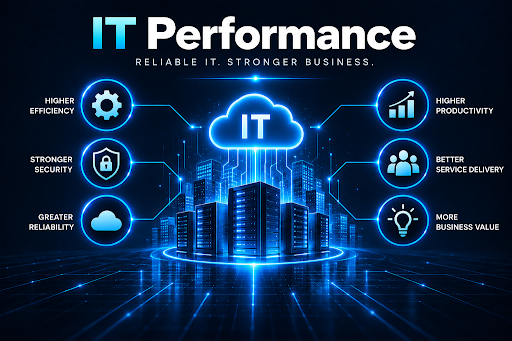
IT Performance provides leaders with a structured way to understand whether technology operations are efficient, reliable and aligned with enterprise priorities. Generative AI in IT creates new opportunities to strengthen that performance by automating knowledge work, accelerating development and improving technology service delivery.
Organizations that connect generative AI with clear performance measures, reliable technology data and effective governance will be better positioned to create sustainable value. The long-term opportunity is to build an intelligent IT organization that delivers stronger productivity, service quality and business performance.