Spine-Leaf Architecture and AI Network Connectivity
Spine-leaf architecture has become the standard design model for modern data centers, especially in environments supporting cloud computing, virtualization, and AI workloads. It offers predictable latency, high bandwidth, and simplified scalability. For AI Token-based platforms, this network structure is especially valuable because token requests may need to move quickly between API gateways, inference servers, GPU clusters, storage systems, and monitoring platforms. Stable east-west traffic performance helps improve response consistency when large volumes of AI tokens are processed across multiple models.
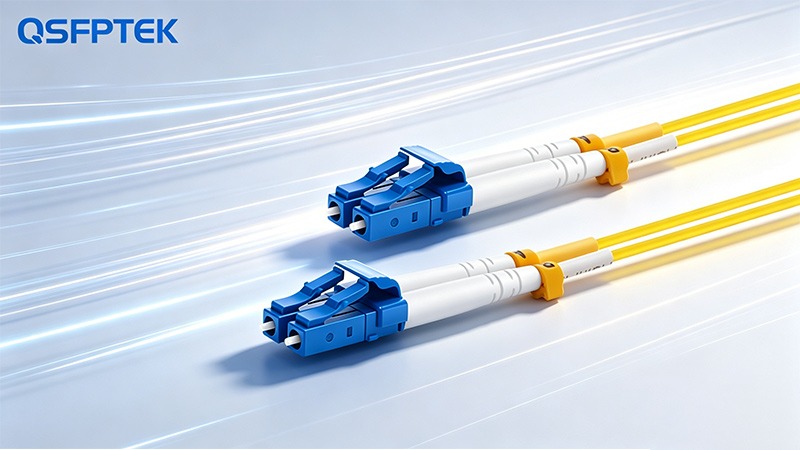
While much of the attention in these networks is focused on high-speed links such as 100G, 400G, and beyond, LC duplex OS2 patch cords still play a critical and often underappreciated role in the overall design. They are commonly used for single-mode fiber connections between switches, patch panels, and optical transceivers, helping maintain clean and reliable signal transmission. In AI data centers, even small connectivity issues can affect model access, token routing, and service availability, so high-quality OS2 patch cords remain an important foundation for scalable AI infrastructure.
Spine-Leaf Is Not Only High-Speed Links
In theory, spine-leaf architectures are designed for high-throughput interconnects between leaf and spine switches. These links often use high-speed optics such as 100G or 400G over single-mode fiber, typically based on OS2 infrastructure.
However, not every connection in the data center operates at these speeds. Supporting systems such as management networks, out-of-band (OOB) access, storage monitoring, and infrastructure services still require reliable lower-speed connectivity. This is where LC duplex OS2 patch cords remain highly relevant.
OS2 in Leaf-Level and Access Connections
LC duplex OS2 patch cords are most commonly used in leaf-to-endpoint or leaf-to-supporting-device connections where single-mode fiber is required but ultra-high bandwidth is not necessary.
For example, management switches, firewall appliances, and storage controllers often connect using 1G or 10G links over OS2 fiber. These connections benefit from the same single-mode infrastructure used in higher-speed spine-leaf interconnects, ensuring consistency across the physical layer.
This approach simplifies cabling design. Instead of maintaining separate multimode and single-mode systems, many modern data centers standardize on OS2 fiber throughout the entire infrastructure. LC duplex patch cords then become the universal interface at the edge.
Why OS2 Is Used Even in Mixed-Speed Environments
One of the key advantages of OS2 fiber is its long-distance capability and low attenuation. In spine-leaf architectures, this becomes important not only for spine-to-leaf connections but also for inter-row or cross-zone links within large facilities.
LC OS2 patch cords provide flexibility in environments where distances vary. Whether connecting devices within the same rack or across multiple rows, OS2 ensures consistent optical performance without redesigning the physical layer.
Another reason OS2 remains widely used is future scalability. Even if current endpoints operate at 10G or 25G, the same fiber plant can support upgrades to 100G or higher speeds without replacing the underlying cabling infrastructure. This makes LC duplex OS2 a long-term investment rather than a short-term solution.
Separation of Roles in Spine-Leaf Design
In a typical spine-leaf architecture, it is useful to divide the network into layers based on function:
Spine-to-leaf links: High-speed single-mode connections (100G/400G)
Leaf-to-server links: Mix of speeds depending on workload
Leaf-to-management or auxiliary systems: Often 1G/10G over OS2
Infrastructure services: Monitoring, control, and storage networks
LC duplex OS2 patch cords are most commonly found in the second and third categories. They provide reliable connectivity without introducing unnecessary complexity or cost.
Operational Simplicity and Standardization
From an operational perspective, using OS2 throughout the data center reduces complexity. Technicians do not need to manage separate multimode and single-mode fiber inventories. Instead, a consistent LC duplex OS2 ecosystem simplifies installation, troubleshooting, and spare-part management.
This is particularly important in large-scale deployments where hundreds or thousands of fiber links must be maintained. Standardization reduces human error and improves overall network reliability.
Conclusion
While spine-leaf architectures are often associated with high-speed optical technologies, the reality of data center design is more layered. LC duplex OS2 patch cords play a foundational role in supporting not only high-speed interconnects but also the essential lower-speed and management networks that keep the entire system operational.