Australia has some of the highest UV radiation levels in the world, and your car’s interior absorbs that radiation every single day, through the glass, at every red light, on every commute. The damage is slow and invisible at first, then suddenly obvious: a cracked dashboard, leather that splits along the seams, fabric seats that look washed out, door trims that have gone from deep black to a chalky grey.
None of this is wear and tear in the conventional sense. It is photodegradation, the systematic breakdown of materials caused by ultraviolet radiation and it is entirely preventable with the right window film.
What UV Radiation Actually Does to Your Car Interior
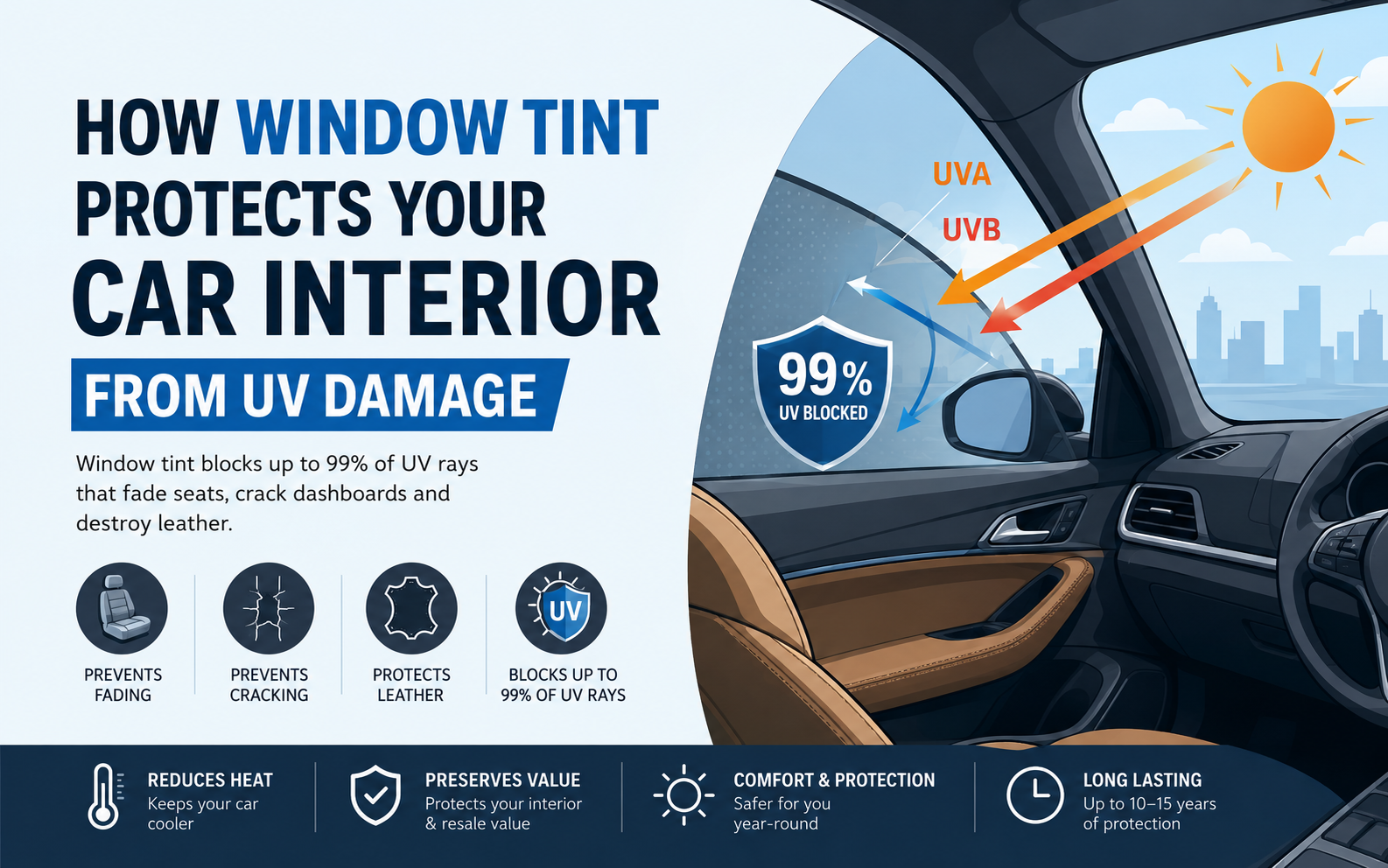
Sunlight contains UVA and UVB radiation. UVB causes the acute surface damage you feel on your skin, but UVA penetrates deeper into materials and is responsible for the majority of interior fading and structural breakdown. Standard automotive glass blocks most UVB, but side windows allow UVA to pass through with very little resistance.
When UVA reaches the materials inside your car, it attacks at the molecular level. The radiation breaks chemical bonds within polymers, dyes, and organic compounds. This is not surface fading that can be polished away. It is internal degradation that changes the physical properties of the material itself.
Leather loses the oils and flexibility that keep it supple. Without those properties, it dries, stiffens, and eventually cracks. The pigments within the leather break down unevenly, so the areas that receive the most direct sunlight bleach out while shaded areas retain their original colour, creating a mottled, aged appearance that no conditioning product can fully reverse.
Fabric upholstery responds similarly. The fibres weaken under UV exposure, making them more susceptible to tearing and fraying. The dyes that give fabric its colour degrade under radiation, resulting in uneven discolouration across the seat surface depending on which sections receive the most sun.
Dashboard plastics and vinyl contain polymers that break down under UV bombardment. As the polymer chains fracture, the material loses its structural integrity. It becomes brittle, shrinks slightly, and eventually cracks or warps under the thermal stress that accompanies UV exposure. Once a dashboard reaches this stage, the damage cannot be repaired without full replacement.
Door trims, steering wheel coverings, centre consoles, and headliners all follow the same degradation path. Even electronics and display screens inside the cabin are affected, with prolonged solar radiation causing fading in instrument panels and accelerating the deterioration of adhesives that hold trim components in place.
How Window Tint Blocks UV Radiation
Window tint film works by incorporating UV absorbers and reflectors within its layer structure. These materials intercept incoming ultraviolet radiation and either absorb it and convert it to a negligible amount of heat, or reflect it away from the glass before it can penetrate into the cabin.
Quality window films can block up to 99% of both UVA and UVB radiation. The mechanism is independent of how dark the film appears — this is a point that confuses most car owners. A clear or very lightly shaded ceramic film can block 99% of UV radiation while still transmitting most visible light. Visible light transmission (VLT) and UV rejection are separate properties governed by different components within the film.
This matters practically because it means you can have near-complete UV protection on front side windows while staying within NSW’s legal VLT requirements of 35% minimum. The protective benefit does not require a dark film. It requires the right film technology.
The Different Tint Film Technologies and Their UV Performance
Dyed films are the entry-level option. They reduce glare and provide some privacy, but their UV rejection performance is limited and degrades over time as the dye fades. They are not a serious UV protection product.
Metalised films incorporate metal particles within the film layers that reflect both heat and UV radiation. Their UV rejection is substantially better than dyed films, but the metallic content interferes with GPS, mobile signal, and Bluetooth connectivity — a meaningful drawback for modern vehicles.
Carbon films block heat and UV without the signal interference of metalised products. They provide good UV rejection and durability, do not fade the way dyed films do, and offer a consistent performance profile across their lifespan.
Ceramic films are the highest-performing option available for automotive applications. Using nano-ceramic technology rather than metallic or dye-based materials, ceramic films block over 99% of UVA and UVB radiation with no signal interference. They provide superior heat rejection, do not fade, and maintain their UV protection performance for the life of the film. Ceramic tint is the appropriate choice for Australian conditions where UV intensity is extreme, summers are long, and the cumulative annual UV dose reaching a car’s interior is significantly higher than in most other markets.
For Sydney drivers specifically, ceramic film applied by a professional provides the most complete and lasting protection against the UV damage that degrades interior materials and ultimately reduces the vehicle’s resale value.
What Window Tint Protects and What It Preserves in Dollar Terms
The financial case for window tinting is straightforward when you consider what UV damage costs to remedy rather than prevent.
A cracked or warped dashboard on a mid-range vehicle costs between $500 and $1,500 to replace depending on the make and model. Leather seat restoration or replacement ranges from $800 to $3,000 or more for a full set. Faded interior trim panels are typically replaced rather than restored. These are not hypothetical expenses — they are the actual repair costs that accumulate in vehicles driven in Australian conditions without UV protection.
A quality ceramic tint installation costs a fraction of these remediation costs and provides protection across the entire interior simultaneously. Beyond the cost of repairs, UV damage reduces a vehicle’s resale value because prospective buyers factor interior condition into what they are willing to pay. A car with a cracked dashboard and faded seats will sell for measurably less than a comparable vehicle whose interior has been protected.
The Heat Reduction Component and Why It Matters for Interior Protection
UV radiation and heat are distinct problems, but they work together to accelerate interior deterioration. Window tint addresses both simultaneously.
Without tinting, a car parked in Sydney’s summer sun can reach cabin temperatures of 60 to 80°C within an hour. At these temperatures, plastics warp, adhesives soften and release, and the thermal cycling between extreme heat when parked and cooled temperatures when the air conditioning runs stresses every material in the interior.
Quality window films reject infrared heat, not just UV radiation. This keeps cabin temperatures meaningfully lower during parking and reduces the temperature differential that drives thermal stress. Interior surfaces that are not repeatedly exposed to extreme heat cycles retain their structural integrity longer, age more slowly, and maintain the appearance and feel of newer materials for significantly more years.
Window Tinting and the Role of Professional Detailing
Window tinting prevents UV damage from occurring, but vehicles that have already accumulated some exposure benefit from professional attention to restore the interior before protection is applied.
Bonded contamination, oxidation on exterior surfaces, and degraded protective coatings need to be addressed before applying any new protective product if the product is to bond and perform correctly. This is why car detailing Sydney at Noir Coatings is a natural complement to window film installation — removing what has already degraded and contaminated the surfaces, restoring them to the best condition achievable, and then allowing protective measures including window film to work from a clean foundation.
NSW Tinting Laws and What They Mean for Your Installation
In New South Wales, the legal VLT limits for car window tinting are 35% for front side windows and 20% for rear side and rear windows. The windscreen may only be tinted on the top strip above the AS1 line.
These legal limits do not compromise UV protection when the right film is specified. As covered above, UV rejection is independent of film darkness. A 35% VLT ceramic film provides essentially the same UV rejection as a 20% VLT ceramic film — both can reach 99% UV blockage. The VLT percentage determines how much visible light passes through, not how much UV radiation is blocked.
Professional installation is required to stay within legal VLT limits accurately because the final VLT of the installed film is calculated by multiplying the factory glass VLT by the film VLT. Without precise measurement, it is possible to install a film that places front windows below the legal threshold. A professional installer measures and verifies compliance as part of the installation process.
Professional car window tinting Sydney at Noir Coatings uses high-quality films matched to each vehicle’s factory glass VLT, ensuring full UV protection within NSW legal limits and with results that last rather than peeling, bubbling, or fading prematurely as low-quality film applications typically do.
How Long Window Tint Lasts and What Affects Its Lifespan
A standard dyed film has an effective lifespan of approximately 5 years before its UV protection degrades noticeably. Carbon films perform reliably for longer. High-quality ceramic films are documented to maintain their UV rejection performance for 10 to 15 years with proper care, which means a single installation protects the vehicle through the majority of a typical ownership period.
The factors that most affect tint longevity are film quality, installation quality, and care. Films installed with small bubbles, poor edge adhesion, or contamination under the film will fail earlier. Films cleaned with harsh abrasive products or ammonia-based glass cleaners deteriorate faster. Professional installation with quality film and appropriate aftercare guidance is the starting point for getting the full protective value from the investment.
What to Look for When Choosing Window Tint for UV Protection
When the objective is UV protection for interior preservation, the selection criteria are straightforward:
Verify the UV rejection percentage of the specific film, not the brand’s marketing claims. Films designed for serious UV protection will specify 99% or higher UVA and UVB rejection.
Confirm that the film technology is ceramic or carbon rather than dyed-only. Dyed films do not provide meaningful long-term UV protection.
Ensure the installer measures factory glass VLT and selects the appropriate film to keep the final VLT within NSW legal limits.
Ask about warranty coverage on both the film materials and the installation. Quality installations come with warranties that cover bubbling, peeling, and colour change.
Choose an installer who works with quality film brands and has the experience to handle complex window shapes, curved rear windows and modern frameless glass present challenges that distinguish professional results from amateur ones.
The interior of your car is one of the largest investments in the vehicle after the vehicle itself. In Australian conditions, protecting it from UV radiation is not a cosmetic concern. It is a practical maintenance decision that affects durability, comfort, and resale value across every year the vehicle is on the road.
READ ALSO: The Secret to Estate-Level Curb Appeal: Precision Lawn Care