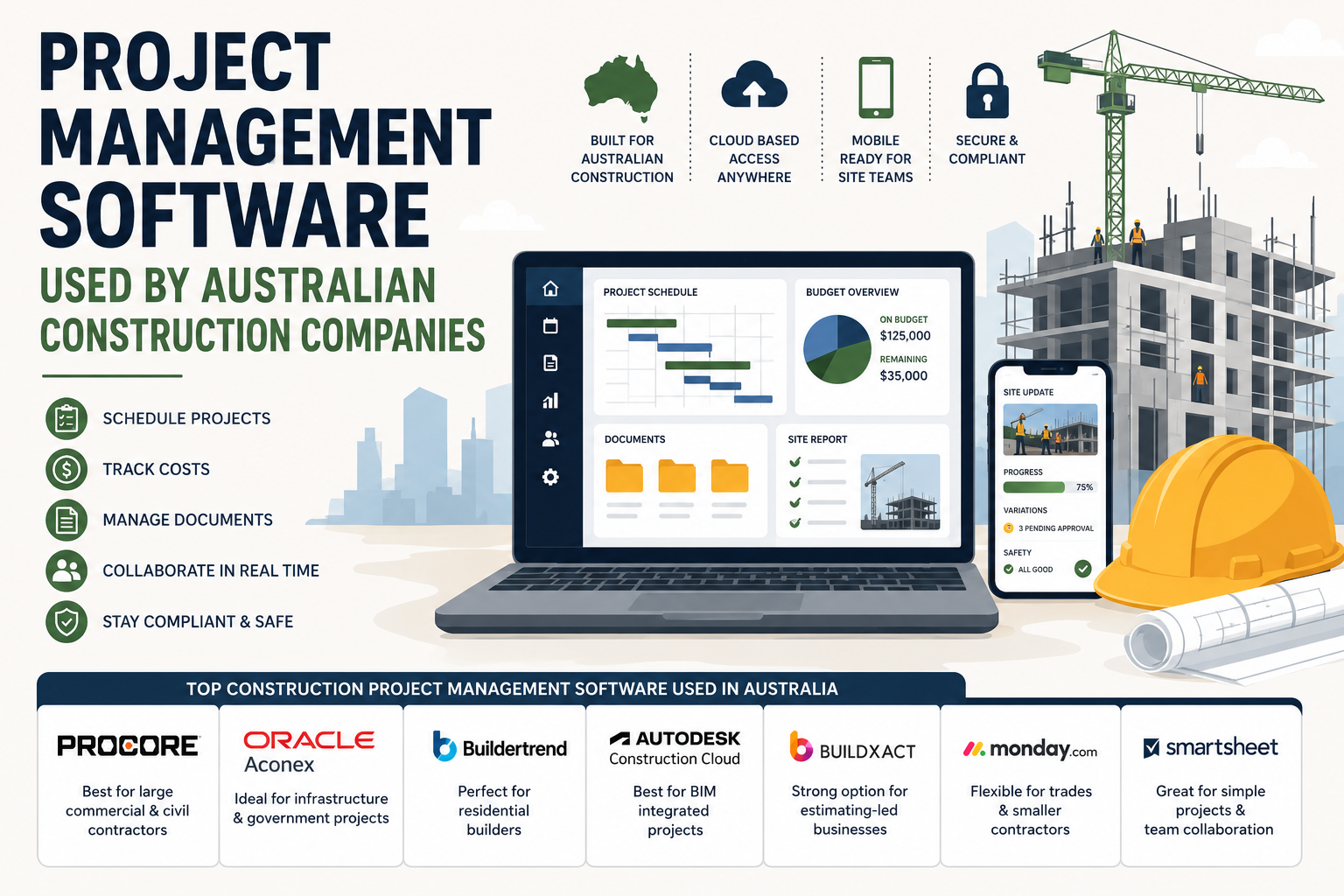
Australian construction has a spreadsheet problem. According to the HIA Builder Survey 2025, 67% of small builders still use spreadsheets for project management, costing them an estimated 10 or more hours per week in duplicated admin. Construction software adoption among Australian builders increased 34% year-on-year in 2026, driven largely by builders under 10 employees seeking integrated platforms.
The reason for that shift is not hard to understand. A missed variation, a drawing sent to the wrong subcontractor, a safety incident with no digital record these are not just operational headaches. They are the kinds of mistakes that wipe out a project’s margin or trigger a compliance investigation. Managing them through a collection of emails, WhatsApp threads, and Excel files is no longer sustainable as projects grow more complex and regulatory expectations tighten.
The right construction project management software brings scheduling, estimating, document control, job costing, site reporting, and subcontractor communication into one platform. The result is fewer errors, less duplicated admin, and real-time visibility into what is actually happening on site. The Australian project management software market is projected to grow from $209.9 million in 2023 to $689.3 million by 2030, a trajectory that reflects just how quickly the industry is moving.
What Australian Construction Companies Actually Need From Software
Before comparing platforms, it helps to be clear on what this category of software needs to do. Construction projects are not like other industries, they involve multiple subcontractors, formal documentation requirements, concurrent work streams, safety obligations, budget variations, and deadlines that compound in cost when missed.
The most valuable project management tools for Australian builders are those that support local financial workflows, compliance requirements, and construction-specific cost tracking. That means:
- GST handling and progress claims | software that does not understand Australian tax and payment schedules creates more work, not less
- Xero and MYOB integration | the majority of Australian construction businesses run their accounts on one of these two platforms, so integration is a practical requirement, not a bonus
- SWMS and safety documentation | Safe Work Method Statements and site induction records are non-negotiable compliance obligations on Australian worksites
- Variation management | tracking approved variations against updated budgets and schedules is essential for protecting margin
- Mobile access with offline functionality | site teams need to use the platform in the field, including in locations without reliable internet
Not every platform delivers all of these equally well. The right fit depends on company size, project type, and the technical confidence of your team.
Procore The Enterprise Standard for Commercial Contractors
Procore is one of the most widely used construction management platforms in Australia, particularly among commercial general contractors and tier two builders. It provides tools for RFIs, submittals, financial management, and scheduling across the entire project lifecycle, and integrates with Xero, MYOB, Sage, and several ERP systems used by larger Australian contractors.
The platform’s strength is its comprehensive document control and field-to-office communication. Drawings, RFIs, submittals, site diaries, and cost management are all connected in one system, which significantly reduces the information gaps that cause rework and variation disputes on complex commercial projects.
The tradeoff is cost and complexity. Procore’s custom pricing structure makes it harder for smaller businesses to evaluate upfront, and the learning curve is steeper than most competitors. It is best suited to commercial builders and civil contractors managing multi-stakeholder projects where document control and cost management are genuinely critical, not a small residential builder running five jobs at once.
Buildertrend For Residential Builders
Buildertrend is the most widely adopted platform in the Australian residential construction market. It covers the full project lifecycle from initial lead through to client handover, with scheduling, client communication tools, budgeting, job costing, and document management in one integrated system.
Where Buildertrend differentiates itself is the client-facing functionality. The client portal allows homeowners to view progress updates, approve selections, and sign off on variations without a phone call or email chain. For custom home builders and renovation specialists, this is genuinely useful, it reduces back-and-forth, creates a written record of client approvals, and improves the overall client experience.
The platform is particularly relevant for the kind of work carried out by Sydney Renovation & Building Specialists, residential projects where client communication, variation management, and job costing need to work together in a single system rather than being managed across separate tools.
Buildertrend integrates with Xero and is available at a significantly lower price point than enterprise platforms like Procore. The main limitation is that its document control and RFI workflows are basic by commercial standards, it is built for residential workflows, and it shows when applied to more complex commercial scopes.
Autodesk Construction Cloud Best for BIM-Integrated Projects
Autodesk Construction Cloud (ACC) consolidates several previously separate Autodesk products including PlanGrid and BIM 360 into one construction management environment. In Australia, it is primarily used on projects where building information modelling (BIM) is either required by the client or central to the design and delivery process.
The key advantage of ACC is the connection between design and field execution. Site teams work from the same model and drawing set as designers and engineers, which reduces document version conflicts and design coordination errors during the build phase. For projects where design changes continue through construction, this integration removes a significant layer of risk.
The platform is more complex to implement than field-focused alternatives and costs more at full deployment. It is best suited to commercial builders, developers, and contractors on design-led projects where the BIM workflow is already in place.
Oracle Aconex The Choice for Major Infrastructure Projects
Oracle Aconex occupies a specific part of the Australian market large-scale infrastructure, resources, and government projects where document control is a formal contractual requirement rather than an operational preference. It has been used on some of Australia’s largest infrastructure projects for over a decade and remains the platform most commonly specified by major project owners and government clients.
Aconex is structured around formal correspondence workflows between organisations. Every document transmission, approval, and communication is logged and auditable. For major projects where the audit trail is as important as the project outcome itself, this level of traceability is exactly what is needed.
It is not practical for smaller residential or commercial builders the cost and complexity do not match the need at that scale. But for tier one contractors on major civil and infrastructure projects, Aconex remains the industry standard.
Buildxact | Strong Option for Estimating-Led Businesses
Buildxact is an Australian construction software platform with a particular strength in the estimating workflow. It is designed for small to mid-sized builders who want digital estimating with plan takeoff capability connected directly to project management, budgeting, and client communication tools.
For builders who spend significant time on quoting and estimating custom home builders, renovation contractors, and smaller commercial builders Buildxact addresses the workflow where most businesses lose the most time. Digital plan takeoffs, supplier pricing integration, and direct connection between the estimate and the live project budget reduce the manual re-entry that creates errors in traditional workflows.
The platform integrates with Xero and handles GST and progress claims in the Australian format. It is positioned between entry-level tools and enterprise platforms, making it a practical option for growing businesses that have outgrown spreadsheets but are not ready for the complexity and cost of Procore.
Monday.com and Smartsheet For Trades and Simpler Projects
Not every construction business needs a purpose-built construction platform. For trades businesses, small subcontractors, and companies managing less complex project types, general project management platforms like monday.com and Smartsheet offer a practical and cost-effective starting point.
Monday.com is well suited to smaller contractors and trades that want flexible, visual project management with fast setup and strong integrations. Smartsheet appeals to teams already comfortable with spreadsheet-style interfaces who need more structure around dependencies, compliance documentation, and multi-stakeholder reporting.
The limitation is that general platforms are not built for construction-specific workflows. RFI management, formal submittal processes, site diaries, and SWMS documentation require workarounds. As project complexity increases, those workarounds become a bottleneck, and the case for moving to a construction-specific platform becomes clearer.
Practical Considerations Before Choosing a Platform
Choosing construction software is not just a technology decision it is an operational one. The platform needs to match how your business actually runs, not an idealised version of it.
Project type is the first filter. Residential, commercial, and civil projects have different documentation standards, subcontractor structures, and client expectations. A platform optimised for residential home building will feel limited on a complex commercial fitout, and an enterprise platform will be over-engineered for a small renovation specialist.
Field usability matters as much as features. The best software in the office is useless if site supervisors will not use it. Mobile usability, ease of daily reporting, and offline functionality for sites with limited connectivity are practical requirements, not optional extras.
Integration with existing systems is non-negotiable. If your accounting runs on Xero and the software does not integrate cleanly, you are creating double-handling. For businesses managing Home Renovation Sydney projects where accurate job costing, variation tracking, and progress billing need to work together that integration is the difference between the software adding value and creating more admin.
Total cost of ownership includes implementation. Licence fees are rarely the whole story. Training, data migration, configuration, and ongoing support all have costs. Factor in the realistic time it takes for your team to adopt a new platform before committing to an enterprise solution.
Which Platform Suits Which Construction Business
| Platform | Best For | Project Type | Local Support |
| Procore | Large commercial and civil | Commercial, civil | Yes |
| Oracle Aconex | Infrastructure and government | Major infrastructure | Yes |
| Buildertrend | Residential builders | Residential, renovation | Limited |
| Autodesk Construction Cloud | BIM-integrated projects | Commercial, design-led | Yes |
| Buildxact | Estimating-led builders | Residential, small commercial | Yes |
| monday.com / Smartsheet | Trades and small contractors | Simple projects | Limited |
Summary
There is no universally best construction project management software only the one that fits your project type, team size, technical capability, and budget. The platforms that consistently perform well for Australian construction companies share a few common traits: they integrate with Australian accounting systems, they work properly on mobile in the field, they handle variations and progress claims in the local format, and they are adopted consistently by the whole team rather than just the project manager.
Start with the platforms that match your project type, request demos with real project data, and evaluate them on what your site team will actually use not just the feature list on the vendor’s website.
Frequently Asked Questions
What construction project management software do most Australian builders use? Procore is the most widely adopted platform among commercial and civil contractors. Buildertrend dominates the residential market. Buildxact is popular among smaller builders focused on estimating workflows. For small trades businesses, monday.com and Smartsheet are common starting points.
Do Australian construction software platforms handle GST and progress claims? Purpose-built Australian platforms like Buildxact and Buildertrend handle GST and progress claims in the local format. International platforms like Procore require configuration to align with Australian tax and payment requirements. Always confirm this capability during the demo before committing.
What is the typical cost of construction project management software in Australia? Pricing ranges from approximately AU$49 per month for entry-level platforms like Built Simple through to $10,000 or more per year for enterprise platforms like Procore. Most small to mid-sized builders spend between AU$100 and AU$300 per month on a platform that covers scheduling, estimating, and job costing.
How long does implementation take? Simple platforms like monday.com can be operational within days. Mid-range platforms like Buildertrend typically take two to four weeks to configure. Enterprise platforms like Procore can take several months to implement fully across a larger organisation, particularly when integrating with existing ERP or accounting systems.
READ ALSO: Best Construction Planning Methods in the UK to Improve Project Profitability