Ransomware has moved well past the category of occasional IT nuisance. For organizations across healthcare, manufacturing, finance, and local government, it now represents one of the most immediate operational threats a business can face. A successful attack does not just lock files — it halts production lines, exposes patient records, freezes financial transactions, and in some cases takes entire organizations offline for days or weeks at a time.
The cost of recovery is rarely limited to the ransom itself. Businesses absorb lost revenue during downtime, compliance penalties from regulators, reputational damage with clients, and the extended labor required to rebuild systems and verify data integrity. For many mid-sized organizations, a single incident is enough to reshape how they invest in security for years afterward.
Against that backdrop, the market for specialized security firms has grown significantly. Choosing the right partner is not a simple procurement exercise. It requires understanding what kind of firm is actually capable of doing, whether they focus on prevention, detection, response, or all three, and whether their operational model aligns with your industry’s regulatory environment and risk exposure.
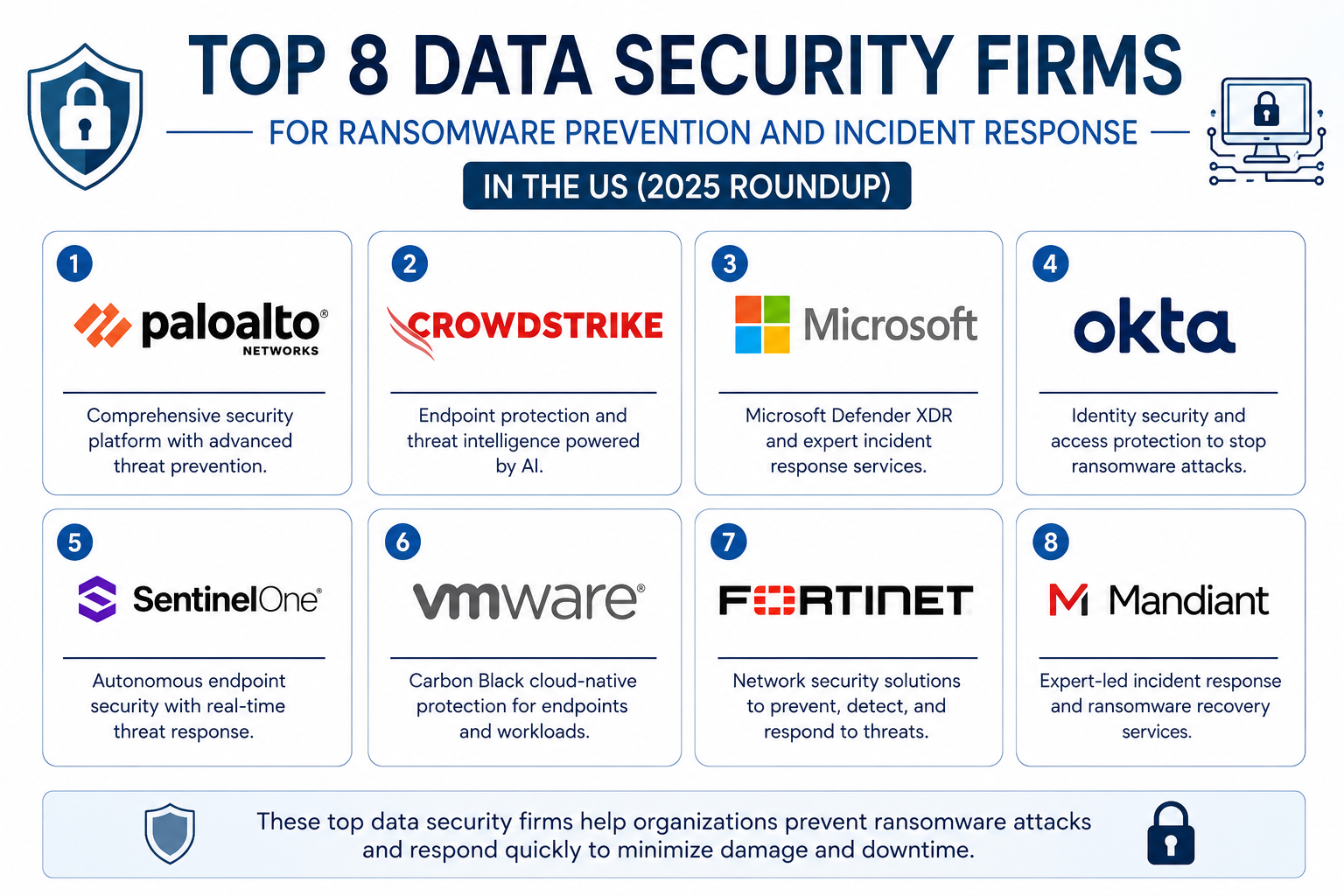
This roundup examines eight firms operating in the US market in 2025 that have established credible track records in ransomware-related work. The list covers a range of specializations, firm sizes, and service models so that decision-makers across industries can make informed comparisons.
What to Expect from a Specialized Security Firm in 2025
The role of a data security firm ransomware prevention incident response provider has changed substantially over the past several years. Early iterations of managed security services focused heavily on perimeter defense — firewalls, antivirus software, and email filtering. Today, effective ransomware protection requires a layered operational model that addresses the full attack lifecycle, from initial intrusion detection through containment, recovery, and post-incident analysis.
Organizations researching their options will find that the firms most equipped to handle ransomware threats tend to operate with dedicated threat intelligence teams, maintain 24-hour monitoring capabilities, and have structured response playbooks that have been tested against real incidents rather than simulated environments only. When evaluating partners, the distinction between a firm that sells software and one that actively manages threat environments on behalf of clients is important to understand before any formal process begins.
For businesses that want a starting point for comparing regional and national providers, a directory of data security firm ransomware prevention incident response specialists can provide a practical overview of what firms in the US market are currently offering and where they are located.
Prevention and Response Are Not the Same Service
Many organizations enter conversations with security vendors assuming that ransomware coverage is a single service. In practice, prevention and incident response are distinct disciplines that require different tools, different staffing, and different contractual arrangements. Prevention work includes endpoint hardening, access controls, network segmentation, employee training, and vulnerability scanning. Incident response, on the other hand, is reactive by nature. It involves forensic investigation, containment of active threats, system recovery, and communication with stakeholders including regulators and legal counsel.
Firms that specialize in both areas can offer more integrated protection, but organizations should verify that depth on both sides is genuine. Some firms lead with prevention tools but have limited capacity when an active breach occurs. Others are highly skilled responders but offer minimal ongoing prevention infrastructure. Understanding which category a firm falls into shapes realistic expectations about what the partnership will actually provide.
The Eight Firms Worth Considering
The firms below have been selected based on their demonstrated activity in the US ransomware prevention and response market, their range of service offerings, and the industries they serve. This is not a ranked performance list — it is a comparative reference for organizations in the evaluation stage.
1. CrowdStrike
CrowdStrike operates one of the most widely recognized endpoint detection and response platforms in the market. Their Falcon platform provides continuous monitoring at the device level, with threat intelligence drawn from a global network of sensors. Their incident response practice has handled some of the most high-profile breaches in recent US history, giving their teams direct experience with sophisticated ransomware operators. They serve enterprise clients primarily, though their managed detection and response tier has expanded availability to mid-market organizations.
2. Palo Alto Networks Unit 42
Unit 42 is the threat intelligence and incident response arm of Palo Alto Networks. The team combines proactive advisory services with reactive breach response and has published extensive research on ransomware group behavior and tactics. Their retainer model allows organizations to secure response capacity in advance rather than scrambling for support after an incident begins. They are well-suited for organizations that want a partner capable of handling both regulatory disclosure support and technical remediation simultaneously.
3. Mandiant (now part of Google Cloud)
Mandiant built its reputation through nation-state threat investigations and large-scale incident response engagements. Following its acquisition by Google, the firm retained its independent brand identity within the Google Cloud security ecosystem. Their forensic capabilities are well-regarded across government and critical infrastructure sectors. For organizations with elevated threat profiles or complex regulatory environments, Mandiant brings depth in attribution, legal coordination, and structured recovery planning that general IT firms rarely match.
4. Secureworks
Secureworks has operated as a managed security provider for over two decades and has a broad client base that spans healthcare, finance, retail, and public sector organizations. Their Taegis platform combines extended detection and response capabilities with threat intelligence from their Counter Threat Unit research team. Their service model tends to work well for organizations that want consistent monitoring coverage without building an internal security operations center. They also offer breach readiness assessments that identify gaps before an incident occurs.
5. Coveware
Coveware occupies a more focused position in the market. Their primary specialization is ransomware incident response and negotiation support. When an organization has already been hit and is dealing with an active extortion situation, Coveware provides structured guidance on decision-making, negotiation with threat actors where appropriate, and data recovery options. They also publish quarterly ransomware market reports that provide reliable data on current attack trends, ransom demands, and payment outcomes. As noted by the Cybersecurity and Infrastructure Security Agency, organizations should always report ransomware incidents to federal authorities, and Coveware’s teams are experienced in coordinating those communications.
6. Arctic Wolf
Arctic Wolf positions itself as a security operations provider accessible to mid-sized organizations that do not have internal security operations center capacity. Their concierge security team model pairs clients with dedicated analysts who understand the specific environment rather than rotating through generic alert queues. Their focus on reducing alert fatigue and improving detection accuracy makes them a practical choice for organizations in growth phases that are building out security infrastructure without large IT departments.
7. Optiv
Optiv operates as a security solutions integrator with consulting, managed services, and incident response capabilities. They work across a broad range of industries and maintain partnerships with most major security technology vendors. Their value for clients is often in their ability to assess an existing security stack, identify redundancies or gaps, and build a more coherent program from what is already in place. For organizations that have accumulated security tools over time without a unified strategy, Optiv’s advisory practice can be a useful starting point.
8. GuidePoint Security
GuidePoint is a consulting and managed security firm that works heavily in the mid-market and enterprise segments. Their ransomware preparedness practice includes tabletop exercises, incident response plan development, and technical assessments. They also offer emergency response services for organizations that have not established a formal retainer in advance. Their regional presence across multiple US cities makes them accessible for organizations that prefer a partner with local team availability alongside national delivery capabilities.
How Firms Differ in Practice
Reading firm descriptions at face value rarely captures meaningful operational differences. Two firms can both claim incident response capability while having very different response times, staffing models, and actual experience with active ransomware events. The questions worth asking during a formal evaluation go beyond service descriptions and into the specifics of how a firm operates under pressure.
Retainer Structures and Emergency Access
Many organizations do not engage a data security firm ransomware prevention incident response provider until after an incident has already disrupted operations. At that point, firms with active client rosters may have limited immediate availability, and emergency engagements often carry significantly higher costs. Pre-established retainer agreements address this by securing a firm’s response capacity before a crisis occurs. The retainer model also allows for relationship-building, tabletop exercises, and environment familiarization that makes actual response faster and more effective when needed.
Industry-Specific Regulatory Knowledge
Healthcare organizations dealing with ransomware face different regulatory obligations than a regional manufacturer or a financial services firm. Breach notification timelines, documentation requirements, and coordination with sector-specific regulators all vary. A firm that understands the operational context of your industry — not just the technical side of the attack — is better positioned to help manage the full scope of the incident. This includes communications with legal counsel, insurers, and regulators who will be asking specific questions about what happened and what was done in response.
Building a Realistic Evaluation Process
The evaluation process for a security partner should be structured around operational fit, not just technical capability. A firm may have impressive tools and references but operate in a way that does not align with how your internal teams work or what your industry requires. Taking time to map your current vulnerabilities, your most likely threat scenarios, and your internal response capacity before speaking with vendors makes the comparison process significantly more productive.
Questions That Reveal Operational Depth
During conversations with potential partners, the answers that reveal genuine capability tend to come from operational questions rather than technical ones. Asking how many active ransomware incidents a firm has responded to in the past year, what their average time to containment looks like in a real scenario, and how they coordinate with a client’s legal team during an active breach provides more useful information than a feature comparison sheet. Firms that can answer these questions with specific, grounded responses have usually earned the right to do so through real-world experience.
Conclusion
Ransomware is not a problem that organizations can solve entirely through software purchases or policy updates alone. The threat environment in 2025 involves sophisticated actors with clear economic incentives and a well-documented record of targeting organizations that have not invested in both prevention and response capability. The firms listed in this roundup represent a range of approaches, price points, and industry focuses that reflect what is actually available in the US market today.
No single firm is the right fit for every organization. The most useful outcome of any comparative review is a clearer picture of what your organization actually needs — whether that is ongoing monitoring, emergency response capacity, regulatory guidance, or a combination of all three. The decision to engage a data security firm for ransomware prevention and incident response is ultimately a risk management decision, and like all risk management decisions, it benefits from being made before the risk materializes rather than after it does.
Organizations that approach this process with clear internal requirements, realistic questions, and a willingness to invest in ongoing partnerships rather than one-time engagements tend to find partners that genuinely reduce their exposure. Those that wait until after an incident often spend significantly more to achieve a result that is far less complete.