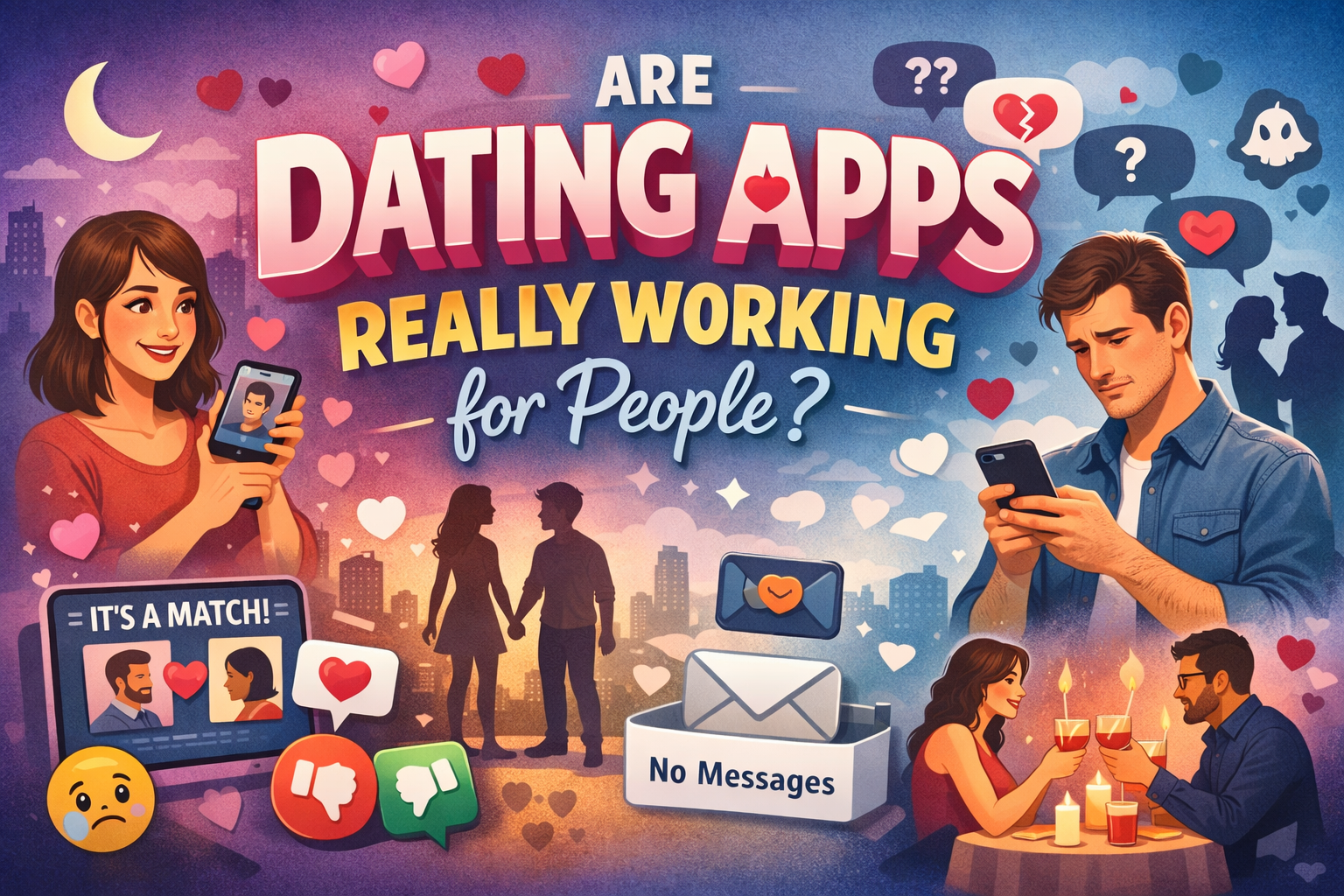
Many users today question whether dating apps really work in real life or simply create an endless cycle of swiping. 27% of couples who married in 2024 or planned weddings for 2025 said their relationship started on a platform, according to The Knot’s survey of nearly 17,000 U.S. couples. When all online channels are included, about 60% of newlyweds met through the internet in some form. Those numbers make it look like the system is working. But they measure outcomes for the people who succeeded. They say nothing about the much larger group still inside the process, swiping, matching, and going nowhere.
Among all users, 12% ended up in a committed relationship or marriage through one of these platforms. 42% said they had been in a committed relationship with someone met online at some point. The majority, the remaining 58%, had not. That split defines the real picture better than any wedding statistic.
The Satisfaction Gap
41% of people who have used these platforms called the process positive. 32% called it negative. 27% fell somewhere in between. Those numbers have not moved much in recent years. The satisfaction rate has stayed flat even as the technology has improved, which suggests the problems are not technical. They are structural.
Among Gen Z and millennial users, 79% reported exhaustion. 58% of Gen Z specifically said the process brings more frustration than fulfilment. 40% of respondents in a separate survey said they could not find a meaningful connection. 27% cited repeated rejection. 24% pointed to conversations that went in circles. 84% of younger users said they had been ghosted, and 2 out of 3 admitted to ghosting someone themselves. The loop of matching, messaging, and disappearing has become the default rhythm rather than the exception.
What People Are Looking for Instead
A growing number of people have started turning toward more specific options. Niche services for particular relationship types, including sugar daddy website platforms, faith-based matching, and hobby-driven groups, attempt to reduce the noise by narrowing the pool. The idea is that a smaller, more targeted group produces better matches than a massive, undifferentiated one.
Others have stepped away from platforms entirely. Speed dating events, social clubs, and community meetups have seen renewed interest, particularly among Gen Z in urban areas. The counter-movement is not anti-technology. It is anti-volume. People want fewer, better interactions, and the dominant model has not delivered that.
Revenue Tells Its Own Story
Tinder’s paying subscriber count peaked at 10.9 million in Q2 2023 and has declined for 6 consecutive quarters since then. Revenue fell 3% year over year, and the paying user base dropped 8% to 8.77 million. Bumble reported Q4 2025 revenue of $224.2 million, down 14.3% from the same period a year earlier. Its paying users fell 20.5% to 3.3 million. These are not niche platforms. They are the two largest names in the category, and both are shrinking.
Hinge is the exception. Its revenue grew 26% year over year to $186.5 million in Q4 2025, making it the strongest performer in the Match Group portfolio. Hinge has positioned itself around relationship intent rather than volume. The contrast with Tinder is instructive: a platform that signals seriousness is growing while the ones built around casual swiping are losing ground.
On Hinge, 14% of Matches Become a Date
That number, from platform data estimates, means that for every 100 matches a person accumulates, roughly 14 result in a first meeting. The other 86 go nowhere. This is not a failure rate specific to Hinge. It reflects the broader economics of matching. A match is a low-commitment signal. It does not indicate interest strong enough to act on. Most users match broadly and filter later, which means the matching phase itself has become a screening tool rather than a stepping stone.
The gap between matching and meeting produces the fatigue users describe. A person can accumulate hundreds of matches and still have no dates scheduled. The volume creates an illusion of progress that does not translate into actual contact. For people who measure success by real-world meetings, the ratio is discouraging.
Couples Who Met Online Report Comparable Outcomes
A replication study published in 2024 found that meeting online had a small negative association with relationship success among married couples, but the gap was minor. Among unmarried couples, the disadvantage disappeared entirely. 5.96% of marriages that started online ended in separation or divorce by the time of the survey, compared with 7.67% for couples who met offline. 61% of adults surveyed said relationships that begin online are as successful as those formed in person.
These numbers suggest that the platform itself is not the problem for the people who manage to get through it. The issue is upstream. Most users never reach the point where relationship quality becomes relevant because the process filters them out long before then. The question is not if platforms can produce good relationships. They can. The question is how many people have to burn through the system before one forms.
What the Numbers Add Up To
The platforms work for a minority. 12% reach a committed relationship. 27% of recent marriages started there. For the remaining majority, the process consumes time, attention, and emotional energy without producing a result. The industry is responding to this by losing customers. The users are responding by leaving or reducing their engagement. Neither trend suggests the model is sustainable in its current form.
Conclusion
Dating apps are not failing in absolute terms, but they are not working efficiently for most users. The data shows a clear imbalance: a visible minority achieves meaningful outcomes, while the majority remains engaged in a cycle that does not consistently lead to results.
For those asking, do dating apps really work, the answer is nuanced. They can lead to successful relationships, but the path is often inconsistent and requires persistence. Users who approach these platforms with clear intent and selective engagement tend to have better outcomes than those relying purely on volume.
As behavior continues to shift toward more intentional dating, platforms that prioritize quality over quantity may define the next phase of the industry. Ultimately, success in modern dating depends less on the platform itself and more on how it is used.
FAQ
Do dating apps really work for most people?
They work for a minority of users, but most people do not reach long-term relationships through them.
Why do dating apps feel exhausting to use?
Repeated swiping, low conversion from matches to real meetings, and inconsistent communication create fatigue over time.
Are niche dating platforms more effective?
They can be, because they reduce the number of irrelevant matches and focus on specific preferences or relationship goals.
Are online relationships as successful as offline ones?
Research shows that once formed, online relationships can be just as successful as those that begin offline.