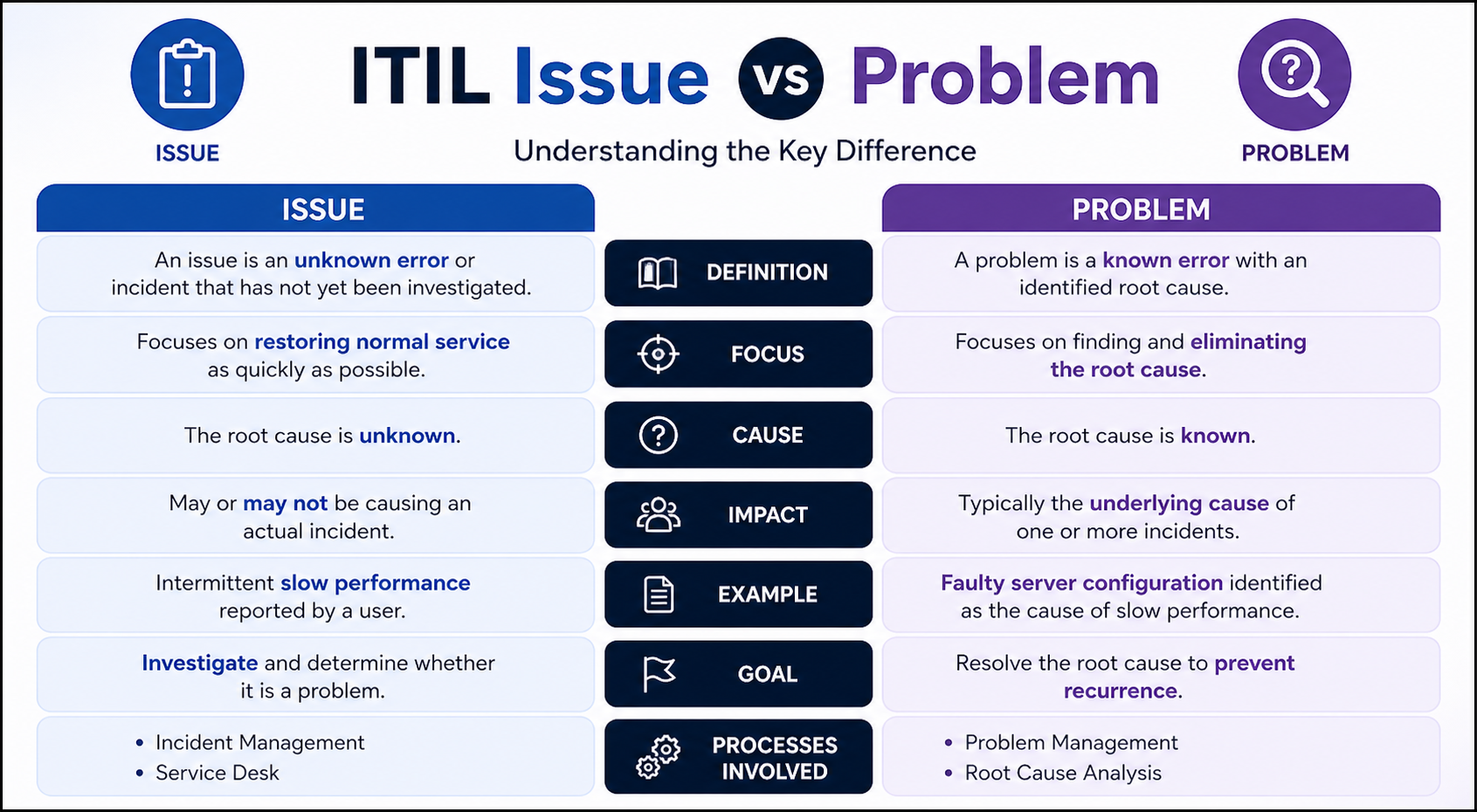
In most IT departments, “issue” gets used as a catch-all for anything that goes wrong – a frozen laptop, a slow VPN, a mailbox stuck syncing. The habit is convenient in casual conversation and dangerous in a service desk queue. The moment a team starts treating every disruption with the same workflow, the difference between fixing a symptom and fixing a cause disappears, and so does the chance of preventing the same disruption next week.
This is exactly the gap the ITIL framework is built to close. The ITIL issue vs problem question – really a question about incidents versus problems – is one of the foundational distinctions in modern service management, and getting it wrong has measurable consequences: longer mean time to resolution, repeated SLA breaches, audit findings, and IT teams stuck firefighting instead of improving.
This guide unpacks the ITIL issue vs problem distinction in technical detail: what each term actually means, how the two practices differ, where teams typically conflate them, and how to structure tooling and workflow so the distinction holds up under operational pressure. The goal is to give technical leaders a practical reference for ITIL issue vs problem decisions made at intake, in escalation, and in the data model.
A Quick Note on Terminology: “Issue” Is Not an ITIL Term
Strictly speaking, ITIL does not define “issue” as a service management object. The two formal entities are incident and problem. “Issue” is the colloquial label most users – and many technicians – reach for when describing any service disruption, and that informality is the root of much of the confusion that follows.
When people ask about ITIL issue vs problem, they usually mean one of two things. The first is the difference between an incident (an unplanned event affecting a service) and a problem (a recurring or systemic cause behind one or more incidents). The second is the broader question of how to triage user-reported “issues” into the correct ITIL workflow at intake. Both interpretations matter, because both shape how a service desk responds.
For the rest of this article, “issue” is treated as the everyday word users actually use, and mapped to its proper ITIL counterpart – incident – wherever the technical distinction matters.
What Is an Incident in ITIL?
An incident is an unplanned interruption to a service or a reduction in the quality of a service. ITIL 4 defines incident management as the practice of minimizing the negative impact of incidents by restoring normal service operation as quickly as possible. Within the ITIL issue vs problem framing, the incident is the “issue” side of the equation – the visible disruption.
Three characteristics define an incident in operational terms. The trigger is something that has already happened and is affecting users – a printer offline, a core application throwing 500 errors, a VPN tunnel dropping every twelve minutes. The clock is running, and the service desk’s job is to stop the bleeding.
The goal is restoration, not explanation. If rebooting a switch brings connectivity back, that’s a successful incident closure, even if no one yet knows why the switch hung. Investigating the underlying cause is a separate workflow.
The success metric is speed. Mean time to acknowledge, mean time to resolve, and SLA compliance are the numbers that matter. An incident that lingers in the queue is, by definition, ongoing service degradation. Most of what arrives at a service desk – password resets, hardware failures, application errors, connectivity drops – is incident-class work.
What Is a Problem in ITIL?
A problem, in ITIL terms, is the underlying cause of one or more incidents. Problem management is the practice that investigates, identifies, and addresses those causes, with the explicit goal of preventing future incidents or minimizing their impact when prevention is not possible.
Problems do not always come from incidents. Some are identified proactively – through trend analysis, capacity reviews, or vendor advisories – before any user feels them. But every problem either has caused or has the potential to cause incidents, and that causal relationship is what makes it a problem rather than just an interesting technical detail.
Problem management has two distinct modes. Reactive problem management starts after one or more incidents have occurred and looks backward to find the root cause. Proactive problem management looks forward, scanning the environment for weaknesses – an aging storage array, a service running on an unsupported OS, a workflow with a single point of failure – and addresses them before they generate tickets.
The deliverable of problem management is rarely a fix at the moment of investigation. It is more often a known error: a documented record that captures the root cause, the symptoms, and a workaround, so the next incident matching the pattern can be resolved in minutes rather than hours.
Within the ITIL issue vs problem distinction, the problem is the cause side – the underlying defect that needs to be removed, not the symptom that needs to be patched. The work is fundamentally different in tempo, in skill set, and in what counts as success.
ITIL Issue vs Problem: A Side-by-Side Comparison
The differences sharpen considerably when laid out against each other. The table below compares incident handling (the “issue” users report) against problem management across the dimensions that matter operationally.
| Dimension | Incident (the “issue” users report) | Problem |
| Definition | Unplanned interruption or quality reduction in a service | Cause, or potential cause, of one or more incidents |
| Primary goal | Restore service as quickly as possible | Identify root cause and prevent recurrence |
| Time horizon | Minutes to hours | Days to months |
| Trigger | User report, monitoring alert, automated check | Recurring incidents, major incident review, proactive analysis |
| Owner | Service desk / Tier 1 – 2 support | Problem manager / specialist engineering |
| Key metric | MTTR, SLA compliance, first-contact resolution | Recurring incidents reduced, known errors documented, problems closed |
| Closure criterion | Service is restored and user confirms | Root cause addressed, or known error published with workaround |
| Example | “Email is down for the marketing floor right now” | “The Exchange storage tier saturates every Tuesday during backup window” |
Reading across the rows makes the operational difference clear: incidents are managed in real time against the clock; problems are investigated against a hypothesis. The ITIL issue vs problem comparison ultimately reveals two practices with different skills, different tools, and – critically – different definitions of “done.”
A Real-World Example That Shows the Difference
Consider a marketing team that loses access to email at 9:47 a.m. on a Tuesday. The service desk receives twenty-three tickets in the next eight minutes.
The incident response is to acknowledge the disruption, escalate to the messaging team, fail over to the secondary mail node, and confirm with users that mail flow has resumed. By 10:14, service is restored and the incidents are closed. The MTTR clock is satisfied. From the user’s perspective, the issue is over.
But the messaging team noticed something. This is the third Tuesday morning in five weeks that the primary mail node has saturated. That observation triggers a problem record. Investigation finds that a backup job scheduled for 9:30 Tuesday mornings is consuming roughly 80% of the storage controller’s IOPS, and the mail node’s database commits time out as a result. The root cause is a scheduling collision, not a mail server defect. The fix is to move the backup window. The known error is published, so that if the same symptom appears in any future incident, Tier 1 has an immediate workaround.
Without problem management, that storage collision keeps generating incidents indefinitely. The service desk closes them faster each time and the team feels productive, but the underlying defect persists. That is the real cost of treating every report as just an “issue” – and it is the most concrete illustration of the ITIL issue vs problem distinction in action.
Why Confusing These Two Terms Damages Service Quality
When teams collapse the ITIL issue vs problem distinction into a single workflow, several predictable failure modes emerge. They accumulate quietly – in dashboards, in audits, in team morale – until the cost of mishandling the ITIL issue vs problem boundary becomes too large to ignore.
Recurring incidents are closed individually with no causal record linking them. The service desk fixes the same symptom thirty times in a quarter without ever writing the trend up as a problem. Capacity planning, audit reporting, and continual improvement all suffer because the data needed to justify investment in a permanent fix never gets aggregated.
SLA dashboards look healthy while user satisfaction quietly declines. Closing tickets fast is rewarded; investigating root cause is not. Technicians learn to optimize for the metric, and the organization optimizes itself into a state of low-grade chronic disruption.
Audit and compliance posture weakens. Regulators in healthcare, public sector, finance, and aviation increasingly expect to see evidence of structured problem management – not just a fast incident queue. Without a clean separation between incident records and problem records, demonstrating that systemic risks are being managed becomes difficult, and audit findings tend to follow.
Knowledge stops accumulating. Known errors are the principal way an IT organization learns. When every report becomes an incident with no problem record behind it, that institutional memory never gets written down.
The Incident Management Workflow in Practice
Incident management, in practice, follows a tight, time-bound sequence: detection and logging, classification and prioritization, initial diagnosis, escalation if needed, resolution, and closure. Each step is measured. The whole flow is designed to compress time, not to investigate causes.
The most common operational sin in incident management is over-classification. Teams build elaborate category trees with hundreds of options, hoping granularity will help reporting. In practice it does the opposite: technicians pick inconsistently, the data becomes noisy, and the analytics layer that the categories were supposed to feed becomes unusable. A flat, well-curated taxonomy of fifteen to thirty categories almost always outperforms a deep tree of two hundred. Get classification right and the ITIL issue vs problem boundary is much easier to enforce, because incident trends become legible and the threshold for opening a problem record becomes obvious.
The Problem Management Workflow in Practice
Problem management has a different rhythm. The flow begins with detection – either reactively from incident patterns or proactively from analysis – then moves through logging, categorization, prioritization, root cause investigation, workaround development, known error publication, and resolution. The investigation phase is open-ended. Closing a problem record because the timer says so defeats the practice.
Mature problem management organizations distinguish reactive and proactive problem records explicitly, track them on separate dashboards, and protect engineering time for proactive work. Without that protection, reactive firefighting consumes the entire calendar and the proactive arm of the practice quietly disappears, taking the ITIL issue vs problem balance with it.
Common Mistakes Teams Make in Practice
Even well-resourced IT teams stumble on the ITIL issue vs problem distinction in similar ways. Recognizing the patterns is half the work of fixing the ITIL issue vs problem split inside an existing operation. Five appear most often:
- Closing recurring incidents without ever opening a problem record, so the trend is never investigated and the underlying defect is never addressed.
- Treating every problem investigation as urgent, which collapses problem management back into incident management and removes the longer time horizon that root cause work requires.
- Failing to publish known errors once a workaround is identified, leaving Tier 1 to rediscover the same fix repeatedly.
- Categorizing too aggressively at intake, producing reporting data that is technically rich but practically unusable.
- Holding the service desk accountable only for MTTR, with no metric that rewards identifying or escalating problems.
Each of these is a process and culture failure as much as a tooling failure – but tooling that doesn’t make the distinction visible amplifies the cultural problem rather than constraining it.
Building Mature Incident and Problem Management
The mature pattern is to separate incident and problem records at the data layer, link them with traceable relationships, and surface that linkage in everyday operations. When a Tier 1 technician closes the third matching incident in a month, the system should suggest opening a problem record. When a problem moves to “known error,” every related incident should automatically inherit the workaround. When a problem is resolved, every related incident’s category should reflect the cause, so reporting tells a coherent story – and the ITIL issue vs problem distinction is enforced by the platform rather than by individual discipline.
That kind of integration is hard to retrofit on top of spreadsheets, ticketing-only tools, or fragmented stacks where incidents live in one product and problems live in another. It is the central reason mid-market organizations eventually outgrow Lansweeper-plus-email, Jira-with-bolt-ons, or homegrown helpdesks: those setups can record incidents and problems separately, but they cannot reliably express the relationships between them, and that is where the value of the ITIL practice actually lives. A consolidated ITSM platform with native incident, problem, asset, and change records – such as Alloy Software – lets the linkages live in the data model rather than in technicians’ heads, which is the only sustainable way to keep the ITIL issue vs problem distinction enforced at scale.
Implementation does not have to be a multi-year, ServiceNow-style project. For most mid-market IT teams, the practical sequence for putting the ITIL issue vs problem distinction into operation is to define a clean incident category taxonomy first, agree on the threshold at which recurring incidents trigger a problem record, configure the tool to enforce that threshold, and only then layer on proactive problem management once the reactive pipeline is producing reliable trend data.
Closing Thoughts
The ITIL issue vs problem question is sometimes treated as a vocabulary lesson, but it is really a question about whether an IT organization is built to fight fires forever or to make fires rarer over time. Incidents protect today’s service. Problems protect next quarter’s. A team that runs both practices well, and respects the ITIL issue vs problem boundary in both data model and workflow, closes the recurring-disruption gap that every long-tenured IT department eventually accumulates, and earns the operational headroom to do work that is neither reactive nor compliance-driven.
For technical leaders evaluating where their own practice sits, three diagnostic questions usually expose the truth. Can you produce, on demand, a list of every recurring incident pattern from the last quarter? Do you have published known errors that Tier 1 actually uses? Is there a named owner for proactive problem management whose calendar is protected? If any answer is no, the ITIL issue vs problem distinction is being collapsed somewhere in the workflow, and the cost is showing up in metrics that nobody is currently looking at.