You land a big sponsorship, your AdSense payments grow, and a friend asks the question that stops you cold: “Shouldn’t you be VAT registered by now?” Any good influencer accountant hears this worry every week. Creators earn from YouTube, TikTok, Instagram, affiliate links, memberships and even free products. Some of that income counts towards UK VAT. Some of it does not, and the difference can surprise you.
This guide shows which income counts, when registration becomes compulsory, and what changes afterwards.
Do influencers need to register for VAT?
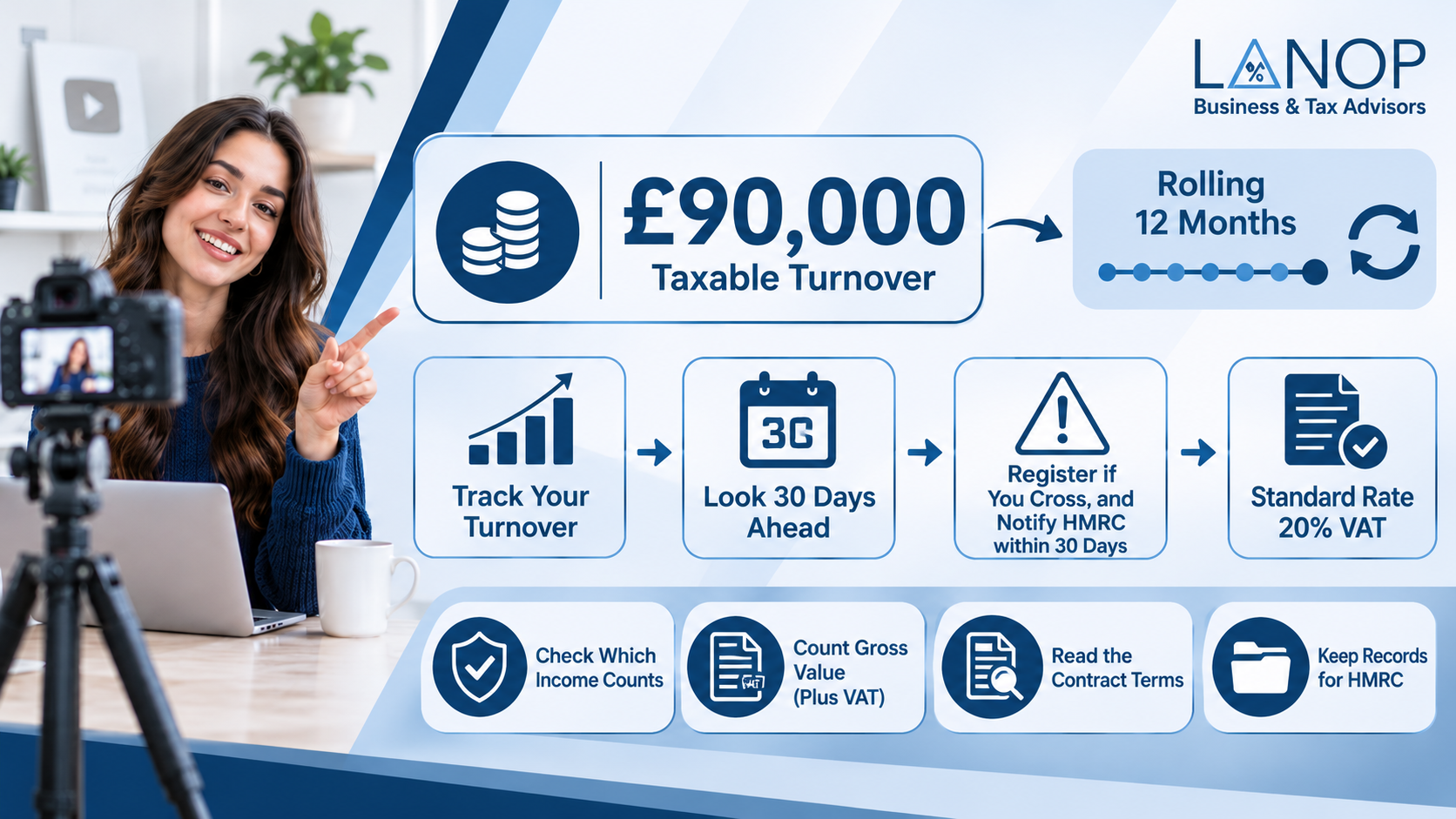
Yes, once your VAT-taxable turnover passes £90,000. That figure has applied since 1 April 2024 and stays unchanged in 2026. It rose from £85,000.
Two points trip creators up. First, the test uses turnover, not profit. Earn £100,000, spend £65,000 and keep £35,000? You still measure yourself against £100,000, because expenses do not reduce it. Second, VAT is separate from income tax. You can owe one without the other.
The rolling 12-month test
The limit applies to any rolling 12-month period, not a fixed calendar or tax year. Each month, add up your taxable turnover for the previous twelve months. If the total goes over £90,000, you must act.
Picture a creator whose last twelve months total £86,000 in May. In June, a big campaign replaces a quiet month from a year earlier, and the total jumps to £91,000. June is the trigger.
The 30-day rule
A second test looks forward. You must also register if you expect taxable turnover to pass £90,000 in the next 30 days. One £95,000 brand deal signed today would do it.
Under the rolling test, you notify HMRC within 30 days of the end of the month you crossed. Registration usually starts on the first day of the second month after you cross.
Which influencer income counts?
Each income stream needs its own check. Here is what decides the answer.
| Income source | What to check |
| YouTube AdSense | Who contracts with you, and where they are based |
| Brand sponsorships | Customer location and the written agreement |
| Affiliate commissions | Who pays you, and what for |
| Patreon and memberships | Who supplies the service to the fan |
| Gifted products | Gift, or payment for promotion |
| Courses and merchandise | Product type, customer and location |
Affiliate commissions, memberships and courses each hinge on who actually supplies what to whom. An affiliate network may be your customer. A platform like Patreon may be the supplier to your fans. A digital course can carry VAT depending on where the buyer lives.
Free products deserve a closer look. A lipstick sent with no strings is a gift, not payment. A phone you receive in return for a promised video is different. HMRC treats that as barter, so its market value counts as turnover.
Overseas income causes the most confusion. Being paid from abroad does not make income exempt. For services to business customers overseas, the place of supply is usually the customer’s country. That income normally sits outside UK VAT and does not count towards £90,000. Consumers follow different rules.
Take a creator who receives £30,000 from UK brands, £35,000 from a US business and £25,000 from Google Ireland. The bank shows £90,000. Yet only the £30,000 may count, if the overseas customers are genuine businesses. Read each contract before you assume anything.
How do you work out your turnover?
Look at the gross value of what you supplied, not what lands in your bank. A platform will often take a cut. But if they are acting as your agent then you may receive the gross amount.
If you are working with a marketplace that takes a £200 commission from your brand you will receive £800. But depending on the agreement you will have a turnover of £1,000. Keep things simple and track how much you have earned each month.
What happens if you cross the line?
You must notify HMRC on time. Register late, and you owe VAT from the date you should have registered, whether or not you charged it. Penalties and interest can follow.
That hurts most with fixed-fee deals. If you agreed a sponsorship of £5000 and there is no mention of VAT in the contract, HMRC may assume that the amount includes VAT resulting in only around £4167 being paid. Therefore include “plus VAT” in any future contracts.
For temporary increases you can apply for an exemption. If you can prove your taxable supplies will be less than £88,000 (de-registration limit) in the next 12 months you can apply. The decision is made by HMRC and it cannot be guaranteed even if you have a large campaign.
If you missed the deadline, work out when you breached, look at your contracts and platform statements, work out how much you owe and get in touch with HMRC or your adviser as soon as possible.
What changes once you are registered?
Standard rate services (most branding work) will have 20% VAT. You can claim back the VAT on business expenses such as cameras, lenses, mics, laptops and editing software. As long as you have valid VAT invoices you can only claim back the proportion of the item used for business purposes.
You may even reclaim VAT on some purchases made before registering. Goods still held can go back four years, and services six months. You will also keep digital VAT records and file returns online.
Once registered, you can choose standard VAT accounting or the Flat Rate Scheme. Neither is automatically better. The “limited cost trader” rules can make flat rate more expensive for creators who spend little on goods.
Should you register voluntarily?
Sometimes. If your clients are VAT-registered brands, they reclaim the VAT you charge. You also recover VAT on your kit. That can make registration cheap.
If you are selling primarily to fans/customers then you will have to increase your prices by adding VAT or reduce your margins. You should consider both options.
How can an Influencer Accountant help?
The influencer accountant can help break down what income you have coming in, understand the variable threshold, make sense of the international contracts, prepare your returns, ensure that invoices are correct and identify when you need to register.
Before you meet one, gather these:
- Platform earnings statements and AdSense reports
- Sponsorship and gifted-product agreements
- Affiliate and Patreon statements
- Expense receipts and bank statements
- Any HMRC letters
You can find specialist support through Lanop’s influencer accountants.
Frequently asked questions
Do I need to register for VAT below £90,000?
No, but you can register voluntarily. Compulsory registration starts when taxable turnover passes the threshold.
Is the threshold based on income or profit?
It uses taxable turnover. Your expenses do not reduce it.
Does YouTube AdSense count?
It depends on the contracting entity and the place of supply. Many creators contract with Google Ireland, so check your agreement.
Do I pay VAT on gifted products?
Not on unconditional gifts. Products given in exchange for promotion can create a VAT liability.
What if I pass £90,000 in one month?
The rolling 12-month test applies, plus the separate 30-day forward test. Either can trigger registration.
Conclusion
The £90,000 limit measures taxable turnover, not profit. Different income streams get different VAT treatment, so review your contracts, platform payments and expenses early. Check the rolling total every month. If your position is unclear, speak to an influencer accountant at Lanop Business & Tax Advisors before HMRC raises the question for you.