Rainwater has a sneaky way of finding its way into your boat. You leave your dinghy moored for a few days, an afternoon storm rolls through, and suddenly you’ve got pounds of water sitting in the bilge. For years, the only fix was grabbing a bucket and bailing it out by hand. Not exactly the relaxing boating life most of us signed up for.
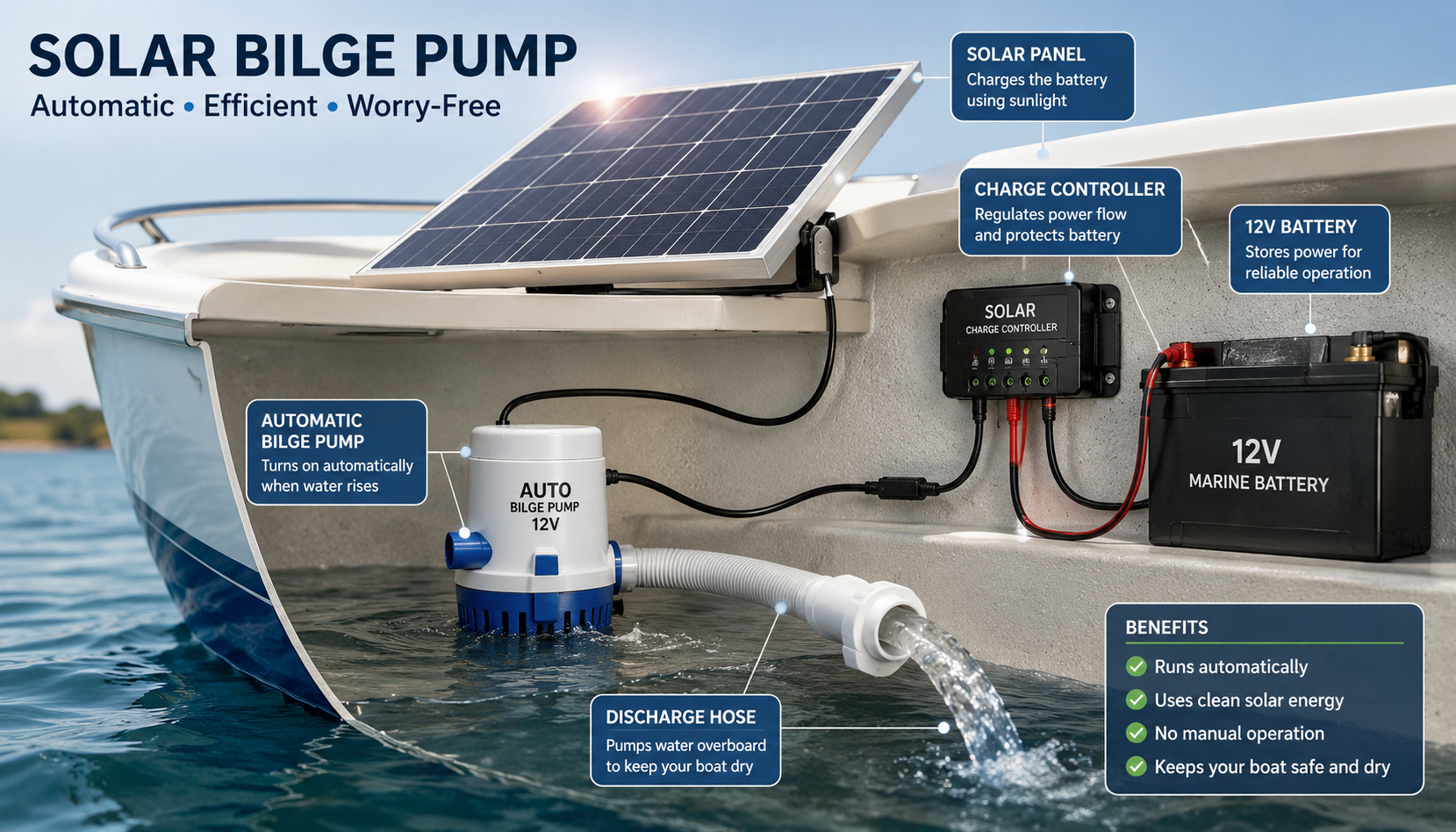
Solar-powered bilge pumps have changed all of that. These self-contained units sit in your boat, detect water automatically, and pump it out using nothing but sunlight and a built-in battery. No wiring, no fuss, no daily trips to scoop out rainwater. If you’ve been searching for a smarter way to protect your vessel, this guide will walk you through what makes a great solar pump and why so many boaters are making the switch.
Why a Solar Bilge Pump Beats Manual Bailing
Anyone who keeps a boat at a lake house, dock, or mooring knows the routine. After every rainstorm, you check on your boat and find water pooling where it shouldn’t be. Open boats like tenders, Whalers, Zodiacs, and skiffs are especially prone to this, since they have no cabin to keep the rain out.
A solar bilge pump solves the problem without any effort on your part. It runs on its own internal battery, which recharges through an attached solar panel. Smart sensors inside the unit detect when water starts to collect, then switch the pump on automatically. When the water is gone, it shuts off. You don’t have to be there, and you don’t have to lift a finger.
The biggest win is peace of mind. Instead of stressing through every downpour, you can rest knowing your boat is taking care of itself.
What Makes the Best Solar Bilge Pump
Not all pumps are created equal. When you’re comparing options, a few features separate the reliable units from the ones that will let you down.
Solid-State Sensors Instead of Float Switches
Traditional bilge pumps rely on mechanical float switches, which are notorious for sticking, jamming, and failing over time. The best solar bilge pump uses solid-state sensors instead. These have no moving parts to break, so they detect water and activate the pump with far greater reliability. It’s a simple design choice that makes a big difference in the long run.
Truly Self-Contained Power
A great solar pump should require zero installation. Look for a unit that operates entirely on its own internal rechargeable battery, topped up by an intelligent solar panel. This means no drilling, no electrical work, and no draining your boat’s main battery. The best systems are ready to go within about a minute of setup, with no tools or wiring needed.
Marine-Grade Construction
Your pump is going to live outside, exposed to sun, rain, and possibly salt spray. That demands tough materials. Premium units use stainless steel hardware and marine-grade components built to handle harsh conditions. If you boat in saltwater, look specifically for 316 stainless steel intake and outlet ports, which resist corrosion much better than lower grades.
Low-Profile Design
Water tends to collect in the lowest, hardest-to-reach spots of your bilge. A low-profile pump can fit into those tight areas and remove water down to as little as a quarter inch. That kind of thorough drainage keeps your boat truly dry rather than just mostly dry.
A Closer Look at the Raintaker® System
One option that checks every one of these boxes is the Raintaker®, a solar bilge pump engineered and built in the U.S.A. It’s designed for dinghies, tenders, Zodiacs, Whalers, and even boat or pool covers. The unit activates automatically day or night and pulls water down to a quarter inch.
Raintaker® comes in two models to suit different needs:
- Raintaker® System: A 500 GPH marine pump with 304 stainless steel hardware, built for open boats and covers up to 20 feet. It keeps roughly 800 pounds of water out of your boat per day, making it ideal for fresh water and rainwater use.
- Raintaker® PRO System: A 1100 GPH high-torque pump with 316 stainless steel hardware, designed for open boats and covers up to 30 feet. It handles both fresh and saltwater and clears up to 1500 pounds of water per day. The PRO even works on pool covers.
Both models skip float switches entirely in favor of intelligent sensors, run on a self-contained solar battery, and need no external power. Each comes backed by a two-year warranty and a 30-day money-back guarantee, so you can try one with confidence.
How to Choose the Right Model for Your Boat
Picking between models comes down to your boat size, water type, and how much rain you typically deal with.
Choose a standard 500 GPH system if you have a smaller open boat or cover up to 20 feet and keep it in fresh water. It handles everyday rainwater removal beautifully and costs less.
Choose a 1100 GPH PRO system if you have a larger boat up to 30 feet, boat in saltwater, or face heavy storms regularly. The higher capacity and 316 stainless steel hardware give you extra muscle and corrosion resistance when conditions get rough.
If you’re still unsure, think about the worst rainstorm your area throws at you and size up rather than down. A pump with extra capacity will never struggle, while an underpowered one might fall behind during a real downpour.
What Real Boaters Are Saying
The proof is in how these pumps perform out on the water. Boaters who once spent years bailing by hand report checking their vessels after heavy rain and finding zero water accumulation. Owners of Boston Whalers, Zodiacs, RIBs, and jet tenders describe finally being able to sleep through storms without worrying about their boats filling up. That hands-off reliability is exactly what a good solar pump should deliver.
Keeping Your Boat Dry, Effortlessly
A boat that stays dry lasts longer, looks better, and is simply more enjoyable to own. Rather than dreading every forecast, you can let a smart, self-contained pump do the work for you. When you’re ready to invest in the best solar bilge pump for your vessel, focus on solid-state sensors, marine-grade build quality, and a genuine self-contained power source. Those three things will keep you covered through any storm.
Take a look at the models available, match one to your boat size and water type, and enjoy the kind of worry-free boating you deserve.
Frequently Asked Questions
How does a solar bilge pump work without any wiring?
A solar bilge pump runs entirely on an internal rechargeable battery that recharges through a built-in solar panel. Sensors detect water and switch the pump on automatically, so there’s no need to connect it to your boat’s electrical system. Setup usually takes about a minute.
Will a solar bilge pump work at night or on cloudy days?
Yes. Because the unit stores power in its internal battery, it keeps working day and night, even during stretches of cloudy weather or heavy rain. The solar panel simply tops the battery back up whenever the sun is out.
Can I use a solar bilge pump in saltwater?
You can, as long as you choose a model built for it. Saltwater-rated pumps like the Raintaker® PRO use 316 stainless steel hardware to resist corrosion. If you boat in saltwater, avoid pumps made only with lower-grade materials.
What size boat works best with a solar bilge pump?
These pumps suit open boats, dinghies, tenders, and covers. Smaller 500 GPH units handle boats and covers up to 20 feet, while higher-capacity 1100 GPH models manage boats and covers up to 30 feet. Match the capacity to your boat size and typical rainfall.