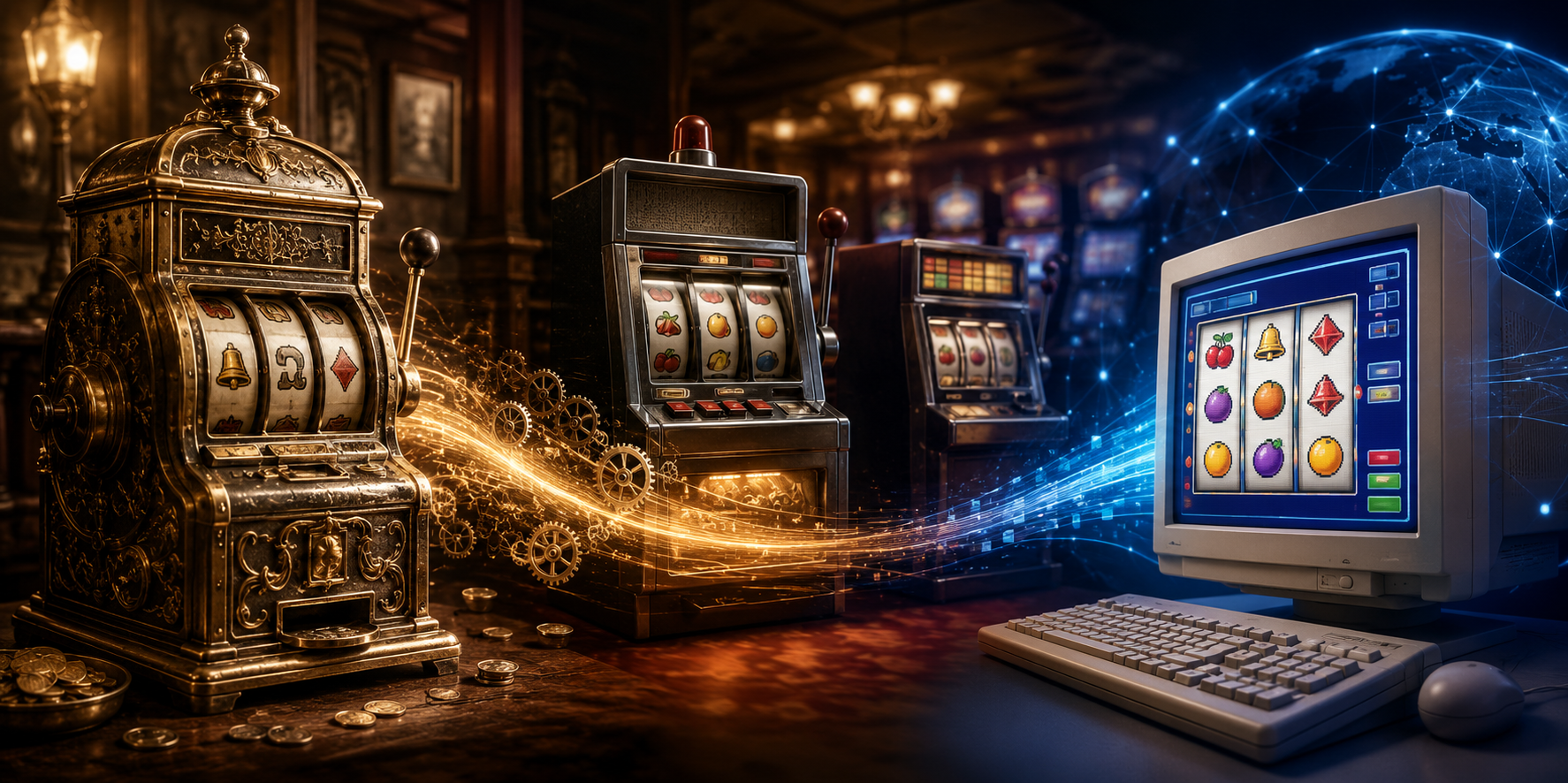
Every modern slot machine with bonus rounds – and mobile gaming in general – has its roots in a mechanical box weighing several kilograms, assembled in a San Francisco workshop over a century ago. The history of this evolution — from cast-iron reels to server clusters — explains why the industry is structured the way it is. At the same time, it gives the reader a practical skill: by understanding the origins of the mechanics, it becomes easier to distinguish a game’s actual features from the marketing myths surrounding it.
This interest in the industry’s past is no coincidence. The more deeply gambling moves into the digital realm, the more people need systematic information — from historical background to comparisons of modern platforms, which are compiled by themed portals such as no-kyc-casino.eu.com. It is wise to apply the same principle to any such source as the one that runs like a common thread through this article: check the facts and terms yourself, rather than relying solely on grandiose promises.
1891: Sittman and Pitt’s poker machine
Strictly speaking, the first ‘ancestor’ was not a three-reel machine, but a New York invention by Sittman & Pitt: five rotating cylinders featuring 50 playing cards. The machine was installed in bars, and winning combinations were paid out not in cash, but in cigars or drinks provided by the establishment.
Some interesting details from that era:
- bar owners would remove the ten of spades and the jack of hearts from the deck, reducing the chance of hitting a royal flush by almost half — a precursor to the modern concept of ‘payout adjustment’;
- there were no automatic payouts: the bartender would hand out the winnings after assessing the hand by eye;
- even then, a debate arose over legality, one that remains familiar to the industry to this day.
1895: Charles Fey’s Liberty Bell
German-born emigrant mechanic <a href=”https://ru.wikipedia.org/wiki/Фей,_Чарльз”>Charles Fey</a> solved the key engineering challenge — automatic payouts. To achieve this, he reduced the five card cylinders to three reels with five symbols: horseshoes, stars, playing suits and the Liberty Bell, which gave the machine its name.
Why this particular design became the standard
This simplification proved to be a stroke of genius. Fewer combinations meant the mechanism could recognise the result itself and dispense coins without human intervention. The ‘three reels, one payline’ format remained the industry standard for almost eighty years, and the Liberty Bell is still a common symbol in classic video slots.
The Age of Fruit and Chewing Gum
The bans of the early 20th century gave rise to an unexpected workaround: the machines became ‘vending’ machines, dispensing chewing gum. Cherries, lemons and plums on the reels indicated the flavour of the prize — thus was born the fruit symbolism, which has outlived its creators by a century. The BAR symbol originated from the Bell-Fruit Gum company logo.
1963: Electromechanics and Money Honey
Bally’s design was the first to combine electrically driven mechanical reels with a 500-coin hopper. This transformed the economics of gaming halls: multi-tiered payouts, sound effects and backlighting were introduced. Engineers began compiling the first gaming analytics — statistics for each machine — to understand utilisation rates, plan maintenance and calculate profitability. The same approach, only orders of magnitude more detailed, is used today by operators of digital platforms: session telemetry has long since replaced mechanical counters.
1976: a screen instead of reels
Las Vegas-based Fortune Coin unveiled a video slot based on a 19-inch Sony television. The Nevada State Gaming Commission tested the new machine for several months, fearing public scepticism towards ‘drawn’ reels. These fears proved unfounded — the digital format paved the way for bonus features that were impossible to implement in mechanical machines.
1994: the dawn of the online era
Events then unfolded in parallel at two points across the globe:
- the island nation of Antigua and Barbuda passed the Free Trade & Processing Act, permitting the issuance of licences for remote gambling for the first time;
- on the Isle of Man, the future giant Microgaming began developing software that is widely regarded as the foundation of the first online casino.
One final hurdle remained: money. Secure online payments emerged in 1995 thanks to encryption protocols developed by CryptoLogic, and by 1996, InterCasino was already accepting real-money bets online. It is telling that industry historians are still debating who was ‘the very first’ – marketing myths have accompanied the sector since its inception.
What this history tells the modern player
- symbols and mechanics are the legacy of specific engineering constraints, not a ‘code of luck’ that can be deciphered;
- the issue of fairness has always been resolved in the same way: through external oversight, from a barman with a deck of cards to certification laboratories;
- each technological wave (electricity, screens, the internet, smartphones) has expanded the possibilities, but the mathematical foundation has remained unchanged — the house edge is built into the rules;
- when choosing a platform today, it is wise to scrutinise its regulator and the transparency of its terms and conditions just as closely as the Nevada Gaming Commission scrutinised the first video slot.
Gambling is a form of entertainment, not a way to make money. Participation is permitted only for those aged 18 and over (in some countries, including Ukraine and Greece, the age limit is 21). Please gamble responsibly and set limits in advance.