Picture a future where satellites don’t become space junk after their missions end. Imagine a spacecraft designed from the beginning for repair, refurbishment, and recycling rather than disposal. This vision of sustainable space technology isn’t a distant fantasy—it’s becoming reality as the industry confronts its environmental responsibilities both in orbit and on Earth.
The irony is hard to ignore: satellites that monitor climate change, track deforestation, and measure pollution also leave an environmental footprint of their own. Spacecraft manufacturing requires significant energy and raw materials, launches generate emissions, and inactive satellites contribute to orbital congestion. Forward-thinking approaches to sustainable space technology—such as solutions offered by platforms like https://dragonflyaerospace.com/components/, where organisations can buy satellite parts designed for efficiency and reuse—help address these challenges by reimagining how humanity builds and operates technology beyond Earth’s atmosphere.
What makes this transformation urgent? Orbital debris threatens the very space infrastructure enabling environmental monitoring. Without sustainable practices, the industry risks destroying the orbital environment it depends upon. Understanding how satellites support sustainable development requires examining both their environmental monitoring capabilities and their own ecological impact.
How Satellites Support Sustainable Development Goals
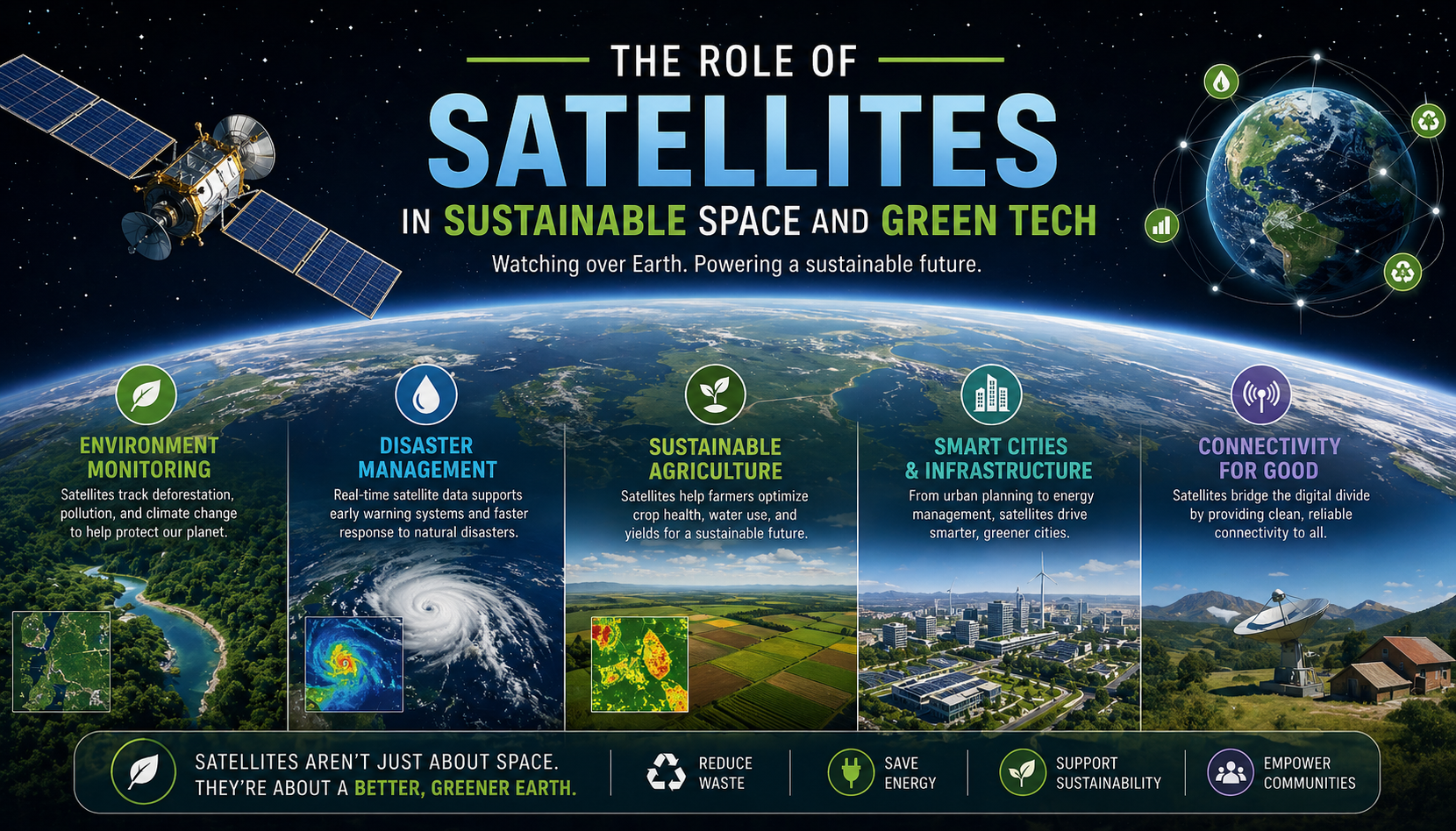
Satellites for sustainability play crucial roles in achieving global environmental objectives. Climate monitoring depends entirely on space-based observations that track atmospheric composition, ocean temperatures, ice sheet changes, and vegetation health across decades. These long-term records reveal trends impossible to detect through ground observations alone.
Precision agriculture reduces resource waste through satellite-guided farming. Farmers apply water, fertiliser, and pesticides only where needed rather than blanketing entire fields. This targeted approach cuts costs while minimising environmental impact. Satellite data helps producers increase yields using fewer inputs, directly supporting food security and environmental conservation.
Renewable energy optimisation leverages space-based weather forecasting. Solar and wind farm operators receive accurate predictions, enabling efficient grid integration. Satellites track cloud movements, measure atmospheric conditions, and provide data that maximises clean energy generation. Green space technology supports the transition away from fossil fuels through better resource planning.
Disaster early warning systems save lives while reducing economic and environmental damage. Satellites detect developing hurricanes, monitor drought conditions, and track wildfire spread. According to UN space sustainability research, these capabilities enable proactive responses that minimise destruction compared to reactive approaches after disasters strike.
The Environmental Cost of Space Operations
Launch emissions remain a significant concern as satellite deployment accelerates. Rocket exhaust releases water vapour, carbon dioxide, and other compounds into the upper atmosphere. While individual launches contribute less than aviation overall, the space industry’s rapid growth demands attention to emissions reduction.
Manufacturing satellites consumes substantial energy and materials. Clean room facilities require constant temperature and humidity control. Testing procedures involve thermal vacuum chambers, vibration tables, and electromagnetic compatibility chambers—all energy-intensive operations. Sustainable satellite technology requires rethinking production processes to minimise environmental impact.
Electronic waste becomes problematic when organisations do not consider end-of-life disposal. Circuit boards contain precious metals and hazardous materials requiring careful recycling. Component manufacturing generates waste streams that demand responsible management. Green space technology extends to supply chains and material sourcing.
Orbital debris poses environmental risks in space itself. Dead satellites, rocket stages, and collision fragments create hazards for operational spacecraft. Each collision generates more debris in cascading reactions that could render certain orbits unusable. Sustainable space technology must address debris mitigation as urgently as terrestrial pollution.
Designing Satellites for Sustainability
Modular satellite architecture enables component reuse and upgrading. Rather than replacing entire satellites when technology advances, operators could swap outdated instruments for modern sensors. This approach extends mission lifetimes while reducing launch requirements. Satellite parts for sustainability include standardised interfaces supporting future modifications.
Power-efficient components reduce energy demands throughout satellite lifecycles. Modern processors deliver more computing capability while consuming less electricity. Solar panel efficiency improvements mean smaller arrays generate equivalent power. These advances shrink satellite footprints both physically and environmentally.
Radiation-hardened commercial components cost less and enable faster development than traditional space-grade electronics. This shift toward commercial technology makes sustainable satellite technology more economically viable. Lower costs encourage longer mission planning and better component selection.
Extended mission designs incorporate propulsion for end-of-life deorbiting. Satellites equipped with thrusters can remove themselves from crowded orbital zones when missions are complete. Some designs enable moving defunct spacecraft to graveyard orbits, clearing paths for operational systems. Sustainable space technology requires planning disposal before launch.
How Satellites Reduce Environmental Impact on Earth
Forest monitoring prevents illegal logging through continuous surveillance. Satellites detect clearing activity within days, enabling enforcement before extensive damage occurs. This capability protects carbon sinks essential for climate stability. Green space technology directly supports conservation efforts that would be impossible using ground patrols alone.
Ocean health tracking reveals pollution sources, illegal fishing, and ecosystem changes. Satellites monitor algae blooms, track plastic accumulation, and measure sea surface temperatures. This information guides policy decisions and enforcement actions protecting marine environments. Sustainable space technology enables ocean stewardship at global scales.
Urban heat island mapping helps cities reduce energy consumption. Satellite thermal imaging reveals which neighbourhoods suffer excessive temperatures from poor planning. City administrators use this data to prioritise tree planting, green space development, and reflective roofing programs. Space-based observations inform sustainable urban development directly.
Carbon emission monitoring holds industries and nations accountable for climate commitments. Satellites detect methane leaks from pipelines, measure carbon dioxide concentrations, and track emission sources globally. This transparency supports climate action by providing objective measurements that verify reported data. How satellites reduce environmental impact includes enabling the enforcement of environmental agreements.