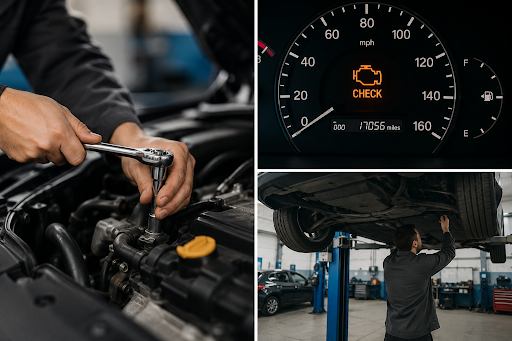
That grinding noise when you brake. The engine warning light that appeared last Tuesday and has not gone away. The slow crank on a cold morning that makes you hold your breath. Every driver in the UK knows the feeling, something is not right, and you are not sure whether to worry or wait.
The truth is, most car problems do not appear out of nowhere. They send signals first. The drivers who catch them early save money. The ones who ignore them end up with breakdowns, tow trucks, and repair bills that could have been avoided. This guide covers the 15 most common car problems, what they feel like, what they cost, and how to spot them before they escalate.
Why Cars Develop Problems Over Time
Cars are made up of thousands of moving parts, fluids and electrical systems, all working together under constant stress. Heat, vibration, weather and mileage gradually wear these components down. Short journeys, cold winters and infrequent servicing can all speed up wear and tear, particularly on components like batteries, brakes and tyres.
Understanding what is normal wear versus what signals a genuine fault is the first step to keeping your car reliable and safe.
At TJ Services in Fleet, we diagnose every problem on this list weekly. Not from a manual — from cars that have been driven in with exactly these symptoms. The difference between a £50 fix and a £500 fix is usually how early the driver acted. Here is what we check first when each of these problems walks through our door.
The 15 Most Common Car Problems
1. Battery Issues
A weak or dead battery is one of the most frequent reasons drivers get stranded, especially during colder months. Symptoms include slow engine cranking, dashboard warning lights, or the car failing to start altogether. Batteries typically last several years before their capacity fades, and cold weather makes the problem worse. Diagnosis usually involves a simple voltage test, and repair costs depend on whether the battery needs charging, testing, or full replacement.
2. Brake Problems
Squealing, grinding, or a soft brake pedal are all signs that your braking system needs attention. Worn brake pads, low brake fluid, or a faulty master cylinder are common culprits. Because braking is a safety-critical system, any unusual noise or feel should be checked promptly.
Costs vary depending on whether it is pads, discs, or a more involved hydraulic issue.
We see this constantly: a driver ignores squealing for three weeks because ‘it still stops fine.’ By the time they reach us, the metal backing plate is grinding into the disc. A £140 pad replacement becomes a £380 pad-and-disc job. The noise was the warning, not the problem.
3. Tyre Wear and Damage
Uneven tread wear, bulges, or frequent pressure loss point to tyre problems that affect both safety and fuel efficiency. Poor wheel alignment, underinflation and general age all contribute to premature wear. Checking tread depth regularly and rotating tyres where appropriate helps extend their lifespan. Replacement costs depend on the tyre size, brand, and the number of tyres affected.
At TJ Services, we include tyre inspection as standard with every MOT test in Fleet. Worn tyres are one of the most common MOT failures we see, and they are also one of the most preventable. We inspect tread depth, sidewall condition, and alignment, and we maintain a stock of common sizes for same-day fitting if needed.
4. Engine Warning Light
That small light on your dashboard can mean anything from a loose fuel cap to a serious engine fault. It is triggered by the car’s onboard diagnostic system detecting a fault code. Ignoring it is risky, as small issues can develop into expensive repairs if left unresolved. A diagnostic scan is the quickest way to identify exactly what has triggered the light.
5. Overheating Engine
An engine that runs hotter than normal, or a temperature gauge creeping into the red, usually points to a cooling system issue. Common causes include low coolant, a failing thermostat, or a faulty water pump. Overheating should never be ignored, as continued driving can cause serious engine damage. A mechanic will typically check coolant levels, hoses and the radiator to pinpoint the cause.
6. Oil Leaks
Dark patches under your parked car, a burning smell, or a dropping oil level on the dipstick are classic signs of an oil leak. Leaks often stem from worn gaskets, seals or a loose sump plug. Left unchecked, low oil levels can cause serious engine wear. Diagnosis involves inspecting the engine bay for the source, with repair costs depending on which seal or gasket needs replacing.
7. Transmission Trouble
Jerky gear changes, slipping gears, or unusual noises when shifting are signs your transmission needs inspecting. Automatic and manual gearboxes both suffer from wear over time, often linked to old or low transmission fluid. This is one of the more complex repairs, so early diagnosis genuinely helps limit the damage.
8. Suspension Problems
A bouncy or unstable ride, uneven tyre wear, or clunking noises over bumps usually point to worn suspension components such as shock absorbers or springs. Poor road surfaces and higher mileage both accelerate suspension wear. A test drive combined with a physical inspection is the standard way to diagnose the fault.
The potholed A-roads around Hartley Wintney and the speed humps in Church Crookham punish suspension harder than motorway cruising. We see more shock absorber failures on cars that do short rural runs than on those that cover 20,000 motorway miles a year.
9. Exhaust System Issues
A louder-than-usual engine note, a smell of fumes inside the cabin, or visible rust and holes in the exhaust pipe all indicate exhaust problems. The exhaust system does more than quieten the engine; it channels harmful gases away from the vehicle, controls emissions through the catalytic converter, and maintains the back-pressure your engine needs to run efficiently.
When the exhaust develops a hole or leak, gases escape before reaching the tailpipe. That is why you smell fumes inside the cabin, carbon monoxide and other gases are entering the vehicle through gaps in the floorpan or vents. This is not just unpleasant; it is dangerous. A leaking exhaust can also cause the engine to run lean, which increases combustion temperatures and risks damaging valves or the catalytic converter over time.
Rust is the most common cause of exhaust failure in the UK, particularly on cars that do frequent short journeys. The exhaust never gets hot enough to evaporate the moisture that condenses inside it, so the inside of the pipe corrodes from the inside out. By the time you see a hole on the outside, the damage is often extensive. These issues affect emissions and will cause an MOT failure if not addressed. We inspect the full exhaust system during every MOT, not just the visible pipe, but the mounts, joints, and catalytic converter condition.
10. Electrical Faults
Flickering lights, malfunctioning windows, or dashboard warnings that come and go can all be traced back to electrical faults. Wiring corrosion, blown fuses and failing sensors are common causes. These problems are often intermittent; the fault appears one morning, disappears for three days, then returns. That pattern makes them frustrating to diagnose without proper equipment.
The reason is simple. A corroded wire may only lose contact when the engine bay heats up, and the metal expands. A failing sensor may only throw a code when the car is cold. A DIY code reader might show nothing because the fault was not active when you plugged it in. We use live data diagnostics that monitor the electrical system while the engine runs, not just when it is stationary. This catches intermittent faults that a static scan misses.
Common electrical issues we see in Fleet include failed window regulators on VW Group cars, corroded earth points on Japanese imports that have seen salted winter roads, and parasitic drains from aftermarket alarms or dashcams wired incorrectly. The fix is rarely the part alone, it is finding where the circuit is breaking down.
11. Starter Motor Failure
If you turn the key and hear a clicking sound but the engine does not turn over, the starter motor may be at fault. This differs from a flat battery, though the symptoms can seem similar at first. A flat battery produces rapid clicking; the relay tries to engage, but there is not enough power. A starter motor fault usually produces a single loud click, or nothing at all, because the solenoid is not engaging the drive gear with the flywheel.
The starter motor is a high-torque electric motor that physically turns your engine over at around 200-300 rpm until combustion begins. Every start cycle wears the carbon brushes and copper contacts inside. After 100,000+ miles, the brushes wear down, the contacts pit, and the motor loses its ability to generate enough torque, especially when cold, because cold oil makes the engine harder to turn.
12. Alternator Problems
The alternator keeps your battery charged while driving, so a failing one often shows up as dimming headlights, a battery warning light, or electrical accessories behaving oddly. Left unresolved, this can leave you with a flat battery even after driving. Testing the charging system is a quick way to confirm whether the alternator is the culprit.
13. Clutch Wear
For manual cars, a clutch that feels spongy, slips under acceleration, or makes the biting point feel unusually high or low is a sign of wear. The clutch is the mechanical link between your engine and gearbox. When you press the pedal, the clutch plate disengages from the flywheel, allowing you to change gears. When you release the pedal, the plate re-engages, transferring power to the wheels.
Every gear change wears the friction material on the clutch plate slightly. Stop-start traffic and frequent short journeys speed up this wear because you are riding the clutch, keeping it partially engaged, more often. Hill starts, reversing, and slow-speed manoeuvres are particularly hard on the clutch because the plate slips against the flywheel to control speed, generating heat that degrades the friction material faster.
A slipping clutch is often the first sign. You press the accelerator, the engine revs rise, but the car does not accelerate as it should. That is the clutch plate failing to grip the flywheel. Left unchecked, the metal backing plate will contact the flywheel directly, scoring the surface and turning a clutch replacement into a flywheel machining job, doubling the cost.
14. Air Conditioning Faults
Weak airflow, warm air instead of cold, or strange smells from the vents point to an air conditioning issue. Your car’s air conditioning does more than keep you cool in summer. It is a dehumidifier. When you press the demist button in winter, the AC compressor runs to remove moisture from the air before it hits the windscreen. Without it, you are blowing damp air at a cold surface, which makes condensation worse, not better.
Low refrigerant is the most common cause of weak cooling. The AC system is sealed, so if the level is low, there is a leak somewhere, usually a failed O-ring at a joint, or porosity in the condenser from stone chips. A blocked cabin filter restricts airflow and can cause musty smells because the trapped moisture breeds bacteria. We do not just top up refrigerant and send you on your way. We pressure-test the system, check for leaks with UV dye, and replace the cabin filter as part of a full AC service. A proper recharge with leak detection takes about 90 minutes and lasts, a quick top-up from a canister at the petrol station rarely does
15. Steering Problems
Stiff steering, unusual noises when turning, or the car pulling to one side can indicate power steering fluid issues or worn steering components. Modern power steering systems use either hydraulic pressure from a pump driven by the engine or electric motors built into the steering column. Hydraulic systems rely on fluid pressure to assist your input; electric systems use torque sensors and motors. The symptoms differ slightly depending on which system your car has.
Hydraulic systems: low fluid causes whining when turning, stiff steering at low speed, and eventually pump failure if the leak is ignored. The fluid is usually red or pink; a puddle under the front of the car after parking overnight is a clear sign. Electric systems: failure is usually sudden, the steering goes heavy without warning, often accompanied by a dashboard warning light. There is no fluid to leak, so the fault is typically in the motor, the control module, or the torque sensor.
When to See a Mechanic
Some symptoms are safe to monitor for a short while, others need immediate attention. As a general guide.
- Any warning light relating to brakes, oil pressure or engine temperature should be checked the same day.
- Unusual noises that get progressively louder or more frequent are worth investigating sooner rather than later.
- Anything affecting steering, braking or tyre grip should never be left, given the safety implications.
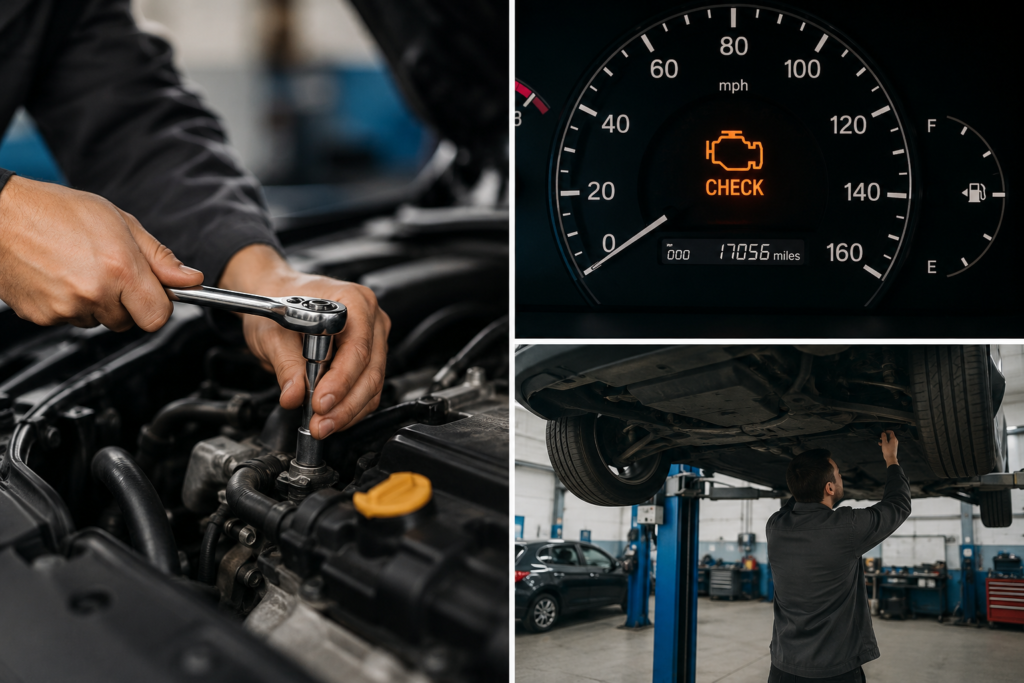
Booking in for a routine service is the easiest way to catch these problems before they turn into something bigger. Our car service in Fleet includes a full 15-point health check covering every problem on this list, battery, brakes, tyres, fluids, belts, and more. We flag what needs attention now, what can wait, and what to watch for. No surprises, no pressure
Understanding Repair Costs: What Influences the Final Bill
While every car problem is different, a few consistent factors tend to shape what you end up paying for a repair. Knowing these can help you understand why two seemingly similar faults can cost very different amounts to fix.
Parts versus labour. Some repairs are dominated by the cost of parts, such as a full exhaust replacement, while others are mostly labour, such as diagnosing an intermittent electrical fault. Jobs that require partial disassembly of the engine or dashboard tend to carry higher labour charges simply because of the time involved.
Make and model. Certain vehicles use parts that are harder to source or more specialised in design, which can push costs up regardless of the fault itself. Older cars sometimes face the opposite issue, where parts availability becomes limited as models age.
How early the fault is caught. This is often the biggest factor of all. A worn brake pad caught early is a straightforward, relatively inexpensive job. Left too long, it can damage the brake disc as well, turning one repair into two. The same pattern applies to oil leaks, coolant issues and clutch wear, where early attention almost always costs less than delayed attention.
Diagnostic complexity. Faults with a single obvious cause, like a flat tyre, are quick to diagnose and fix. Problems with multiple possible causes, such as an engine warning light or an electrical fault, may need more diagnostic time to pinpoint accurately before any repair work begins.
Routine maintenance history. Cars that have been serviced regularly tend to develop fewer surprise faults, since small issues are typically flagged and addressed along the way. This is one of the clearest arguments for keeping up with scheduled servicing rather than waiting for something to go wrong.
Understanding these factors will not tell you exactly what a specific repair will cost, but it does explain why timing, vehicle type and fault complexity all play a role in the final bill, and why early diagnosis is consistently the more affordable path.
Conclusion
Car problems rarely appear out of nowhere. Most issues, from battery faults to suspension wear, give off warning signs well before they cause a breakdown. Paying attention to unusual noises, dashboard lights or changes in how your car feels to drive can save you time, stress and unnecessary expense.
Staying on top of routine maintenance remains the most reliable way to keep small issues from becoming major repairs. If you have noticed any of the symptoms above, or you are not sure whether that noise is normal, find TJ Services on Google to check our hours, read reviews from drivers in Fleet and Farnborough, and book your check online or by phone.
Frequently Asked Questions
What is the most common car fault in the UK?
Battery and lighting faults are consistently among the most reported issues, particularly during colder months when batteries are put under extra strain.
How often should I get my car checked?
Most manufacturers recommend a service once a year or every 10,000 to 12,000 miles, whichever comes first, alongside your annual MOT.
Can I still drive with the engine warning light on?
It depends on the cause. Driving a short distance carefully is usually fine, but a full diagnostic check should be booked as soon as possible to avoid further damage.
Why does my car pull to one side while driving?
This is often linked to tyre pressure, wheel alignment or worn steering and suspension components, and should be checked promptly for safety.
How do I know if it is my battery or my alternator?
A flat battery that recharges and holds charge is usually a battery issue, while a battery that keeps draining while driving points to the alternator.