Story points are a unit agile teams use to estimate the relative effort of their work. Instead of guessing hours, the team scores each user story against the others. A story point captures complexity, uncertainty, and workload in a single number.
This relative approach keeps estimates stable even when team members work at different speeds. The team focuses on how hard a task is compared to others, not on how long one person might take to finish it.
What Are Story Points?
Story points are an abstract measure of effort assigned to a user story. They combine three factors: how complex the work is, how much is unknown, and how much there is to do. The team agrees on a scale, then scores each story against a reference.
Because points are relative, they stay consistent across sprints. A five-point story should always feel like roughly five times a one-point story. This consistency lets teams forecast capacity without committing to fixed hours.
How Do You Estimate With Story Points?
Teams estimate story points through discussion and comparison. A shared reference story keeps the scale anchored, and a card-based vote keeps each estimate independent.
- Pick a small, well-understood story as the reference point.
- Assign it a baseline value, often one or two points.
- Compare each new story to that reference.
- Vote privately, then reveal all cards together.
- Discuss outliers and re-vote until the team agrees.
Why Use Story Points Instead of Hours?
Story points measure relative effort, which makes them more reliable than hour estimates. Hours depend on who does the work, while points describe the work itself. That distinction keeps forecasts steady as a team’s members change.
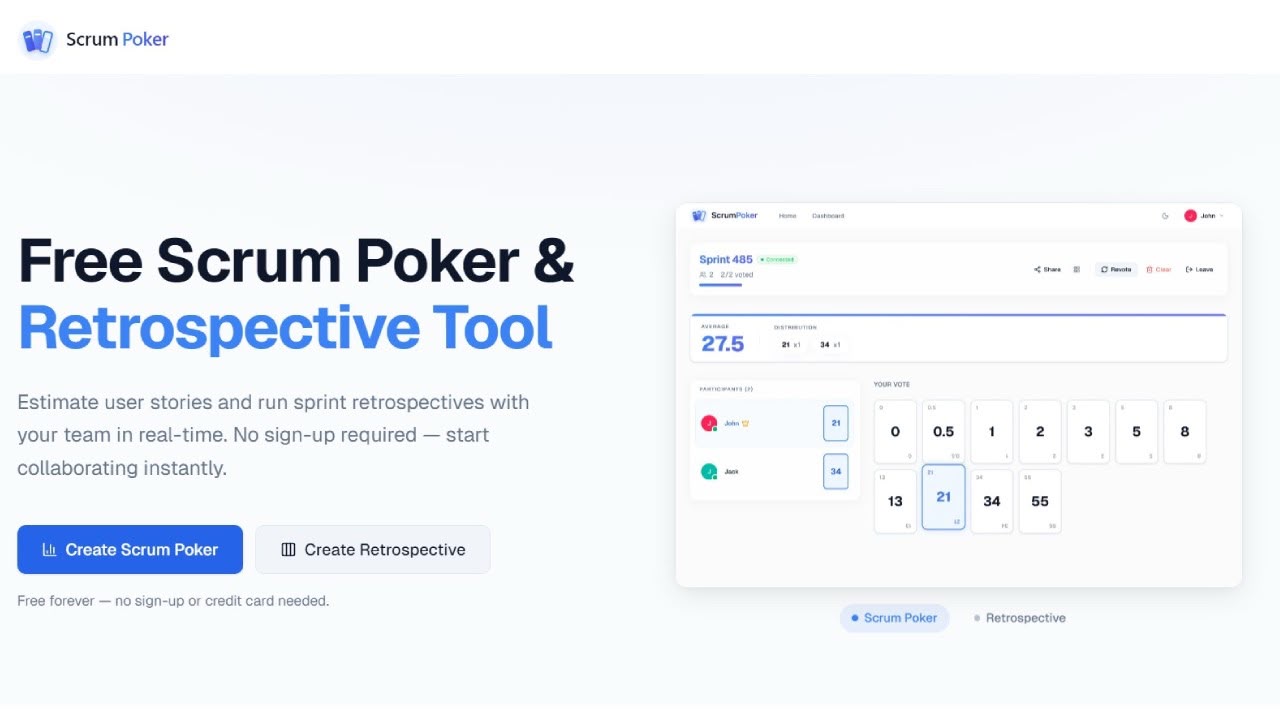
Teams often assign story points in a real-time room so everyone votes at once without bias. The main advantages of points over hours include the following.
- Estimates stay consistent regardless of who is assigned.
- Relative sizing is faster than calculating exact hours.
- Velocity becomes a stable planning metric over time.
- The team focuses on scope rather than personal speed.
Common Story Point Scales
Most teams choose a scale where the gaps widen as work grows larger. The table below compares the scales teams use most.
| Scale | Values | Why Teams Use It |
|---|---|---|
| Fibonacci | 1, 2, 3, 5, 8, 13 | Gaps reflect rising uncertainty |
| Powers of two | 1, 2, 4, 8, 16 | Simple doubling for clear contrast |
| T-shirt | S, M, L, XL | Quick sizing before detailed planning |
How Many Story Points Fit in a Sprint?
The number of points a team completes per sprint is its velocity. Velocity is measured, not set in advance, and it stabilizes after a few sprints. The notes below explain how to use it.
- Track completed points across at least three sprints.
- Use the average as a planning guide, not a target.
- Re-check velocity after team or scope changes.
Story Point Mistakes to Avoid
A few common errors distort story points and weaken planning. Avoiding them keeps the metric meaningful.
- Converting points directly into hours.
- Comparing velocity between different teams.
- Inflating points to look more productive.
- Estimating stories the team does not yet understand.
Frequently Asked Questions
Do story points equal hours?
No. Story points measure relative effort, while hours measure time. A team may complete a three-point story faster than a colleague on another team, yet the points stay the same. Mapping points to hours removes the main benefit, which is estimates that hold steady regardless of who does the work.
Who assigns story points?
The whole development team assigns story points together, not a single manager. Each member votes, and the team discusses any disagreement before settling on a number. This shared process captures different perspectives on complexity and risk, which produces estimates the entire team understands and supports.
What scale should we use for story points?
Most teams start with the Fibonacci sequence because its widening gaps reflect growing uncertainty. Powers of two and T-shirt sizes also work well. A tool like Scrum Poker lets you switch scales per room, so the team can experiment and settle on the model that fits its work.
How do story points relate to velocity?
Velocity is the total story points a team completes in a sprint. After a few sprints, velocity stabilizes and becomes a planning guide for how much work to pull in next. It should be measured rather than set as a target, since pushing for higher velocity often distorts the estimates.