Mobile gaming isn’t just a hobby anymore. Games today look and play almost like console titles — sharp graphics, fast frame rates, big open worlds. But the more powerful these games get, the more heat they push out of your phone. And heat is a real problem.
If your phone gets too hot, it starts working against you. That’s why phone coolers have gone from a niche gadget to something serious players actually rely on.
What Overheating Actually Does to Your Game
Your phone is a small device doing a lot of heavy lifting. Running a graphically intense game pushes your processor and GPU hard, and all that work turns into heat. Phones don’t have much room to breathe, so when the temperature climbs too high, your device kicks in a self-protection mode — and that’s where your gaming experience falls apart.
Here’s what you’ll notice:
- Frame drops. Your game starts to stutter. The action gets choppy at the worst possible moments — usually during a fight or a critical in-game event.
- Thermal throttling. This is the big one. When your phone overheats, it slows down its own chip on purpose to bring the temperature down. That flagship processor you paid for? It can drop to mid-range performance within a few minutes of heavy play.
- Slower touch response. Heat can make your screen less responsive. Your taps and swipes feel slightly delayed. In a competitive game, a fraction of a second is the difference between winning and losing.
- Battery damage. Heat wears out your battery faster. The more often your phone runs hot, the sooner you’ll notice it doesn’t hold a charge like it used to.
None of this shows up in a spec sheet. You only feel it after an hour-long session when you need your phone to perform its best.
Games in 2026 Push Hardware Hard
Mobile games have changed a lot. What used to be simple, low-power apps are now full-blown titles with ray-traced lighting, 120Hz refresh rates, and detailed open worlds. These features look great, but they demand a lot from your hardware — constantly.
A 120fps game means your chip is working non-stop with no downtime. Ray tracing adds extra load on top of that. If you’re also cloud gaming or streaming at the same time, your phone is basically sprinting from the moment you hit play.
Phone makers have added better internal cooling over the years — vapor chambers, heat spreaders, smarter chip designs. But a thin phone can only move so much heat on its own. For long sessions, it’s often not enough.
How a Cooler Changes Your Sessions
Quick 20-minute gaming sessions? Most phones handle that fine. It’s the long hauls that cause trouble — ranked matches, tournament play, hours of streaming.
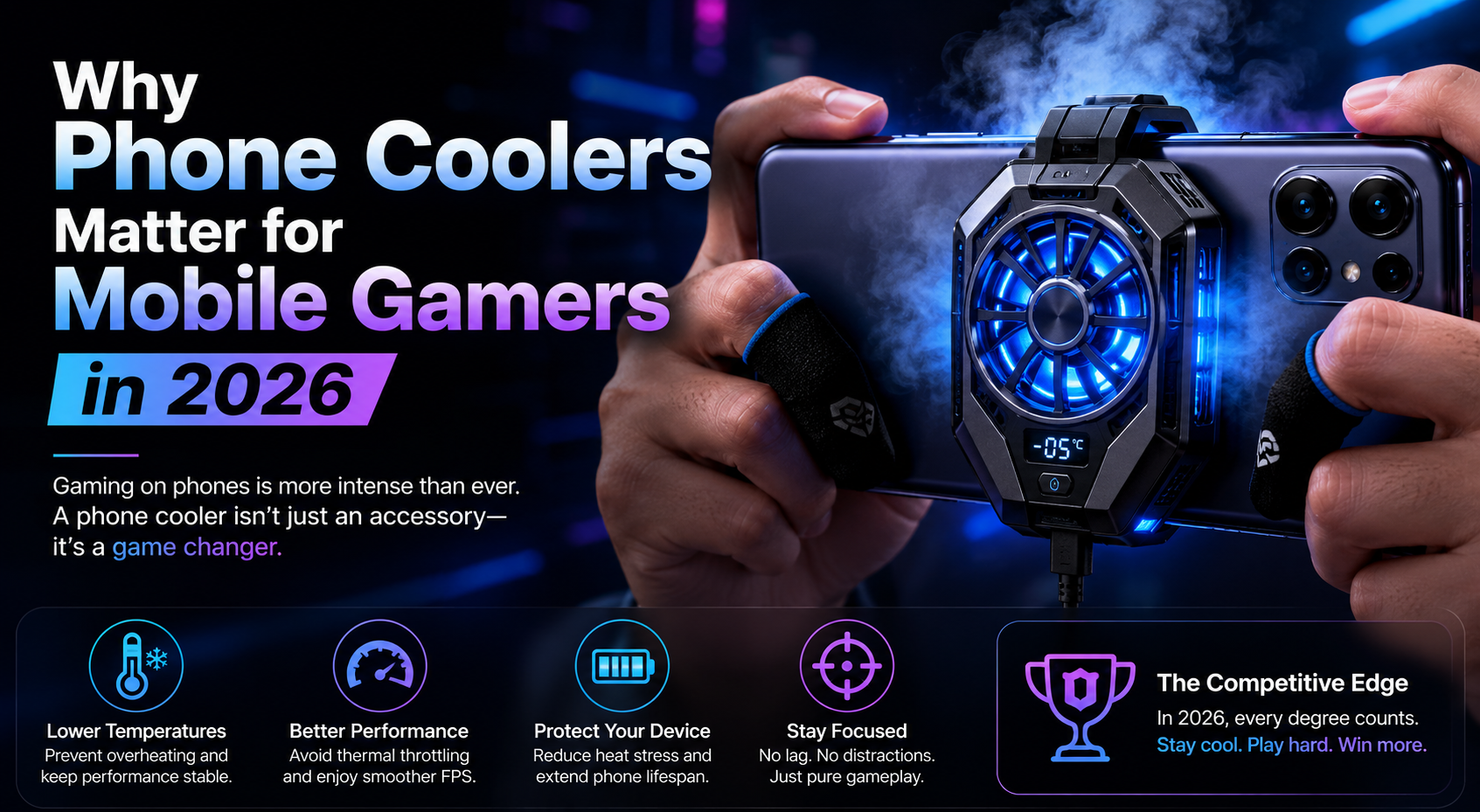
An external cooler pulls heat away from the back of your phone and keeps the chip running at full speed rather than throttling. In practice, that means more consistent frame rates, a touchscreen that stays sharp, and fewer frustrating drops mid-session.
For streamers, the difference is even bigger. Running a game, encoding video, and uploading a stream all at the same time generates a ton of heat quickly. A cooler helps your phone handle all of that without forcing you to take a break.
Over time, there’s another benefit: keeping your phone cooler protects your battery. A battery that doesn’t regularly overheat holds its capacity longer.
The Main Types of Phone Coolers
There are three main options, and each suits a different kind of player.
Clip-On Fans
The simplest and most affordable type. A small fan attaches to the back of your phone and blows air across the surface to carry heat away. Lightweight, easy to use, and usually plugs in through USB.
Good for casual players or anyone who wants a basic cooling boost without spending much. It won’t cool as aggressively as more advanced options, but it makes a noticeable difference for normal gaming sessions.
Semiconductor (Peltier) Coolers
These are the high-performance option. A Peltier element inside the cooler actively chills a metal plate that sits against your phone. It doesn’t just move heat away — it actively brings the temperature down, fast.
The downside: they need a power source to run, and if you’re not careful, they can cause condensation. But for competitive players and streamers who run demanding games for hours, the performance gap is real. The TH28, TH12Ai Magnetic Phone Cooler is a good reference point here — it uses a semiconductor element, attaches magnetically, and is priced under $50. It’s the kind of cooler built for sessions where you genuinely can’t afford throttling.
Cooling Cases
A cooling case covers your phone like a regular case but adds some form of thermal management — either a built-in fan or materials designed to spread heat more evenly.
They’re a practical pick if you want one product that handles both protection and cooling. The cooling effect is generally softer than a dedicated cooler, but you don’t need to carry anything extra.
Which One Should You Get?
It depends on how you play. Casual gaming? A clip-on or dual-fan model is probably all you need. Competitive play or long streaming sessions? A semiconductor cooler gives you the most reliable results. Want something simple and always-on? A cooling case is a solid everyday option.
The core idea is the same regardless of which you choose: as games push phones harder, managing heat is part of getting the performance you’re actually after.
Bottom Line
More powerful games mean more heat. And more heat means frame drops, slower response, throttled performance, and a battery that wears out sooner. These are real, everyday problems for mobile gamers — not edge cases.
A phone cooler won’t make your games look better, but it will help them run the way they’re supposed to — consistently, from the first minute to the last. For anyone who games seriously, that’s worth it.