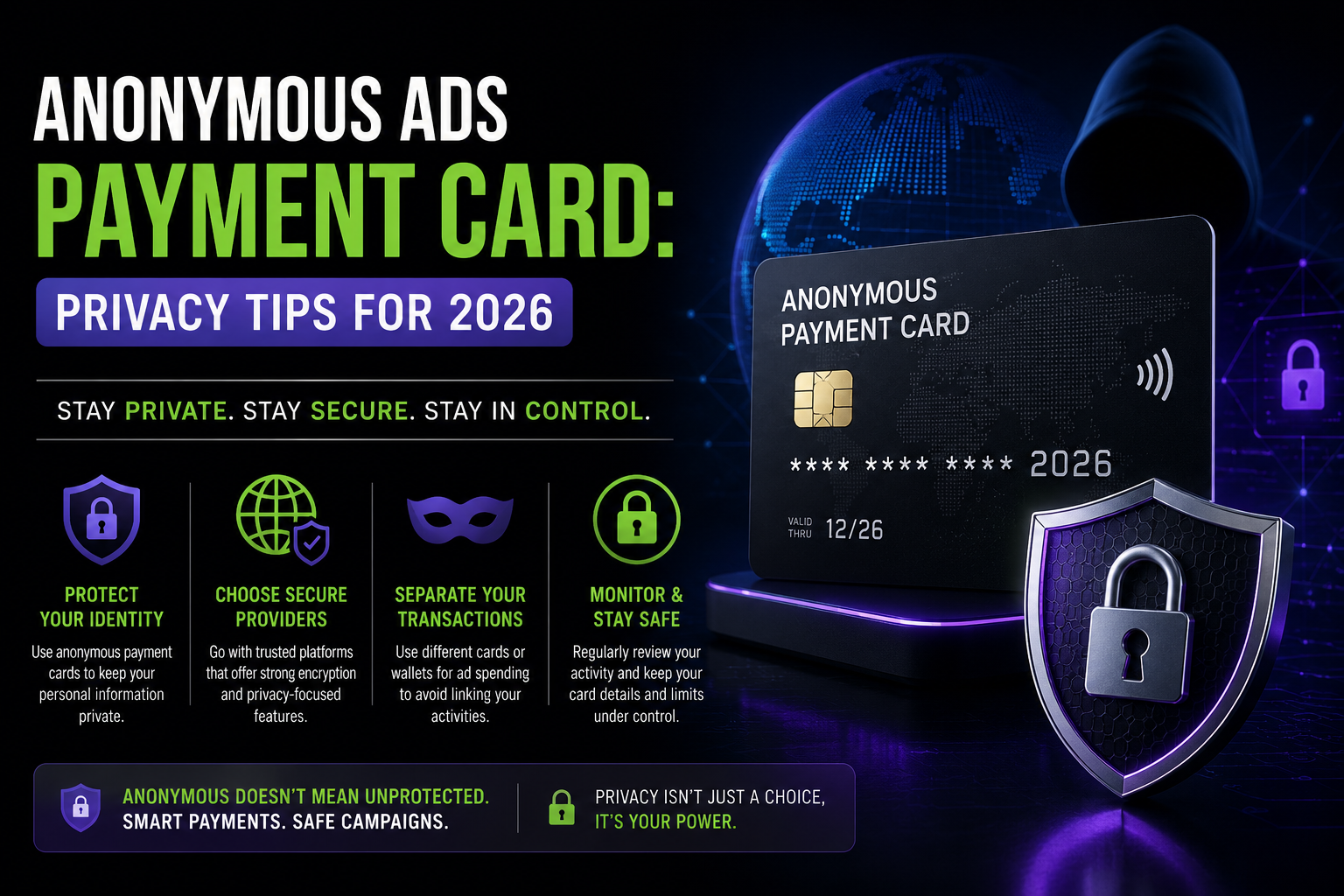
Media buyers running campaigns on Meta, Google, and TikTok know the drill: link a card, wait for approval, then hope the platform doesn’t flag it. But when every ad account ties back to the same personal debit card, one disapproval can cascade into a frozen account, exposed banking details, or a support ticket that goes nowhere. That’s why so many marketers now search for an anonymous ads payment card – something that separates business ad spend from a personal bank account without breaking platform rules.
This guide looks at what “anonymous” actually means for a payment card in 2026, why total anonymity isn’t realistic (or legal) for regulated spend, and how to pick a privacy-focused card that genuinely reduces exposure for ad account funding.
Why “Anonymous” Rarely Means Untraceable
Search for an anonymous ads payment card and most results promise something they can’t deliver: a card that no one can trace back to you. That’s not how regulated payment rails work.
Card issuers, whether they’re traditional banks or crypto-funded platforms, operate under anti-money-laundering (AML) rules. Most require some form of identity verification before a card gets issued, even if that verification happens once during signup rather than every time a merchant runs a charge. A genuinely no-KYC virtual card exists, but it’s usually limited in what it can fund or where it can be used, and it still leaves a transaction trail with the issuer.
What an anonymous ads payment card can realistically offer is business-level privacy: the merchant (in this case, Meta, Google, or TikTok) sees a card number, an expiration date, and a CVV – not a personal name, home address, or bank account number. That’s a meaningful layer of protection. It’s just not the same as being untraceable, and any provider claiming otherwise should raise a flag.
What Privacy-Focused Ad Spend Actually Looks Like
Privacy Card-style services (Privacy.com is a well-known example in the US) work by generating virtual card numbers that sit between the merchant and the actual funding source. The merchant only ever sees the virtual number. Some platforms even offer a private spend mode that limits how much transaction detail gets shared beyond the basic charge.
Crypto-funded cards work on a similar principle, but the funding source is a stablecoin wallet instead of a checking account. Load USDT or USDC onto a virtual card, and the ad platform sees standard card details – nothing that connects back to a personal wallet address or exchange account.
So the honest framing isn’t “anonymous” in the absolute sense. It’s privacy within the rules: separating identity from transaction data at the merchant level, while the issuer still verifies who’s using the account for compliance reasons. That distinction matters, especially for anyone funding ad accounts as part of a registered business.
The Real Risks of One Card Funding Every Ad Account
Media buyers running multiple accounts across clients or verticals often default to one personal or business card for everything. It’s convenient, until it isn’t.
- Cross-account flagging. Ad platforms sometimes link accounts through shared payment methods. If one account gets banned or restricted, the same card on other accounts can get swept into review.
- Exposed personal banking data. A personal debit card shared across ad dashboards, freelance platforms, and client billing portals increases the surface area for fraud or data leaks.
- Slow recovery after a decline. A single bank-issued card that gets frozen or fraud-flagged can take days to replace, stalling campaigns that need daily budget top-ups.
- No separation between clients. Agencies managing several advertisers on one card lose the ability to track spend cleanly per client or campaign.
None of this is about hiding from a platform’s terms of service. It’s about not putting a single point of failure – and a single piece of personal financial data – behind every campaign a marketer runs.
What to Look For in an Anonymous Ads Payment Card
Not every privacy card for ad spend is built the same way. A few criteria separate the useful ones from the gimmicks.
Reload flexibility
Ad budgets change fast. A card that takes days to top up, or that locks funds until a batch threshold is met, doesn’t fit a media buyer’s rhythm. Look for near-instant reloads, ideally something that can be triggered from a phone between meetings.
Fee transparency
Hidden card-loading fees or vague “processing charges” add up quickly across dozens of campaigns. A flat, disclosed top-up fee is easier to model into cost-per-acquisition math than a fee structure that shifts by transaction size or currency.
Multi-account compatibility
Generating a fresh card number per client or per ad account, without opening a new bank account each time, is one of the biggest practical wins of virtual cards. It keeps spend siloed and makes reconciliation far less painful come invoice time.
Issuance speed
Campaigns don’t wait for a card to arrive in the mail. Virtual cards issued in minutes rather than days are the baseline expectation now, not a bonus feature.
Where it’s accepted
Some masked-card providers restrict use to residents of a single country, which is a dealbreaker for agencies running international campaigns or freelancers billing clients across borders. A card accepted broadly wherever the network operates avoids that friction.
The table below summarizes how these factors typically play out across the three common options marketers compare.
| Factor | Traditional bank debit card | No-KYC prepaid card | Crypto-funded virtual card |
|---|---|---|---|
| Identity shared with merchant | Often (name, sometimes address) | Minimal | Card number only |
| Reload speed | Instant to 1-2 business days | Varies, often cash-based | Minutes, once crypto is in the wallet |
| Multiple cards per user | Limited, new applications needed | Sometimes restricted | Typically yes, fresh numbers on demand |
| International use | Depends on bank | Often US-only | Generally global, network-dependent |
| KYC required | Yes | Sometimes none | Usually yes, at account level |
How Crypto-Funded Virtual Cards Fit Into Ad Spend
For marketers and entrepreneurs already holding stablecoins, a crypto card for Facebook ads or Google campaigns solves a specific problem: it lets ad budgets move from a wallet to a spendable card number without touching a personal bank account at all.
Here’s roughly how it works with a platform like WaldenPay. A user registers, gets a unique deposit address for USDT (TRC20) or USDC (ERC20/TRC20), and sends stablecoins to that address. The funds land in an account wallet, and from there they get loaded onto a virtual card, ready in about 5 minutes. The card can go straight into Apple Pay or Google Pay, or its details can be entered manually into an ad platform’s billing page. There’s a flat 5% top-up fee each time the card gets loaded, plus a one-time card issue fee – both disclosed upfront, which matters for anyone trying to keep fee transparency in their spend calculations. Registration, balance checks, and support are free, and there’s no monthly maintenance charge sitting on top of campaign costs.
Because a new virtual card number can be generated without opening a new bank account, a media buyer running five client accounts can, in principle, keep five separate card numbers – each funded and tracked independently. That’s the multi-account compatibility that generic prepaid cards rarely offer. It’s worth checking WaldenPay’s pricing and fee structure directly before committing budget, since fee schedules can be updated over time.
WaldenPay isn’t the only option in this space, and it shouldn’t be treated as a way around a platform’s advertising policies. It’s a tool for keeping ad spend and personal banking separate, funded with stablecoins instead of a linked checking account, and subject to the same AML and regulatory checks any card issuer has to follow.
Practical Setup Tips Before Funding a Campaign
A few habits reduce friction and risk regardless of which privacy-focused card gets chosen.
- Test with a small transaction first. Before loading a full month’s ad budget, run a small charge through the card to confirm it processes cleanly on the platform.
- Keep registration details consistent. Using the same name, email, and business details across card signup and ad account setup avoids mismatches that can trigger manual review.
- Separate virtual cards for online use, physical cards for in-person spend. Ad accounts are entirely online, so a virtual-only card usually covers the need without extra plastic.
- Track fees against ROAS, not just spend. A flat top-up fee is predictable, but it should still be factored into cost-per-result models, especially for agencies billing clients on a pass-through basis.
- Don’t assume “private” means “risk-free.” Ad platforms can still flag accounts for reasons unrelated to the card – policy violations, IP mismatches, or account history. A privacy card for ad spend reduces one risk vector, not all of them.
A Few Ground Rules Worth Repeating
An anonymous ads payment card is a useful phrase for what marketers are actually looking for: separation between personal finances and business ad spend, fewer shared data points across platforms, and faster recovery when one account hits friction. It is not a way to dodge KYC entirely, evade a platform’s terms, or disappear from a payment trail. Every card issuer operating legally, crypto-funded or not, works within AML and know-your-customer frameworks. That’s not a limitation to work around. It’s the baseline that makes a privacy-focused card usable at scale, across countries, and across ad platforms that are themselves watching for the kind of misuse that gets whole ad networks in trouble.
For a media buyer choosing between a stack of personal debit cards and a purpose-built privacy card for ad spend, the practical differences come down to reload speed, fee clarity, and how easily a fresh card number can be spun up per account or per client. Crypto-funded options add one more layer: funding from stablecoins instead of a bank account, which suits anyone already paid or holding value in USDT or USDC. Anyone weighing the switch can compare setups in more depth through resources like WaldenPay’s guide on using a crypto card for Facebook ad campaigns, which walks through account-level specifics beyond what applies to general ad spend across platforms.