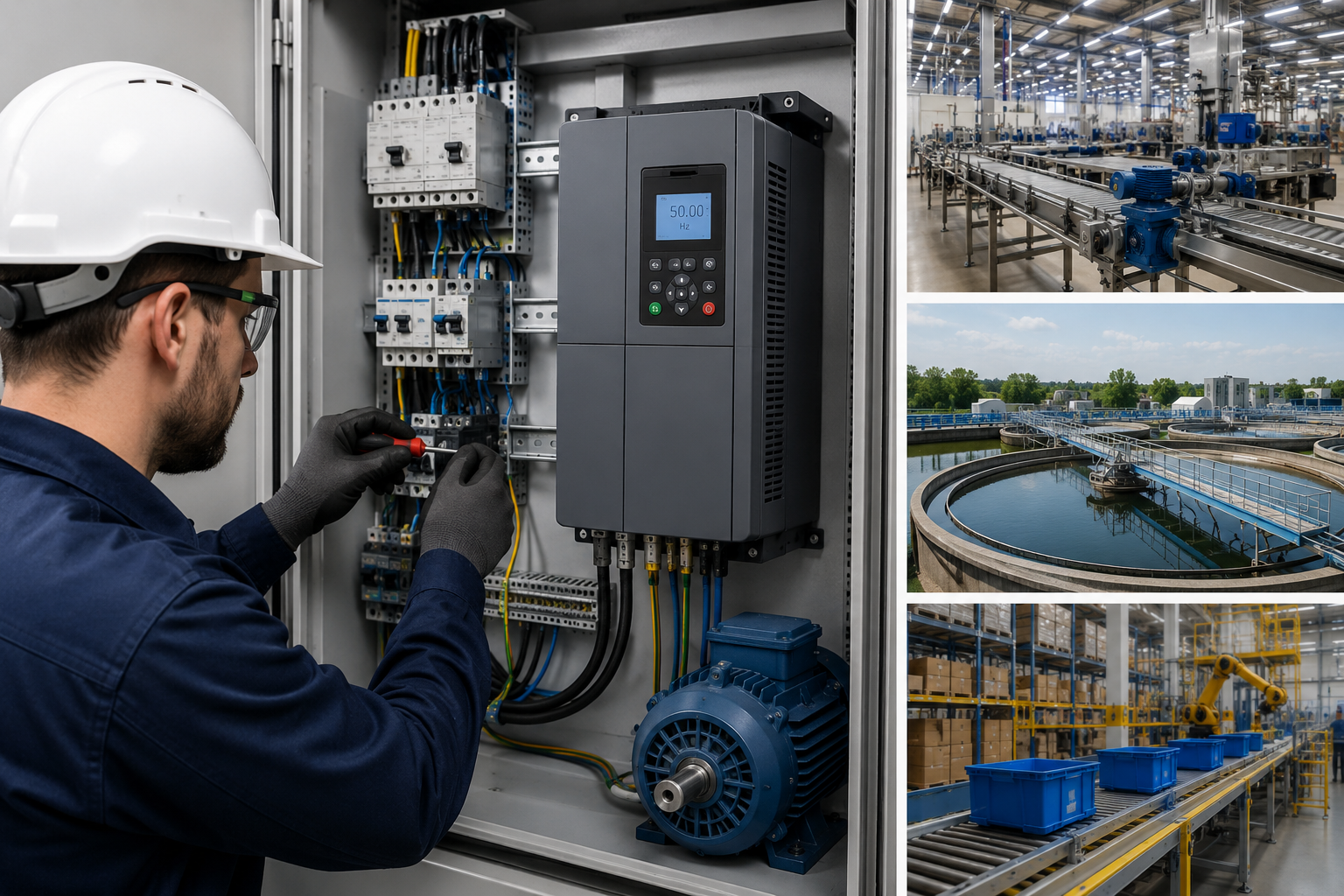
Modern industrial facilities across the UK increasingly rely on Variable Frequency Drives in order to improve energy efficiency, reduce equipment wear, and achieve precise motor control. Whether operating manufacturing plants in the Midlands, water treatment facilities in Yorkshire, food processing lines in Scotland, or warehouse automation across England, correctly installing a VFD is just as crucial as selecting the right drive.
Unfortunately, many performance issues blamed on the drive itself actually result from installation errors. Incorrect cable routing, poor grounding, inadequate cooling, or mismatched motor settings can reduce efficiency, increase maintenance costs, and shorten equipment lifespan.
This guide explains the most common installation mistakes, their technical impact, and how UK engineers can avoid costly downtime.
Why Proper VFD Installation Matters
A Variable Frequency Drive regulates the voltage and frequency supplied to an AC motor, allowing accurate speed and torque control.
Compared to direct-on-line (DOL) starting, VFDs can deliver significant operational advantages:
| Feature | Direct-On-Line Starter | Variable Frequency Drives |
| Starting Current | 600-800% rated current | 100-150% typical |
| Energy Consumption | High | Lower under variable loads |
| Mechanical Stress | High | Significantly reduced |
| Process Control | Fixed Speed | Fully adjustable |
| Equipment Life | Lower | Extended |
| Maintenance Costs | Higher | Lower |
According to the UK Energy Saving Trust and various industrial energy studies, motors account for approximately 65-70% of electricity consumed in industrial facilities, making efficient motor control one of the largest opportunities for reducing operational costs.
- Selecting the Wrong Drive Size
One of the most frequent mistakes is selecting a VFD based solely on motor horsepower or kilowatts. Many installers overlook:
- Overload requirements
- Starting torque
- Duty cycle
- Ambient temperature
- Switching frequency
- Application type
For example: A conveyor typically needs standard overload capacity. A crusher compressor may need high overload capacity exceeding 150%.
Oversizing the drive unnecessarily increases project cost, while undersizing often causes nuisance trips and premature component failure.
Always size the drive according to:
- Motor full-load current (FLC)
- Application duty
- Supply voltage
- Environmental conditions
- Required overload rating
Current rating should always take priority over motor power rating.
- Poor Panel Ventilation
VFDs generate heat continuously and without adequate airflow:
- Capacitor life decreases
- Semiconductor temperature rises
- Internal protection activates
- Thermal shutdown becomes common
Most manufacturers specify minimum clearances above and below the drive to maintain cooling airflow.
For UK installations inside enclosed MCC panels, engineers should consider:
- Filtered ventilation
- Forced cooling fans
- Heat exchangers
- Air-conditioned enclosures for harsh environments
Ignoring thermal management can reduce drive lifespan by years.
- Incorrect Cable Length
Cable length directly affects output voltage quality. Long motor cables create reflected wave voltages that may exceed insulation ratings, especially on modern variable speed electric motors.
Typical problems include:
- Insulation breakdown
- Premature bearing failure
- Excessive motor heating
- Electromagnetic interference
Many manufacturers recommend:
| Motor Cable Length | Recommended Solution |
| Under 25m | Standard installation |
| 25-100m | Output reactor |
| Above 100m | dV/dt filter or sine wave filter |
Always follow recommendations from the manufacturer rather than assuming longer cables are acceptable.
- Improper Grounding
Grounding problems remain one of the largest causes of unexplained VFD faults.
Poor earthing often leads to:
- Failures in communication
- Nuisance tripping
- Encoder errors
- Bearing currents
- Electrical noise
Best practices include:
- Low impedance earth connections
- Dedicated PE conductors
- EMC-compliant cable glands
- 360° shield termination
UK installations should also follow the requirements of BS 7671 (IET Wiring Regulations) where applicable.
- Ignoring EMC Requirements
Electromagnetic Compatibility (EMC) is often overlooked at the time of installation. VFD switching frequencies generate high-frequency electrical noise. Without proper EMC practices, facilities may experience:
- PLC communication errors
- Sensor faults
- Instrument interference
- Unstable automation systems
Recommended practices include:
- Screened motor cables
- Separate routing for power and control wiring
- EMC glands
- Proper cable shielding
- Manufacturer-approved filters
This is particularly important for industries such as pharmaceutical, food manufacturing, and automated production environments common across the UK.
- Incorrect Motor Parameters
Many installers simply power up the drive using factory default settings. However, every motor has unique characteristics. Motor nameplate data should always be entered accurately:
- Rated voltage
- Frequency
- Current
- Speed
- Power factor
- Efficiency class (IE3, IE4, etc.)
Running automatic motor identification (Auto Tone) significantly improves:
- Torque accuracy
- Speed regulation
- Energy efficiency
- Overload protection
This step is frequently skipped despite requiring only a few minutes.
- Using Standard Motors for Demanding Applications
Not all motors are designed for inverter duty. Although many older variable motors can operate with a VFD, continuous operation may result in:
- Insulation degradation
- Overheating
- Shaft voltage damage
- Shorter bearing life
Purpose-built inverter-duty variable speed electric motors generally include:
- Reinforced insulation
- Improved cooling
- Insulated bearings
- Higher thermal capability
These features improve reliability under continuous variable-speed operation.
- Incorrect Acceleration and Deceleration Settings
Aggressive acceleration can:
- Overload the drive
- Trip overcurrent protection
- Damage gearboxes
- Increase mechanical shock
- Not Protecting Against Harmonics
VFDs introduce harmonic distribution into electrical systems. Where multiple drives operate simultaneously, harmonics may cause:
- Transfer overheating
- Capacitor failures
- Reduced power quality
- Increased losses
Solutions include:
- Line reactors
- Passive harmonic filters
- Active harmonic filters
- Multi-pulse drives
Facilities with large motor populations should conduct harmonic analysis at the time of designing the system.
- Ignoring Environmental Conditions
Industrial environments are dramatically different. Dust, moisture, chemicals, and temperature all affect VFD reliability.
Common UK applications include:
| Industry | Environmental Challenges |
| Food Processing | Washroom moisture |
| Water Treatment | Humidity |
| Steel Manufacturing | High temperatures |
| Warehousing | Dust |
| Agriculture | Corrosive atmosphere |
- Poor Control Wiring Practices
Mixing control cables alongside power cables creates electric interference.
Best practices include:
- Separate cable trays
- Shielded analogue cables
- Twisted communication pairs
- Isolated earth references
Maintaining separation improves the stability of the signal.
- Skipping Commissioning Tests
Installation is only complete after commissioning. Essential checks include:
- Insulation resistance testing
- Earth continuity
- Motor rotation verification
- Current measurement
- Parameter backup
- Thermal inspection
- Communication testing
Skipping commissioning frequently leads to avoidable breakdowns during production.
Comparison: Correct vs Incorrect Installation
| Installation Practice | Correct Installation | Incorrect Installation |
| Motor Parameters | Auto tuned | Factory defaults |
| Cable Routing | Segregated | Mixed power/control |
| Grounding | Low impedance | Multiple earth loops |
| Cooling | Manufacturer clearances | Restricted airflow |
| EMC | Shielded | Unscreened cables |
| Harmonics | Filtered | Ignored |
| Commissioning | Fully tested | Immediate operation |
UK Industry Trends
Several developments are increasing demand for professionally installed Variable Frequency Drives across the UK:
- Rising industrial electricity prices encourage energy-efficient motor control.
- Manufacturers continue upgrading legacy fixed-speed systems.
- More facilities are adopting predictive maintenance and industry 4.0 technologies.
- IE4 and IE5 motor adoption is growing alongside inverter-driven systems.
- Carbon reduction targets are encouraging improved energy management in industrial operations.
These trends make installation quality even more important.
Best Practice Installation Checklist
Before energising a new VFD installation, verify that:
- Drive sizing matches motor full-load current.
- Motor parameters are entered accurately.
- Auto-tuning has been completed where recommended.
- Power and control wiring are separated.
- Shielded motor cables are correctly terminated.
- Earthing complies with manufacturer guidance.
- Cooling clearances are maintained.
- Harmonic mitigation has been assessed.
- Acceleration and deceleration ramps are configured correctly.
- Commissioning tests have been completed.
Conclusion
Installing Variable Frequency Drives correctly is essential for achieving maximum efficiency, reliability, and equipment longevity. Most drive failures are not caused by manufacturing defects but by preventable installation mistakes such as incorrect grounding, inadequate cooling, improper parameter configuration, or poor cable management.
For UK industrial facilities, following manufacturer guidance, complying with recognised electrical standards, and selecting compatible variable motors, variable speed motor, and variable speed electric motors can significantly improve system performance while reducing maintenance costs and unplanned downtime.
Investing in proper installation from the outset delivers measurable long-term benefits through lower energy consumption, improved process control, and greater operational reliability.
Frequently Asked Questions
Can an incorrectly installed VFD damage a motor?
Yes. Poor grounding, incorrect parameters, excessive cable lengths, or inadequate cooling can cause overheating, insulation failure, bearing damage, and reduced motor lifespan.
How much energy can Variable Frequency Drives save?
Energy savings depend on the application. In variable torque applications such as pumps and fans, properly configured VFDs can often reduce electricity consumption by 20–50%, with some systems achieving even higher savings under favourable operating conditions.
Do all motors work with a VFD?
No. While many AC induction motors can operate with a VFD, older motors may not be suitable for continuous inverter-duty operation. Modern inverter-rated variable speed electric motors offer better insulation, cooling, and bearing protection.
Are harmonic filters always required?
Not always. Small installations may operate without additional filtering, but facilities with multiple drives or sensitive electrical equipment should assess harmonic distortion and install mitigation where necessary.
Why is motor auto-tuning important?
Auto-tuning enables the drive to identify the motor’s electrical characteristics, improving speed regulation, torque control, efficiency, and protection against overload conditions.
What UK standards should installers consider?
UK installations should follow applicable requirements in BS 7671 (IET Wiring Regulations), manufacturer installation manuals, EMC guidance, and relevant machinery safety standards to ensure safe and reliable operation.