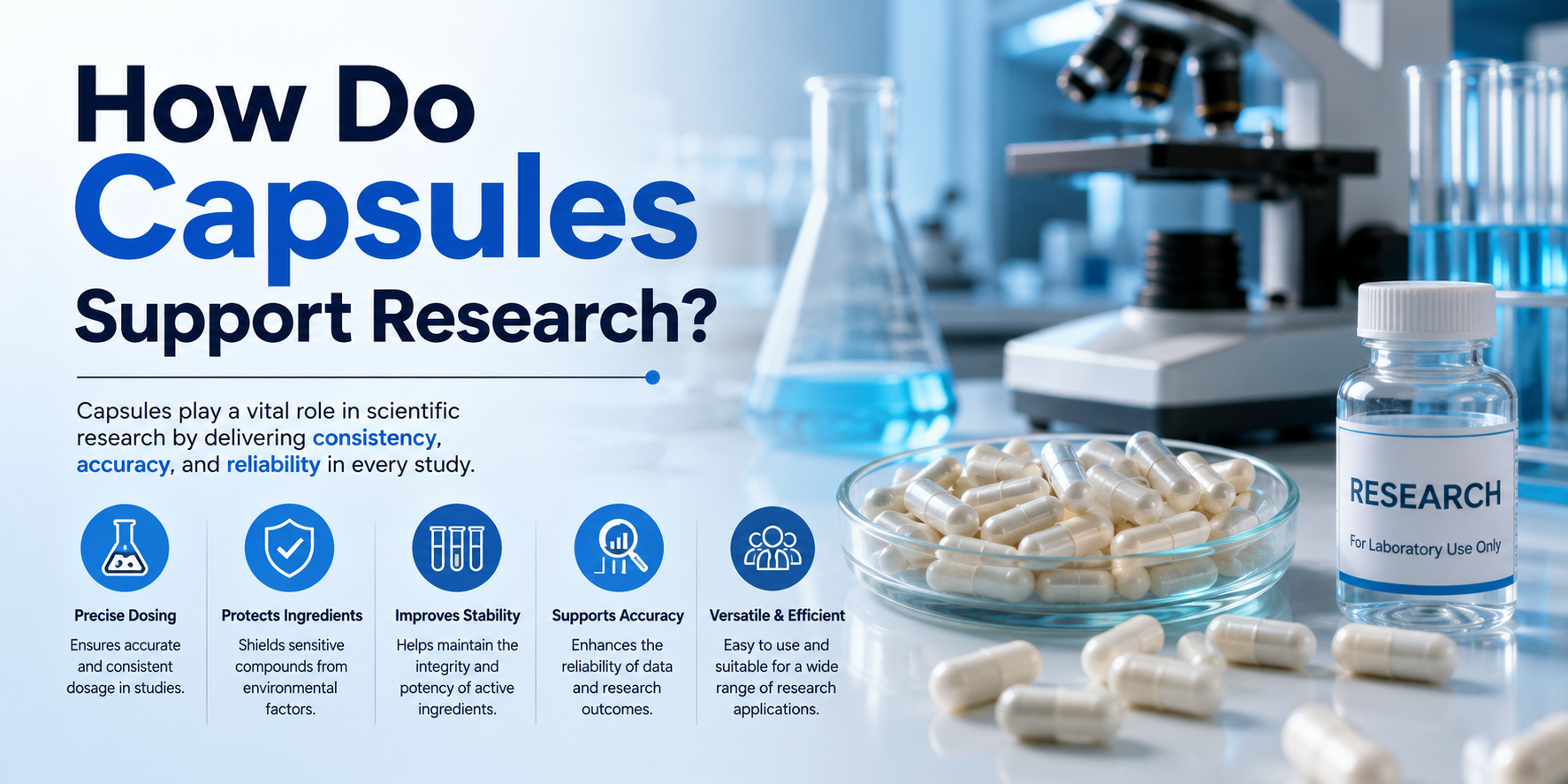
Capsule delivery has quietly become one of the more practical formats for people conducting ongoing personal research, not because it solves every problem other delivery methods have, but because it removes several barriers that make consistent research harder to sustain. For anyone browsing peptide capsules online with research consistency in mind, it’s worth understanding exactly what capsules do well — and where their limitations still matter.
Consistency Is the Foundation of Good Research
Whether someone is tracking a compound’s effect on a specific marker or simply trying to understand how a peptide behaves over time, consistency in administration is essential. Irregular dosing, skipped doses, or inconsistent timing introduce variables that make it much harder to draw any reliable conclusions from personal observation. This is where capsules offer a genuine practical advantage: because they require no reconstitution, no injection technique, and minimal preparation time, they tend to fit more easily into a daily routine than more involved delivery formats.
A research routine that’s easy to follow is one that actually gets followed. This might sound like a minor point, but in practice, adherence is one of the biggest hidden variables in any kind of personal research — a theoretically superior delivery method that gets used inconsistently will often produce less reliable data than a slightly less efficient method that gets used exactly as intended every time.
Reducing Variables That Complicate Observation
Capsules also reduce certain sources of variability that can complicate injectable research. Injection site, technique, and depth can all subtly affect absorption from one dose to the next, especially for someone who hasn’t developed a fully consistent technique. Capsules remove these variables almost entirely — a capsule taken correctly behaves the same way regardless of who’s taking it or how many times they’ve done it before, assuming the formulation itself is consistent from batch to batch.
This doesn’t mean capsules are free of variability altogether. Factors like whether the capsule is taken with food, on an empty stomach, or alongside other substances can still meaningfully affect absorption. But these variables tend to be easier to control and standardize than injection technique, which makes capsules a useful format for anyone trying to minimize noise in their own observations.
Why Formulation Quality Directly Supports (or Undermines) Research Value
None of these practical advantages matter if the underlying formulation doesn’t reliably deliver the compound in the first place. This is where capsule research diverges sharply based on supplier quality. A capsule that uses a well-designed enteric coating and has been tested for consistent concentration batch to batch will support far more reliable research than one that hasn’t addressed these issues, even if both are technically labeled with the same peptide name.
For anyone conducting careful personal research, this means formulation quality isn’t a side consideration — it’s directly tied to whether any observations made are actually meaningful. Inconsistent absorption from batch to batch can make a compound appear ineffective on one occasion and noticeably active on another, when the real explanation is manufacturing variability rather than anything related to the compound’s actual properties.
Documentation Makes Research More Interpretable
Beyond formulation itself, documentation plays a significant supporting role in research quality. Suppliers who provide clear concentration data and batch-specific third-party testing give researchers a baseline to work from — a known starting point that makes it possible to at least rule out gross formulation issues when interpreting results. Without this kind of documentation, any observations are harder to interpret, since there’s no way to confirm whether inconsistent results are due to the compound, the individual, or unknown variability in the product itself.
Practical Habits That Strengthen Capsule-Based Research
A few habits tend to improve the reliability of any capsule-based personal research. Taking capsules at a consistent time relative to meals, keeping a simple log of dose timing and any observations, and sourcing from a single, well-documented supplier rather than switching between products can all reduce unnecessary variability. None of these habits require special expertise — they simply apply the same discipline that any careful researcher would bring to controlling variables in a more formal study.
It also helps to resist the temptation to change more than one variable at a time. Switching suppliers, delivery timing, and dosage all in the same period makes it nearly impossible to attribute any change in observations to a single cause. Adjusting one factor at a time, and giving it enough time to produce a meaningful pattern before changing anything else, is a simple discipline that dramatically improves the quality of personal observation over time.
Why Sourcing Remains Central to This Value
Given how directly formulation and documentation affect research reliability, sourcing quality is arguably even more important for capsule-based research than it is for other delivery formats. Brands like Iron Peptides emphasize batch-specific testing and transparent formulation documentation precisely because this kind of information gives researchers a reliable foundation to build observations on, rather than leaving critical variables unknown.
The Bottom Line
Capsules support research not because they’re inherently superior to other delivery methods, but because they reduce certain practical barriers — reconstitution, injection technique, storage complexity — that can otherwise undermine consistency. That advantage only holds up, though, when paired with a well-formulated, well-documented product. Choosing a supplier that takes formulation and testing seriously is what actually turns capsule convenience into genuinely useful research value.
Anyone weighing whether capsules fit their own research needs should look past the convenience factor alone and ask whether the specific compound they’re interested in has been shown to perform reasonably well in oral form, and whether the supplier they’re considering can back up that performance with actual documentation rather than assumptions.