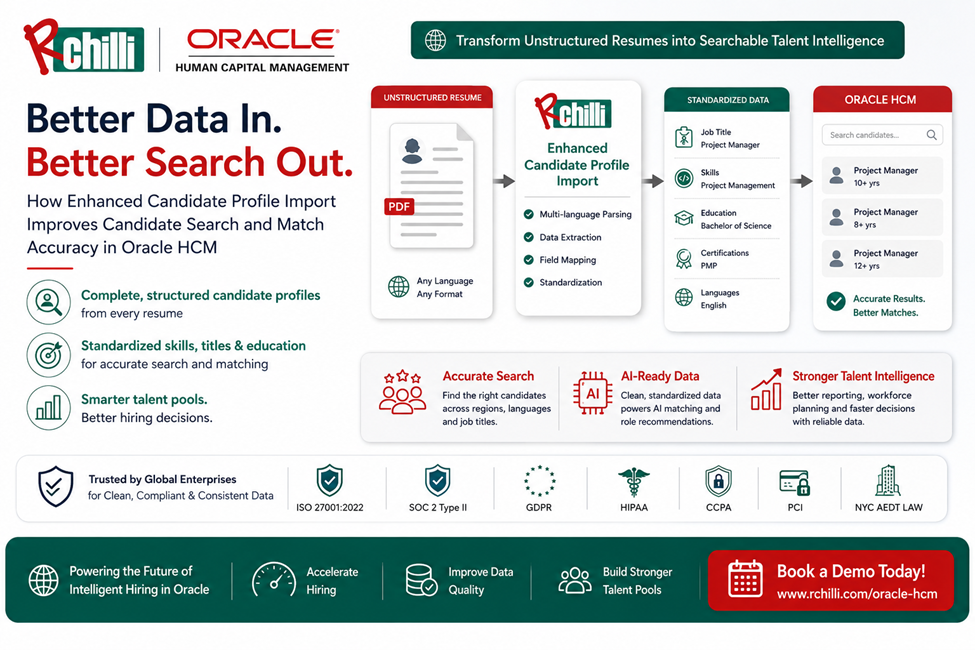
Oracle HCM search and match is only as good as the structured data behind it. When candidate profiles are missing fields, inconsistently worded, or built from manually re-typed resumes, search returns incomplete or misleading results, no matter how good the underlying matching logic is. Enhanced Candidate Profile Import fixes this at the source by capturing full experience, skills, and education data in structured, standardized fields the moment a resume enters the system.
Why Search Fails Even When Candidates Exist in the System
This is a data quality problem, not a search algorithm problem, and it’s worth being precise about that distinction before evaluating any fix. Three patterns show up repeatedly in Oracle HCM tenants that have been running for more than a year or two.
Inconsistent skill entry. “Project management,” “PM,” and “Project Mgr” all describe the same skill, but if a candidate record only contains one variation, a recruiter searching a different term won’t find that profile. This isn’t rare. It’s the default outcome of any system where skills are typed manually rather than mapped to a controlled taxonomy.
Incomplete profiles from manual entry. When recruiters or candidates manually type profile data, fields get skipped, truncated, or entered inconsistently under time pressure. A recruiter processing forty applications in an afternoon isn’t going to catch every missing certification field. Oracle can only match on what’s actually in the record, and manual entry reliably produces records with gaps.
Unmapped job titles across regions or industries. A candidate titled “Sr. Consultant” and one titled “Senior Consultant” should surface in the same search, but without normalization, they’re treated as different string values by Oracle’s search index. The same problem multiplies across industries that use different titles for functionally equivalent roles.
Each of these compounds rather than staying isolated. A talent pool that looks thin in Oracle search often isn’t actually thin. It’s just poorly structured, and the difference matters enormously for how a TA leader interprets their own pipeline health.
The Mechanism: Clean Input at the Point of Intake
Enhanced Candidate Profile Import addresses this before it becomes a search problem, by structuring resume data into standardized Oracle fields at the moment of intake rather than after the fact. It extracts details across work experience, education, skills, certifications, and languages directly from the resume, removing the manual entry step that introduces gaps and inconsistency in the first place. That intake mechanism is covered in more depth on the Enhanced Candidate Profile Import product page.
Two supporting tools do the normalization work that makes search actually reliable once the data is captured:
- List of Values (LOV) maps parsed values like job titles, degrees, and skill variants to Oracle’s controlled picklists, so “Sr. Consultant” and “Senior Consultant” resolve to the same searchable value regardless of which one appeared on the original resume.
- Customizable Taxonomy applies a library of over 3 million skills and 2.4 million job profiles, keeping skill and role terminology consistent across the entire candidate database, not just new records added after the tool is turned on.
For organizations with legacy data already sitting in Oracle, this raises an obvious question: what happens to the years of candidate records that predate this standardization? Full Database Reprocessing applies the same standardization retroactively, refreshing historical candidate records against current parsing and taxonomy rules on a schedule the organization controls, so search performance improves database-wide rather than only for candidates who apply going forward. This sits alongside List of Values and Customizable Taxonomy as part of the broader Data Hygiene suite for Oracle HCM.
Where This Matters Most: Building Talent Pools
A TA manager building a recurring talent pool, for example Oracle HCM consultants for repeat project staffing, depends entirely on consistent tagging across job titles, skills, and education. Structured, standardized data is what makes a searchable pool possible instead of a list of records that all describe the same kind of candidate differently. Without normalization, the same underlying pool of qualified people can look sparse simply because their records use inconsistent terminology, leading a TA manager to conclude, incorrectly, that the talent isn’t there.
This is also the foundation AI Agents for Oracle Fusion Applications rely on for automated matching and role recommendations. AI-driven matching is only as accurate as the structured data feeding it. A matching model, no matter how sophisticated, cannot infer that “PM” and “Project Manager” are the same skill if the underlying data was never normalized to make that connection explicit. Clean, standardized input isn’t a nice-to-have ahead of AI-driven recruiting. It’s the prerequisite that determines whether AI matching actually works or just adds a layer of complexity on top of the same broken data.
Diagnosing Whether This Is Your Problem
Before assuming your search results are limited by an actual shortage of qualified candidates, it’s worth testing the alternative explanation directly. Pull a sample of resumes that should match a given search query based on manual review, and check whether they actually surface when a recruiter runs that search in Oracle. If qualified candidates who clearly match the role are absent from the results, the issue is very likely data structure and normalization, not candidate supply. This distinction changes the entire remediation path: a supply problem calls for more sourcing, while a data problem calls for reprocessing and standardization of what’s already in the system.
FAQ
Why does Oracle HCM search miss qualified candidates who are already in the system? Usually because their profile data is incomplete or worded inconsistently compared to the search terms used, not because the candidates don’t exist. Search can only match what’s structured and standardized in the record.
Does fixing search require re-entering candidate data? No. Full Database Reprocessing can reprocess and standardize existing candidate records against current resumes and taxonomy rules without manual re-entry, applying the correction retroactively rather than starting over.
How does structured candidate data affect AI-driven matching in Oracle HCM? AI Agents and matching tools depend on the same structured, standardized fields that search relies on. Clean data at intake improves both traditional recruiter search and AI-driven recommendations, since neither can compensate for data that was never normalized in the first place.
How can a TA team tell if a thin-looking talent pool is a data problem rather than a sourcing problem? Manually check a sample of resumes that should qualify for a search query, and see whether they actually appear in the results. If they don’t, despite being genuinely qualified, the gap is in data structure rather than candidate supply.
Does this affect internal mobility searches as well as external candidate search? Yes. The same inconsistent tagging that hides external candidates from search also hides internal employees from role-fit and succession searches run by HR or hiring managers looking across the organization.
See how Enhanced Candidate Profile Import builds the structured data foundation Oracle search depends on, or explore the full RChilli Oracle HCM solution suite to see how it fits with Data Hygiene and AI Agents.