
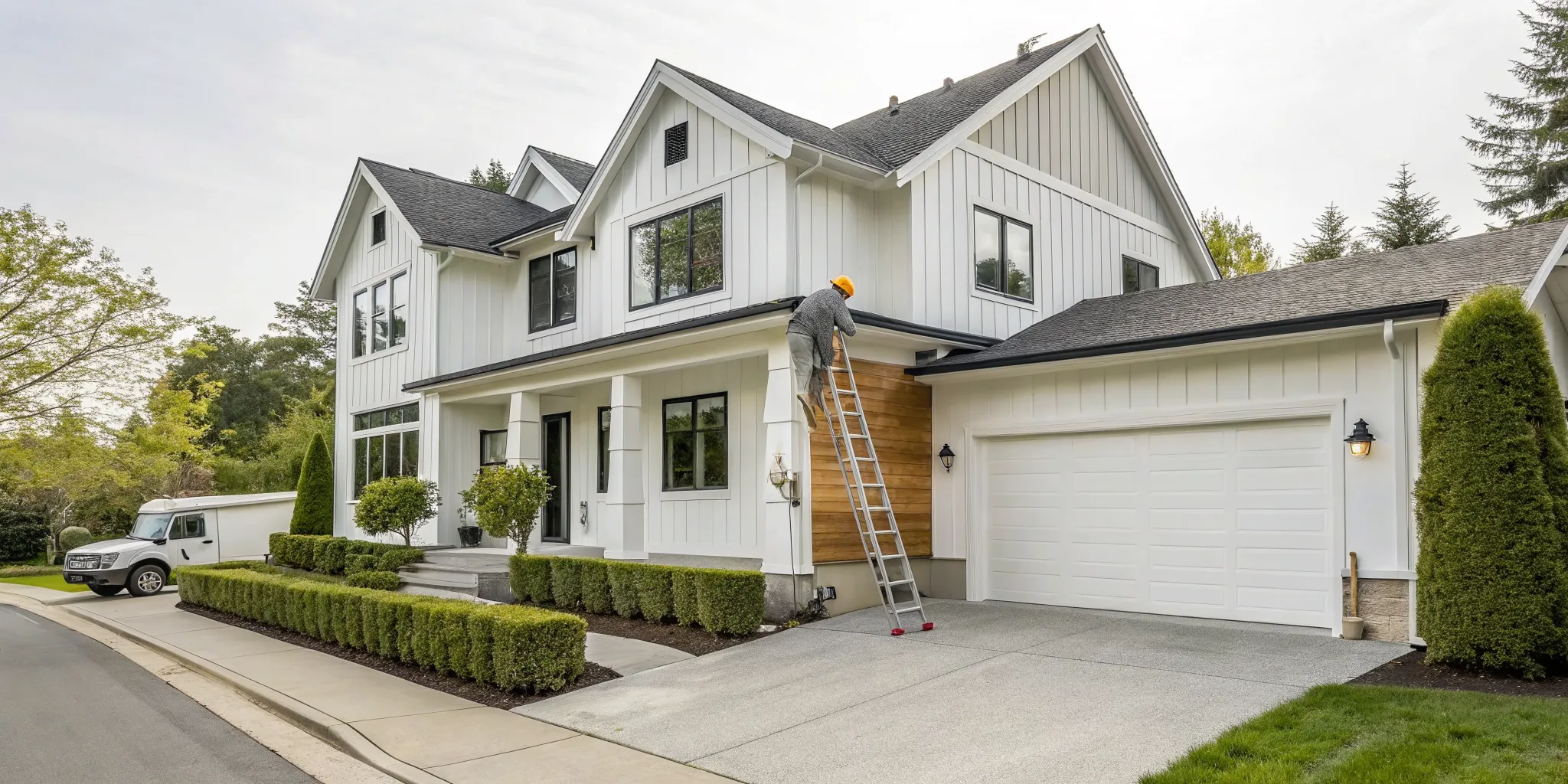
Every year, millions of American homeowners spend money repairing damage that, in many cases, was preventable. Roof replacements, siding repairs, wood rot remediation, and moisture-related structural work collectively represent one of the largest categories of unplanned home expenditure in the country. What connects a significant portion of these costs is not age alone, or even climate — it is the absence of consistent surface protection on the exterior envelope of the home.
The exterior of a home is exposed to UV radiation, freeze-thaw cycles, wind-driven moisture, and biological growth year-round. Without a treatment system in place to slow that exposure, materials deteriorate on a predictable timeline. The financial consequences are not immediate, which is why many homeowners delay action. By the time visible damage appears, the underlying structural impact is usually already well established.
This breakdown examines what it actually costs to skip exterior surface protection — not in abstract terms, but in the real repair and replacement scenarios that follow unprotected exposure over time.
What Exterior Protective Coatings Actually Do for a Home’s Envelope
The role of exterior protective coatings extends well beyond aesthetics. These systems function as the primary barrier between building materials and the environmental forces working against them. When properly applied to roofing, siding, trim, or masonry, they reduce water infiltration, slow UV-driven degradation, and limit the thermal stress that causes materials to expand and contract with seasonal temperature changes. The long-term value of these systems is measurable in the extended service life of the materials beneath them.
According to the U.S. Department of Energy, uncontrolled moisture movement through a home’s envelope is one of the leading contributors to energy loss and structural deterioration. Protective coating systems directly address this by sealing surfaces against the primary vectors of moisture entry.
For homeowners evaluating whether a protective treatment is worth the upfront cost, understanding the full scope of what these systems prevent is the most accurate starting point. A well-maintained exterior coating on a roof or wall system is not simply paint — it is a layer of engineered protection that keeps more expensive repairs from becoming necessary.
The Relationship Between Surface Sealing and Structural Integrity
When exterior surfaces lose their protective layer — whether through wear, improper application, or years of deferred maintenance — moisture begins to move through materials that were not designed to absorb repeated water cycling. Wood framing swells and contracts. Metal fasteners corrode. Masonry absorbs water, which then freezes and expands during winter months, fracturing the surface from within. Each of these failure modes is gradual, which is why the connection between missing surface protection and structural repair bills is rarely obvious until the damage becomes significant.
Homeowners who address surface protection consistently tend to extend the service life of their exterior materials by a substantial margin. Those who skip it typically encounter the same sequence: surface degradation, water infiltration, substrate damage, and eventually a repair scope that now includes not just the surface but the structure behind it.
The Financial Accumulation of Deferred Surface Protection
Deferred maintenance is one of the most common financial traps in home ownership. It follows a consistent pattern: a small, manageable issue is postponed because it does not appear urgent. Over time, that issue progresses into a larger one that requires professional intervention. By the time action is taken, the cost has multiplied — not because the original problem was inherently expensive, but because secondary damage has accumulated around it.
In the context of exterior surfaces, the math is particularly unforgiving. A roof coating treatment applied at the right maintenance interval costs a fraction of what a partial or full roof replacement costs. A surface sealant applied to wood siding costs far less than the rot remediation and board replacement that follows years of unprotected moisture exposure. The financial gap between proactive protection and reactive repair is not marginal — it is typically measured in multiples.
Roofing: The Highest-Stakes Surface on Any Home
The roof represents the single most critical exterior surface on a residential structure. It absorbs direct solar radiation, carries the full force of precipitation, and undergoes more thermal cycling than any other part of the home. Without a maintained protective layer, roofing materials — whether asphalt shingles, modified bitumen, or single-ply membrane systems — begin to degrade from the top down. Granule loss on shingles accelerates UV damage to the underlying mat. Membrane systems develop micro-cracks that allow water to track beneath the surface.
The cost differential between maintaining a roof surface and replacing it is significant. Protective roof coating applications are a recurring maintenance expense. Roof replacements, which become necessary when substrate damage is too advanced to address at the surface level, are capital expenditures. Homeowners who skip the former routinely find themselves facing the latter ahead of schedule.
Siding and Trim: Where Moisture Damage Compounds Quietly
Wood and composite siding systems are particularly vulnerable to the consequences of missing surface protection. Moisture that penetrates an uncoated or degraded siding surface does not stay at the surface. It moves inward, reaching the sheathing layer, the building wrap, and eventually the framing. By the time interior signs of moisture damage appear — staining, odor, softness in wall surfaces — the repair scope has expanded well beyond the siding itself.
Trim work around windows, doors, and rooflines is similarly affected. These areas experience high moisture exposure and are frequently the first to show visible deterioration when surface protection is absent. Trim replacement is a routine repair for homeowners who have let surface coatings lapse, and it rarely happens in isolation — when trim is replaced, adjacent siding and substrate conditions are often found to require attention as well.
Regional Climate Factors That Amplify the Cost of Unprotected Surfaces
The cost of skipping exterior surface protection is not uniform across the United States. Climate plays a direct role in how quickly unprotected materials deteriorate and how severe the resulting damage becomes. Homeowners in different regions face different primary threats, but the underlying dynamic is the same: without a functioning protective barrier, environmental stressors cause damage at an accelerated rate.
High-UV and Heat-Exposed Climates
In the Southwest and other high-solar-exposure regions, UV radiation is the dominant deterioration factor. Unprotected roofing membranes and siding materials in these climates degrade faster than the same materials in cooler, cloudier regions. The thermal expansion and contraction that come with extreme daily temperature swings also place repeated mechanical stress on unprotected surfaces. Homeowners in these areas who skip surface protection tend to encounter premature roofing failures and siding warping at a rate that outpaces national averages.
Freeze-Thaw and High-Moisture Climates
In the Northeast, Midwest, and Pacific Northwest, moisture is the primary threat. Water infiltration followed by freezing temperatures creates a physical force inside building materials — masonry cracks, wood swells and splits, and caulked joints fail. When exterior surfaces are unprotected, this cycle repeats throughout every winter season, compounding damage year over year. The repair costs associated with freeze-thaw damage to unprotected masonry and wood surfaces are among the highest in residential maintenance budgets for these regions.
How Homeowners Underestimate Long-Term Exposure Risk
One of the consistent patterns in deferred maintenance decisions is a miscalculation of cumulative risk. A homeowner who looks at a roof or a stretch of siding and sees no visible damage may reasonably conclude that no action is needed. What that assessment misses is the condition of the protective layer on the surface — not the material itself. By the time a material shows visible deterioration, it has usually been operating without effective surface protection for some time.
The cost of that gap is not visible in the moment. It accumulates beneath the surface, in the substrate, in the framing, and in the connections between building components. When it eventually becomes visible, it does so as a repair bill that reflects not just the surface replacement but everything that was affected during the period of unprotected exposure.
Homeowners who maintain a consistent protective coating schedule avoid this accumulation. They pay predictable, manageable maintenance costs instead of irregular, large repair costs. The financial case for surface protection is not complicated — it is a straightforward comparison between the cost of prevention and the cost of repair.
The Compounding Effect on Home Resale Value
Deferred exterior maintenance has a direct and well-documented effect on home resale value. Buyers and their inspectors look closely at exterior surfaces, and visible deterioration — even when it has not yet reached structural significance — creates negotiating pressure that typically reduces the final sale price by more than the repair cost would have been. More significantly, when inspection reports identify moisture damage, rot, or roofing deficiencies, sellers are often required either to remediate before closing or to accept substantial price reductions.
Homes that have been consistently maintained, with intact exterior coatings and no evidence of moisture infiltration, move through the resale process with fewer complications. The financial advantage of maintained surfaces shows up not just in avoiding repair costs but in the ability to sell without penalty — and in some cases, to command a premium in competitive markets where buyers are specifically evaluating maintenance history.
Closing: Protection Is a Financial Decision, Not Just a Maintenance One
The true cost of skipping exterior surface protection is not captured in any single repair bill. It is the sum of accelerated material degradation, water infiltration damage, substrate and structural repairs, and the reduced market value that follows a history of deferred maintenance. Each of these consequences is predictable, and each of them is largely avoidable.
Homeowners who treat exterior protection as an optional or low-priority expense tend to encounter it again later, reframed as an emergency. The maintenance cost that felt deferrable becomes a repair bill that is not. The pattern is consistent enough across regions, climates, and material types that it is reasonable to treat it not as a possibility but as a near-certainty for homes where surface protection is chronically neglected.
The financial case for maintaining exterior surfaces is simple: the cost of protection is fixed and manageable; the cost of the damage that follows unprotected exposure is variable and substantially higher. For most homeowners, the question is not whether they can afford to maintain their home’s exterior — it is whether they can afford not to.