Water costs rarely attract the same scrutiny as electricity or gas, yet for households and commercial properties alike, water bills can climb significantly without any obvious explanation. A billing error, a rate change buried in the small print, or an undetected leak can inflate what you owe month after month. Most people accept the number on their bill as fixed and final. But in many cases, it is neither.
Utility billing for water is more complex than it appears. Providers apply tiered pricing structures, base service charges, usage thresholds, and seasonal rate adjustments that vary by region and provider. Without a structured way to cross-reference your actual usage against those rate structures, it is genuinely difficult to know whether what you are being charged is accurate. That uncertainty has real consequences, particularly for property managers, landlords, and small business operators who handle multiple accounts or carry high monthly usage volumes.
This article walks through how water billing works, where errors and overcharges tend to occur, and how applying a structured calculation method helps you verify what you actually owe.
What a Water Bill Calculator Actually Does
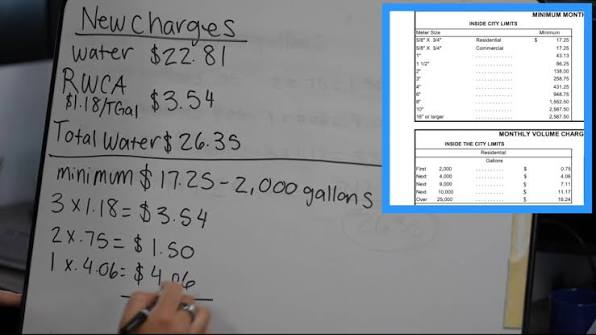
A water bill calculator is a structured tool that takes your recorded water usage and applies your provider’s rate schedule to produce an independent estimate of what your bill should be. It mirrors the same calculation your utility company performs, but it does so transparently, allowing you to see each component of the charge rather than receiving a single total figure. When the output from your own calculation differs from the figure on your bill, that gap is worth investigating.
Most water billing systems are built on tiered consumption blocks. The first block of usage in a given billing period is charged at a base rate. Usage beyond that threshold moves into a higher tier, which carries a progressively higher rate per unit. Providers often apply these tiers differently depending on whether the account is residential, commercial, or agricultural. Running your usage figures through a water bill calculator allows you to apply those tiers correctly and confirm whether the utility has done the same.
This kind of independent verification is not about distrust for its own sake. Rate schedules are updated periodically by utility providers, and those updates are not always communicated clearly to customers. According to the U.S. Environmental Protection Agency, water rates have increased steadily across most U.S. municipalities over the past two decades, making it increasingly important for consumers to understand how those rates are applied to their accounts.
The Difference Between Estimation and Verification
Estimation and verification are not the same process, and conflating them leads to poor conclusions. Estimating your water usage gives you a rough sense of whether your bill seems high or low relative to past months. Verification means applying your provider’s exact rate schedule to your meter readings and checking the result against what you were charged. Only verification can confirm or dispute a billing figure with any real confidence.
The practical value of a water bill calculator lies in this distinction. When you estimate, you are working from memory and general awareness. When you verify, you are working from data. The meter reading on your account, combined with a current rate schedule from your provider, gives you everything you need to produce a number that should match your bill within a reasonable margin. If it does not, you have a documented basis to raise a query with your provider.
Where Water Bills Commonly Go Wrong
Billing errors in water accounts are more common than most customers realize, and they tend to fall into a small number of recurring categories. Understanding where errors originate helps you focus your review in the right places rather than second-guessing every line item equally.
Meter Reading Errors
Water meters are read either manually by a field technician or automatically through remote systems. Manual readings introduce the possibility of transcription errors, where a digit is misread or recorded incorrectly. Automated meter infrastructure reduces this risk but is not error-free, particularly where meters are aging, signal transmission is inconsistent, or the device has not been recently calibrated. A meter that is reading slow or fast will produce usage figures that do not reflect actual consumption, and those inaccurate figures will carry through to every calculation the utility performs.
If your usage appears to have spiked in a given period without a corresponding change in how water was used at the property, requesting a meter test through your provider is a reasonable first step. Most utilities are required to test meters on request, and some jurisdictions mandate that the cost of testing falls to the provider if the meter is found to be faulty.
Rate Schedule Misapplication
Providers occasionally apply the wrong rate classification to an account. A commercial property might be billed at an industrial rate, or a multi-unit residential building might be assessed under a single-family structure. These misclassifications can go unnoticed for months or years because the billing system applies them automatically without generating an exception or alert. The monthly total may not look obviously wrong without a reference point, but over time the accumulated overcharge can be substantial.
Rate misapplication is also common following a utility company merger, a system migration, or a rate restructuring. These administrative transitions create conditions where account data does not transfer cleanly, and the resulting billing irregularities are not always caught before statements go out.
Estimated Bills That Are Never Reconciled
When a meter cannot be read in a given period, utilities typically issue an estimated bill based on historical usage patterns. This is a standard practice and not inherently problematic. The issue arises when estimated bills are issued across multiple consecutive periods without a real reading to reconcile them. If the estimate is consistently higher than actual usage, the account accumulates an overpayment that may or may not be corrected in the next billing cycle. If it is lower, the customer receives an unexpectedly large bill when the actual reading finally takes place.
Tracking which billing periods were based on estimates rather than actual readings is a useful habit, particularly for accounts with variable usage. Your bill should indicate when a figure is estimated rather than read, though this notation is not always prominent.
How to Read Your Water Bill Before Running Any Calculation
Before applying any calculation method, it is worth spending time understanding what your water bill is actually showing you. Utility bills carry a significant amount of information, but it is not always organized in a way that makes it easy to extract the figures you need.
Identifying the Components That Drive Your Total
Most water bills separate charges into distinct components: a fixed service or connection charge that applies regardless of usage, a volumetric charge tied directly to how much water was consumed, and in some jurisdictions, additional charges for wastewater treatment, stormwater management, or infrastructure levies. Each of these components may carry a different rate and a different calculation method.
The volumetric charge is typically where the largest variation occurs between billing periods, and it is the component most directly affected by tiered pricing. To use a water bill calculator accurately, you need to know the specific rates for each consumption tier your provider applies, not just a single average rate per unit. Many providers publish their rate schedules on their websites or will provide them on request. Without the correct rate schedule, your independent calculation will not be meaningfully comparable to your bill.
Checking the Billing Period Dates
Billing periods do not always align to calendar months, and they are not always consistent in length from one cycle to the next. A billing period that is two or three days longer than usual will naturally carry slightly higher usage for the same consumption patterns. This is not an error, but it can look like one if you are comparing your current bill to prior months without accounting for the difference in days. Confirming the exact start and end dates of your billing period, and calculating your daily average usage, gives you a more reliable basis for comparison than total monthly usage alone.
Building a Habit of Periodic Review
Catching a billing error once is useful. Building a process that catches errors regularly is better. Water usage patterns tend to be reasonably consistent within seasons, which means that significant deviations in your bill should prompt a review rather than an automatic payment. Running a calculation at least once per quarter, or whenever usage appears to spike without an obvious cause, keeps your accounts accurate and creates a documented record of your historical usage that can support a dispute if one becomes necessary.
Property managers and facility operators who oversee multiple accounts often find that standardizing this review process saves considerable administrative effort over time. Rather than addressing billing disputes reactively, periodic verification allows errors to be identified and resolved while the relevant billing period is still recent, which simplifies both the investigation and the correction process.
Conclusion
Water billing is not inherently opaque, but it does require active attention to understand correctly. Tiered rates, estimated readings, misclassified accounts, and periodic rate changes all create conditions where what you are charged may not accurately reflect what you actually used. The gap between those two figures is not always large, but over time, and across multiple accounts, it adds up.
A structured calculation approach gives you the means to verify your bill independently, identify irregularities with specificity, and engage your provider from a position of documented evidence rather than general concern. Whether you are managing a single household account or overseeing water costs across a commercial portfolio, the discipline of periodic review is straightforward to maintain and consistently worth the effort.
If your bill has raised questions that a review of the rate schedule alone does not resolve, the next practical step is to run your actual usage figures through a reliable water bill calculator and compare the result against what you were charged. That comparison is usually where answers begin to surface.