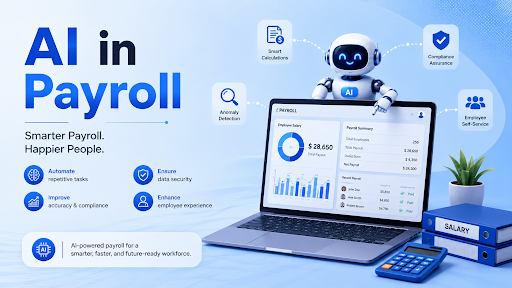
Payroll is a critical part of the employee experience and one of the most complex areas of workforce administration. Organizations must process compensation accurately and on time while managing changing regulations, workforce structures and large volumes of employee data. AI in Payroll is creating opportunities to simplify this complexity by automating repetitive activities, identifying exceptions and improving employee support.
At the same time, payroll is closely connected with broader HR operations, including employee data management, time and attendance, compensation, onboarding and workforce administration. Connecting AI capabilities across these processes can help organizations improve productivity, strengthen service delivery and create a more integrated employee experience.
This article explores how AI in Payroll is transforming HR operations, key applications, business benefits and the priorities organizations should consider when implementing intelligent payroll capabilities.
What is AI in Payroll?
AI in Payroll refers to the use of artificial intelligence technologies to improve payroll processing, validation, analysis, exception management and employee support. These technologies include machine learning, generative AI, predictive analytics and intelligent automation.
AI can analyze payroll information to identify unusual transactions, automate routine workflows and direct payroll professionals toward exceptions requiring further investigation. Generative AI can also help employees understand payroll information and policies through natural-language interactions.
The objective is not to remove human accountability from payroll. Instead, AI can reduce administrative work while helping payroll professionals focus on complex cases, controls and employee support.
What are HR operations?
HR operations encompass the processes, systems and services required to manage employees throughout the workforce lifecycle. They can include onboarding, employee data administration, benefits, compensation, HR case management, time and attendance, payroll coordination and offboarding.
Effective HR operations provide the foundation for consistent employee services while ensuring workforce information flows accurately between HR, payroll, finance and other enterprise systems.
Because payroll depends heavily on workforce data generated through these processes, improvements in HR operations can directly affect payroll performance.
Why AI in Payroll matters for HR operations
Employee changes occur continuously. New hires, promotions, compensation adjustments, leave, overtime and departures can all create downstream payroll requirements.
When HR and payroll processes are disconnected, teams may need to manually transfer information or investigate inconsistencies between systems. This increases administrative effort and can slow issue resolution.
AI in Payroll can help identify data anomalies and potential exceptions earlier. Combined with more integrated HR operations, intelligent workflows can also ensure relevant employee changes move efficiently between systems.
This creates an opportunity to improve the entire employee administration process rather than optimizing payroll independently.
Core technologies enabling intelligent payroll
Several technologies are expanding the capabilities of modern payroll and HR operations.
Machine learning
Machine learning can analyze historical payroll and workforce information to identify unusual transactions, recurring exceptions and patterns requiring attention.
Generative AI
Generative AI can summarize payroll cases, explain policies, draft employee communications and provide conversational access to payroll knowledge.
Predictive analytics
Predictive analytics can help organizations anticipate payroll expenses, overtime trends and changes in workforce costs.
Intelligent automation
Automation can streamline payroll validation, employee record updates, approvals and workflow routing across HR operations.
AI agents
AI agents can potentially coordinate multistep processes across HR, time management, payroll and finance systems while escalating sensitive exceptions to employees.
Together, these technologies can move AI in Payroll beyond isolated automation toward more connected workforce operations.
Key use cases of AI in Payroll
Organizations can apply AI across several payroll activities.
Payroll validation
AI can analyze payroll information before processing to identify missing data, unusual values, duplicate transactions and other potential inconsistencies.
Exception management
AI can categorize payroll exceptions, retrieve relevant information and provide specialists with summaries that accelerate investigation.
Time and attendance analysis
AI can compare working hours, overtime, leave and attendance information to identify inconsistencies that may affect employee pay.
Employee payroll support
AI-powered assistants can answer routine questions about pay statements, deductions, payroll schedules and organizational policies.
Payroll reporting
Generative AI can summarize payroll costs, operational performance and workforce trends for HR, finance and business leaders.
Compliance support
AI can help identify payroll data or transactions that warrant additional review, allowing specialists to focus on potentially higher-risk issues.
These applications demonstrate how AI in Payroll can improve productivity while supporting stronger HR service delivery.
How AI improves broader HR operations
The value of AI extends beyond payroll processing. HR operations generate much of the employee information that payroll depends on, making end-to-end integration essential.
AI can support employee data validation, HR case management, onboarding workflows and knowledge retrieval. When an employee change occurs, intelligent workflows can help ensure the information reaches relevant downstream processes.
Generative AI can also improve employee self-service by providing a consistent interface for questions spanning HR policies and payroll information.
Connecting these capabilities reduces organizational boundaries from the employee’s perspective and creates a more unified service experience.
Business benefits of AI in Payroll and HR operations
Integrating AI across payroll and HR processes can improve several dimensions of performance.
Greater productivity
Automation reduces repetitive administrative work, allowing HR and payroll professionals to focus on exceptions, workforce issues and higher-value activities.
Faster employee service
AI-supported self-service and intelligent case routing can reduce the time employees spend searching for information or waiting for responses.
Better process consistency
Standardized digital workflows can help organizations apply HR and payroll processes more consistently across business units and locations.
Improved workforce insights
Connecting HR and payroll information can provide greater visibility into workforce costs, overtime patterns and organizational trends.
Greater scalability
AI-enabled HR operations can help organizations manage growing employee and transaction volumes without proportional increases in administrative effort.
Best practices for implementing AI in Payroll
Successful implementation requires organizations to address processes, technology, data and governance together.
- Identify high-volume payroll and HR activities where AI can materially improve productivity or employee service.
- Standardize employee and payroll data before scaling advanced AI capabilities.
- Integrate HR, payroll, time management and finance systems where appropriate.
- Simplify workflows before introducing advanced automation.
- Establish strong employee privacy, cybersecurity and data-access controls.
- Maintain human accountability for payroll approvals, regulatory interpretation and complex employee cases.
- Prepare HR and payroll employees to understand and validate AI-generated outputs.
- Measure outcomes through productivity, processing time, exception rates, employee service and operating costs.
These practices can help organizations scale AI in Payroll without compromising the controls required for sensitive workforce processes.
Common implementation challenges
Data fragmentation is a significant challenge because employee information often resides across multiple HR, payroll, time and finance platforms. Inconsistent records can limit AI performance and create unreliable recommendations.
Legacy technology can make integration more difficult, particularly for organizations operating different payroll platforms across countries or business units.
Privacy is another critical consideration. Payroll contains sensitive employee and financial information, requiring strict controls over what AI systems can access and how information is processed.
Employee trust also matters. Organizations should provide clear routes to human specialists when employees need help with complex or sensitive payroll issues.
The future of AI in Payroll and HR operations
The next phase of AI in Payroll will increasingly involve intelligent workflow orchestration across the employee lifecycle.
AI agents could identify an approved employee change, determine which systems require updates, initiate authorized actions and escalate exceptions to the appropriate HR or payroll professional.
Generative AI may also provide employees with a more conversational interface for accessing HR and payroll services, reducing the need to navigate multiple systems and knowledge repositories.
As these capabilities mature, HR operations will increasingly shift from processing individual transactions toward managing exceptions, workforce insights and integrated employee services.
Conclusion
AI in Payroll is creating opportunities to improve payroll productivity, employee support and exception management. Its greatest value emerges when payroll is connected with broader HR operations rather than treated as an isolated administrative process.
Organizations that integrate workforce data, simplify processes and establish strong governance will be better positioned to scale intelligent payroll capabilities. By combining AI with connected HR operations, businesses can create more efficient workforce administration while delivering faster, more consistent employee services.