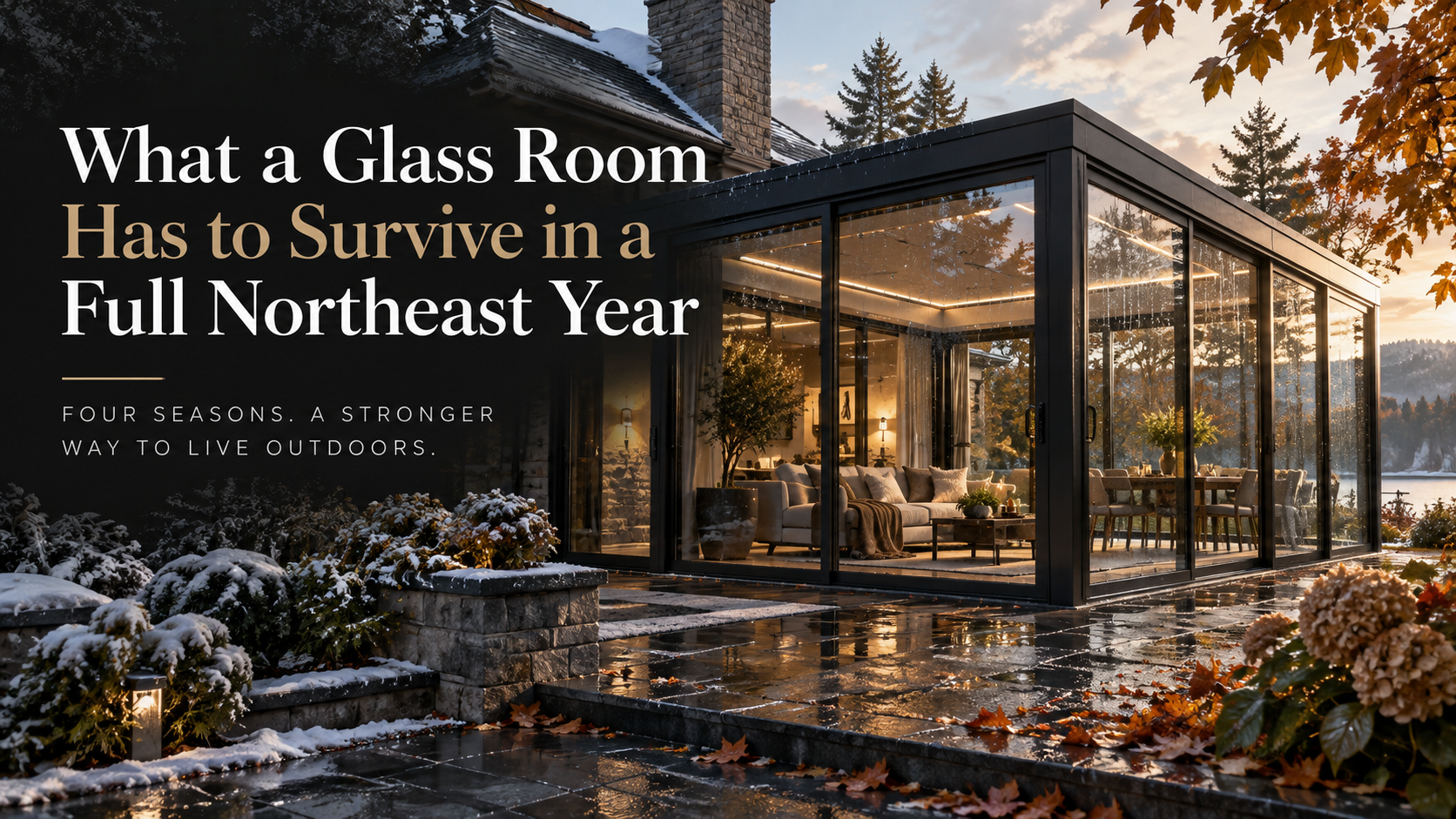
A room built mostly of glass is judged by its worst weeks, not its average ones. In the climate covering New Jersey and New York they are scattered across the calendar: a January night when wind holds the temperature down for days, a March storm throwing rain sideways at the walls, a July afternoon with the sun overhead, a damp October morning when warm air meets cold glass. Each tests a different physical property, and a room can pass three of them while failing the fourth.
January tests the frame more than the glass
Aluminium conducts heat very efficiently, which is useful in a saucepan and expensive in a wall. When a single profile runs uninterrupted from the heated interior to freezing air outside it becomes a thermal bridge: heat travels along the metal and the inner face of the frame drops toward outdoor temperature. In a poorly built enclosure the coldest surface is often not the window, it is the metal around it.
The answer is the thermal break, an insulating barrier bonded between the inner and outer halves of the extrusion so no continuous metal path connects inside to outside. Glazing carries the rest. A double glazed unit with a low emissivity coating reflects long wave heat back inside instead of letting it radiate out, and the sealed cavity between panes slows conduction. Those two decisions together separate a four season sunroom in New Jersey from a glazed porch that gets shut down every November.
Snow lands and stays
Winter also loads the structure from above. Snow is a genuine weight, and wet snow followed by rain is heavier still, so roof spans, beam sizing and pitch are structural questions rather than aesthetic ones. Where the new roof meets the existing house the detail matters most: meltwater that refreezes at a cold eave backs up under the covering. A four season room designed as part of the building envelope treats that junction differently from a lightweight cover bolted to a wall.
Spring rain does not fall straight down
Storm season is a water management problem, not a sealing problem. Wind drives rain horizontally and pressure differences push it into any gap, so a system relying purely on a bead of sealant will eventually leak. Better enclosures assume water gets past the first line and give it a way out: gaskets at the primary seal, sloped sills, drainage channels inside the frame profiles and weep openings. Flashing at the house wall sheds that water downward instead of trapping it against the cladding.
Summer reverses the problem
By July the failure mode flips from heat loss to heat gain. Glass admits short wave solar radiation easily, the room warms, and that energy cannot leave as readily as it arrived. Roof glazing collects the most because the summer sun sits high, so a skylight roof is a comfort decision as much as a design one. Spectrally selective coatings pass visible light while rejecting much of the infrared, shading outside the glass beats any curtain hung inside it, and ventilation works only when openings move air across the room. Vision Art Aluminium in Montclair, for example, offers motorized zip screens and louvered pergolas alongside its enclosures, while others rely on fixed shading or operable glazing.
Autumn belongs to condensation
Condensation is not a defect in itself. It appears when moist indoor air touches a surface below its dew point, which is the autumn pattern exactly. So interior surface temperature and indoor humidity, not the number of panes quoted on paper, decide whether the glass runs wet. Warm edge spacers keep the glazing unit perimeter nearer room temperature, an insulated frame keeps the metal above dew point, and ventilation removes moisture that plants, laundry and hot tubs add to a four season sunroom. Misting between the panes is a separate matter, since the sealed unit itself has failed.
Freeze and thaw attacks what nobody sees
Water expands as it freezes, and the Northeast delivers dozens of freeze and thaw cycles a season. Below the floor, that cycle lifts a slab sitting above the frost line or draining poorly. At the junction with the house, two structures move at slightly different rates, so that joint should accommodate movement rather than be filled solid and hoped for. Foundation depth, drainage away from the slab and a flexible sealed joint are settled before anything glazed reaches the site, and are close to impossible to revisit.
Which property answers which season
| Season | What it tests | What answers it |
| Winter | Heat loss and cold bridging | Thermal break, insulating low emissivity glazing |
| Winter | Snow load, ice at the eave | Structural spans, pitch, roof junction |
| Spring | Wind driven rain | Gaskets, sloped sills, internal drainage, flashing |
| Summer | Solar gain | Selective coatings, external shading, cross ventilation |
| Autumn | Condensation | Warm surface temperatures, humidity control |
Companies in this market, Vision Art Aluminium among them, separate engineered custom builds from standard size self assembly kits. The tests above are where that line shows: frame engineering, glazing specification and sealing at the house connection decide whether a room performs across twelve months or only the mild ones.
What wears out and what does not
Extruded aluminium profiles are close to inert in this climate. They do not rot, insects ignore them, and ultraviolet light does not break them down. The consumable parts sit elsewhere: gaskets harden after years of thermal cycling, glazing units lose their seal, and hardware on sliding, folding or guillotine systems needs adjustment. Anyone planning a sunroom in New Jersey learns more by asking how those parts are replaced than by asking how long the frame lasts.
READ ALSO: 10 Bathroom Custom Design Remodel Mistakes Homeowners Make (And What to Do Instead)