
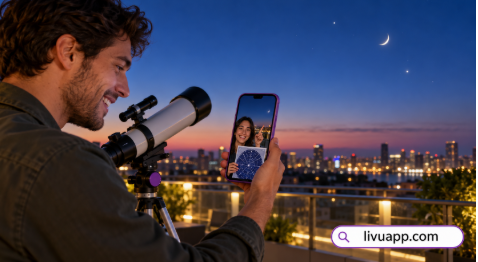
The night sky gives people something rare: a shared subject that can feel both universal and personal. The moon may be visible from many places, but the view around it changes with geography, weather, city lights, and local traditions.
During a chat video live, looking upward can provide a refreshing alternative to familiar questions about work or weekend plans. A simple observation—such as noticing a crescent moon or an unusually bright star—can lead to conversations about science, childhood memories, cultural stories, and the environments people call home.
A video chat mujeres conversation does not require expert knowledge of astronomy. Both participants can explore what they see, compare impressions, and enjoy the fact that curiosity is more important than having every answer.
Start With the Easiest Object to Find
The moon is usually the most accessible place to begin. It is bright, recognizable, and constantly changing.
You might ask:
- “Can you see the moon tonight?”
- “Does it look large from where you are?”
- “Do you notice it often?”
- “Is there a good place near you to watch it?”
- “What does tonight’s shape remind you of?”
These questions work even when the moon is hidden. Clouds, buildings, or daylight on the other side can become part of the discussion.
Avoid insisting that both people must see exactly the same thing. Different viewing conditions are what make the comparison interesting.
Describe the Surrounding Sky
Instead of immediately trying to name stars, describe the sky itself. Is it deep blue, almost black, cloudy, hazy, or tinted by city lights? Can you see only one bright point, or are many stars visible?
Encourage specific observations:
- Which direction seems darkest?
- Are the stars steady or flickering?
- Is the horizon lighter than the space overhead?
- Can you see clouds moving?
- Does the sky look clearer after rain?
These details turn passive viewing into active attention. They also allow people in very different environments to participate equally.
Compare City and Countryside Views
Light pollution creates major differences in what people can see. Someone in a dense city may only notice the brightest objects, while a person in a rural area may see a wide field of stars.
Treat this contrast as an environmental observation rather than a competition. A city skyline can create its own atmosphere, while a dark rural sky offers greater astronomical visibility.
Ask whether the other person has ever traveled somewhere with a dramatically different night sky. Their answer may lead to memories of camping, visiting family, taking a road trip, or experiencing a power outage.
Share the First Sky Memory That Comes to Mind
Many people have a night-sky memory even if they do not consider themselves interested in astronomy. It might involve watching stars from a childhood window, seeing the moon during a late journey, or noticing a meteor unexpectedly.
Useful prompts include:
- “What is your earliest memory of looking at the stars?”
- “Did anyone teach you the names of constellations?”
- “Have you ever stayed outside just to watch the sky?”
- “Was there a sky event that surprised you?”
- “Do you connect the moon with a particular place?”
These questions invite stories without demanding technical expertise.
Explore Cultural Stories Respectfully
Across cultures, people have imagined different figures, animals, and characters in the same groups of stars. The moon also appears in festivals, calendars, songs, and traditional stories.
Ask what someone heard while growing up rather than assuming that every person from a country knows or believes the same story.
For example: “Is there a moon story people tell where you live?” is more open than “Your culture believes this, right?”
Someone may share a family tradition rather than a national one. Another person may have no related story at all. Both answers are valid.
Use a Star Chart as a Guide, Not a Test
A printed chart or astronomy app can help identify a bright star or constellation, but it should not turn the exchange into a quiz.
If one person knows more, they can explain how they locate an object using a simple visual reference. The other person should feel free to ask questions or say that they cannot find it.
Direction, season, latitude, clouds, and nearby buildings can all affect visibility. Failing to locate the same pattern is normal and can itself lead to a useful discussion about perspective.
Talk About Scale Without Losing the Human Moment
Astronomy naturally introduces enormous distances and time spans. Light from a star may have traveled for years before reaching Earth, and the moon can make everyday concerns briefly feel smaller.
Yet the conversation does not need to become a lecture. Ask personal questions connected to the idea:
- “Does looking at the sky make you feel calm or curious?”
- “Do large distances feel exciting or unsettling?”
- “Would you want to travel into space if it were safe?”
- “What question about the universe would you most like answered?”
The science provides context, while the emotional reaction keeps the conversation human.
Compare Nighttime Routines
The sky can lead naturally into discussions about evening life. One person may live in a place where streets remain active late at night. Another may experience quiet evenings with little artificial light.
Ask what people usually do after sunset, which places remain open, or whether nighttime feels social, peaceful, or busy.
This does not require anyone to disclose an exact location. General descriptions are enough to compare how different communities experience the same hours.
Create a Shared Observation Challenge
Choose something simple to notice before a future conversation. It could be the moon’s changing shape, the first star visible after sunset, or the color of the evening sky.
The challenge should remain flexible. Weather may interfere, and no one should feel obligated to go outside late or travel to an isolated location.
During the next conversation, compare what each person observed. Even different results can be valuable: one may have seen a clear crescent while the other watched clouds cover the entire sky.
Keep Observation Safe
Looking at the night sky should happen from a secure place such as a balcony with a proper railing, a familiar garden, a public observation area, or through a window.
Avoid walking while concentrating on a phone, standing near traffic, climbing onto unsafe roofs, or visiting isolated places solely for a call. Protect exact home and location details as well.
People should also never look directly at the sun or use optical equipment for solar viewing without professionally designed protection. Night-sky conversation does not require taking unnecessary risks.
Allow Quiet Moments
Unlike many conversation prompts, observing the sky does not need constant speech. A few seconds of silence can feel natural while both people look for the moon or adjust their eyes to the darkness.
Afterward, a simple question such as “What did you notice?” can restart the exchange.
Shared silence works when both participants understand what they are doing. It becomes part of the experience rather than an awkward pause that must be filled immediately.
Distance Without Disconnection
The sky offers a reminder that distance does not prevent two people from sharing attention. They may see different clouds, lights, and constellations, yet both can pause to observe what is above them.
A chat video live conversation becomes more memorable when the setting itself contributes to the exchange. Similarly, video chat mujeres can move beyond routine introductions when curiosity is directed toward something larger than the screen.
Neither person needs a telescope or expert vocabulary. One clear observation, one respectful question, and one personal story can be enough to turn an ordinary evening into a shared moment.