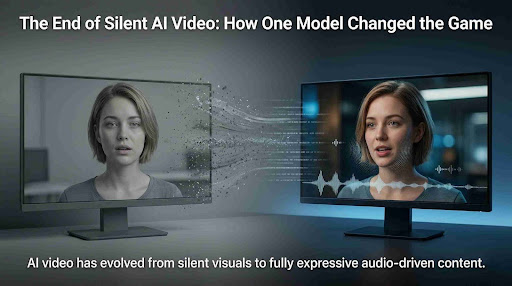
For years, the world of generative AI video was a quiet one. While models could produce stunning visuals, they lacked a voice. Creators were forced into a disjointed workflow of generating a silent clip in one tool, searching for sound effects in another, and spending hours manually aligning lip-sync in a third. This silence was the final barrier between AI experiments and professional-grade production.
In 2026, that barrier has officially collapsed. The emergence of unified creative hubs has introduced a multimodal architecture that generates high-fidelity video and native audio simultaneously. By accessing the Seedance 2.0 model through the Higgsfield ecosystem, creators can finally experience a shift from silent pixels to synchronized storytelling that is fundamentally changing the landscape of digital content.
The Breakthrough of Native Audio-Visual Generation
Traditional AI video models treat sight and sound as separate entities. Usually, a model is trained on images, and then a separate post-processing layer tries to guess what sound should accompany the movement. However, by using Seedance 2.0 on Higgsfield, creators utilize a joint generation model. This means the AI does not just add sound after the fact; it understands the deep relationship between the visual action and the acoustic response from the moment the first frame is rendered.
When you generate a scene of a man running through a crowded street, the model understands the physics of his footsteps and the ambient roar of the crowd. The sound effects land exactly on cue because they are born from the same underlying data as the motion. This single-pass generation on Higgsfield eliminates the need for post-production audio layering, saving creators hours of technical labor.
According to a recent industry study on multimodal video and audio generation, this fusion architecture is the new standard, allowing for 4K video that is semantically coherent with its soundtrack. It prevents the “uncanny valley” effect where the sound feels slightly detached from the action.
Key features of this native audio integration include:
- Frame-Level Precision: Every character, object, and composition detail stays locked across the entire video.
- Contextual Sound Effects: The model automatically identifies and renders sounds like clashing blades, roaring engines, or rustling leaves based on scene physics.
- One-Click Video Recreation: Turn a single sentence into a complete video with style, structure, and intent captured instantly.
- Native Lip-Sync: High-fidelity talking segments where character movements and narration stay in perfect sync across every cut.
Moving Beyond Text: The Multimodal Reference System
One of the primary reasons AI video often felt random was the reliance on text prompts alone. Words are often insufficient to describe complex camera movements or specific character likenesses. If you ask for a “woman in a blue dress,” the AI might give you ten different women in ten different blue dresses.
The Higgsfield platform addresses this with a multi-reference system that allows you to upload images and videos to guide your vision. This ensures that the AI isn’t just “imagining” a scene but is actually “directing” it based on your specific assets. When using Seedance 2.0 on Higgsfield, you can provide:
- Image References: Upload specific photos to lock in character features, costumes, and lighting. This is essential for maintaining “Soul ID” or character consistency.
- Scenario Descriptions: Use natural language to describe the desired action and synchronized sounds.
- Frame-Level Control: Manage scene transitions and screen rhythm down to individual frames to ensure the vision stays on track.
By analyzing these references together, the model produces a coherent output that matches your vision perfectly. It moves the technology from guessing what you want to executing your specific creative direction. This is especially vital for brands that require strict adherence to visual identity across multiple campaigns.
The Era of Multi-Camera Storytelling
Until recently, AI video was mostly limited to single, continuous clips. Building a narrative meant generating dozens of individual files and stitching them together in an editor. The Seedance 2.0 model has introduced native multi-shot generation, allowing a single 15-second output to contain natural cuts and varying perspectives.
The model acts as both a cinematographer and an editor. It understands how to break down a concept into a structured sequence. For example, if you prompt for a “detective entering a room and finding a clue,” the system can automatically generate an establishing wide shot, a medium shot of the detective, and a tight close-up of the clue.
It does this without losing visual continuity. This sequence-level stability ensures that characters, lighting, and environments remain consistent throughout the entire story. By unifying these elements, Higgsfield allows for the creation of short films, high-impact commercials, and complex social media content without the traditional friction of manual scene stitching.
Scaling Content Without Production Teams
The transition to audible, multi-shot AI video is democratizing high-end production. Small marketing teams and solo creators can now produce content that rivals big-budget agencies. In the past, a high-quality 15-second ad required a director, a cameraman, an editor, and a sound designer. Now, it requires a single creative mind and the right model.
For brands, this means:
- Faster Content Cycles: Deliver projects in days instead of weeks. Users on Higgsfield now prototype entire sites and ad campaigns in hours by generating realistic B-roll and hero shots instantly.
- High-Impact Motion: Generate intense action sequences with realistic body dynamics and collision effects. Whether it’s a car chase or a fight scene, the physics stay grounded and believable.
- Perfect Brand Consistency: Produce promotional videos with locked branding and strong storytelling. Since you can upload your own product photos as references, the AI doesn’t hallucinate your product; it renders it accurately.
- Professional Scalability: Scale from small branding projects to large-scale commercial jobs with confidence. The speed of the Higgsfield platform allows creators to accept more work without sacrificing quality.
Breaking the “Randomness” of AI
The biggest complaint about early AI video was that it felt like “rolling the dice.” You would put in a prompt and hope for something good. If it wasn’t right, you had to start over. The 2026 landscape is different because it is deterministic.
Through tools like Cinema Studio on Higgsfield, you have manual sliders for camera movement, zoom, and tilt. You aren’t just asking the AI to move the camera; you are telling it exactly how many degrees to pan. When combined with native audio via Seedance 2.0, you get a “Final Cut” feel directly out of the generation box. This removes the technical bottleneck that previously stopped artists from using AI in professional pipelines.
Conclusion: The New Standard of Fidelity
The silence of AI video is over. The arrival of professional tools marks a point of no return for the industry. We have moved into a new era where the machine doesn’t just see the world; it hears it, moves through it, and tells its stories with professional-grade fidelity.
As native audio-visual generation becomes the standard, the focus shifts from the technology itself to the human vision behind the prompt. By removing the technical barriers of sound design and multi-clip editing, Higgsfield frees creators to focus on what matters most: the story. This is the new standard for visual communication in 2026. Whether you are an influencer looking to scale your UGC or a studio looking to cut costs on pre-visualization, the tools are now ready for prime time.