
Most businesses don’t spend much time thinking about signage until they have to. Then, standing in a supplier’s showroom or scrolling through a print catalogue, the sheer number of material options is quietly baffling. Foamex, Dibond, vinyl, correx — and then there’s acrylic, sitting there looking immaculate. It costs more than the alternatives. It photographs beautifully. And business owners who’ve used it once tend not to go back to anything else. There’s usually a reason for that.
What Makes Acrylic Different from Every Other Signage Board?
Let’s get the basics right first. Acrylic — also sold under the brand name Perspex — is a rigid, transparent thermoplastic. It’s been used in commercial signage for decades, but the way it’s printed has changed dramatically. Utilizing ultraviolet light to cure ink instantly, contemporary UV flatbed printing creates a direct bond with the substrate surface.. No mounting. No laminate peeling at the edges. The colour sits inside the material rather than on top of it, which gives finished signs a depth you simply don’t get from vinyl-applied alternatives.
That depth is the thing people notice first. An acrylic board catches light in a way that flat boards don’t. Hold one up in a bright office reception and the colours look almost luminous. That’s not an accident — it’s the optical property of the substrate itself. Clear acrylic transmits and refracts light cleanly, which is precisely why it’s the preferred material for edge-lit and backlit illuminated signs.
A recent survey found that 76% of UK consumers have visited a business based solely on the quality of its signage. The material you choose is part of that equation.
From a purely practical standpoint, acrylic is also significantly lighter than glass — around half the weight — and roughly ten times more impact-resistant. That matters when you’re installing a large reception sign, a long directional board in a public corridor, or a building directory that people will be walking past and occasionally bumping into for years.
The Case for an Acrylic Board: Real Applications, Real Differences
It helps to be specific about where an acrylic board actually performs at its best, because not every application warrants the investment.
Corporate receptions are the obvious starting point. A printed panel mounted on standoff fixings, carrying a company logo and perhaps a brand strapline, creates a very different first impression from a vinyl-cut wall decal. Choosing this material serves to project specific brand values—excellence, durability, and a clear sense of purpose. Law firms, financial services companies, tech businesses, and consultancies all use it for exactly this reason. It signals the same values they’re trying to communicate in every other part of their brand.
Galleries are another strong application. For photographic prints or artwork reproductions, reverse-printing on clear acrylic — where the design is applied to the back of the panel with a white ink backing layer — produces a result that looks closer to a lightbox than a conventional print. Colours appear more vivid, contrasts sharper. It has become a preferred format for commercial interiors where visual impact needs to be immediate.
Retail environments use acrylic for point-of-sale panels, product launch displays, and branded partitioning. The material can be cut to custom shapes — including logo forms, rounded corners, and complex silhouettes — using CNC routing or laser cutting, which means it can match brand identity precisely rather than defaulting to a standard rectangle.
Where acrylic isn’t the right call
It’s worth being honest about the limitations. Acrylic is susceptible to surface scratching if handled roughly. In genuinely high-impact environments — warehouse signage, construction site boards, or any application involving forklift traffic and heavy equipment — Dibond (aluminium composite) or steel-faced composites are more appropriate. Acrylic is also more expensive per square metre than Foamex or correx, so for short-term or disposable applications, it’s not the most cost-effective choice.
5mm vs 3mm: Why Thickness Is Not a Minor Detail
Acrylic sheet is available in multiple thicknesses, and the difference between them is more significant than it might appear on a spec sheet.
3mm is the standard option for most flat-panel indoor signs — office door nameplates, framed display panels, smaller retail graphics. It’s light, easy to handle, and produces excellent print results. For signs that will be mounted flush to a wall or within a frame, 3mm is generally the right call.
The 5mm perspex sheet is a different proposition. The additional thickness delivers noticeably improved rigidity — hold a 5mm panel and a 3mm panel of the same size side by side and the difference is immediately apparent. That rigidity matters in several situations: when the sign is being wall-mounted on standoff fixings with a gap behind it, when it’s a larger format that would flex or bow under its own weight in 3mm, or when the application calls for edge-polishing, which is only really effective at 5mm and above.
Edge-polishing — the process of finishing the cut edges to a diamond-clear, bevelled surface — is one of the details that separates premium acrylic signage from standard output. On a 5mm perspex sheet, polished edges catch light in a way that makes the sign look more finished, more deliberate. It’s the acrylic equivalent of a tailored hem.
For meeting room signs, boardroom nameplates, reception directories, and branded architectural features, 5mm is the professional specification — not an upgrade, just the right starting point.
Finishes, Colours, and What to Specify
Acrylic is available in three main base finishes, each suited to different applications.
- Clear acrylic is the premium option for reverse printing. The design is applied to the back of the panel with a white ink backing, which makes colours appear more vivid and creates depth through the thickness of the material. Used for branded display panels, photography, and decorative interior signage.
- Frosted (opal) acrylic creates a softer, diffused appearance. It’s popular in professional office environments where a more subtle, considered aesthetic is preferred over the high-gloss clarity of clear sheet. Works particularly well with edge lighting.
- Coloured acrylic sheets provide a solid base for simpler graphics, cut lettering, and layered 3D signage effects. Available in a wide range of standard colours, or custom-coloured to match brand specifications.
For print specifications, supply files as CMYK (not RGB — the conversion will shift your colours and the result won’t match your screen), at a minimum of 150dpi at full print size. If your design includes a white ink layer for printing on clear acrylic, confirm with your printer that this layer is correctly set up before production — it’s the most common source of avoidable errors in acrylic print jobs.
How Acrylic Compares to the Alternatives
If you’re making the case internally for acrylic versus cheaper alternatives, here’s a clear comparison:
| Material | Best For | Lifespan | Price Point |
|---|---|---|---|
| Acrylic | Premium indoor / branded signage | 5–10+ years | ££–£££ |
| Foamex (PVC) | Indoor displays, exhibitions | 1–3 years | £ |
| Dibond (ACM) | Outdoor / permanent signage | 5–10+ years | ££ |
| Correx | Temporary / estate / site boards | Weeks–months | £ |
The key differentiator is not just durability — it’s the category of impression the material creates. Correx and Foamex communicate function. Acrylic communicates quality. In most branded business environments, that distinction is worth the difference in cost.
Mounting Options and Installation Practicalities
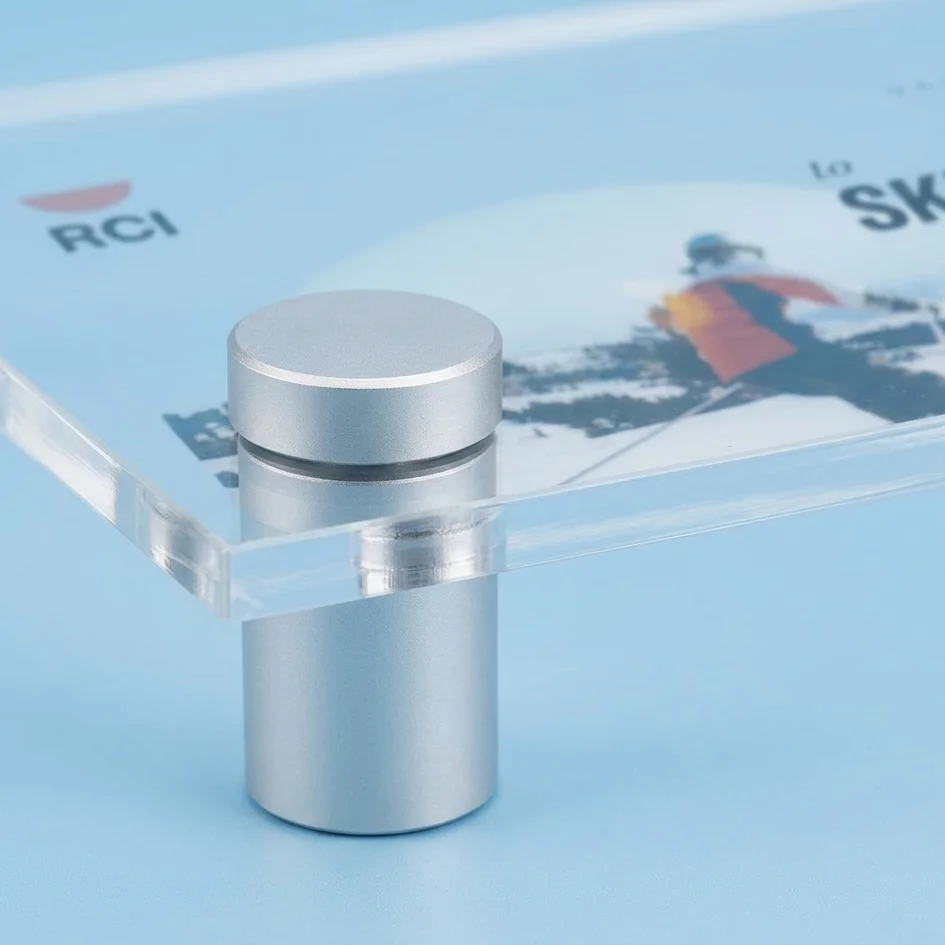
The most common mounting approach for acrylic signs is standoff fixings — sometimes called barrel bolts — which create a small gap between the panel and the wall surface. That gap serves two purposes: it allows the sign to cast a subtle shadow that adds dimensionality, and it makes the installation look considered rather than just stuck to the wall.
For larger or heavier panels, especially those using 5mm sheet, fixing directly into solid masonry is recommended. Lightweight panels on plasterboard can use appropriate cavity fixings, but it’s worth checking the fixing specification against the weight and size of the sign before committing.
Adhesive mounting — using strong double-sided foam tape or structural adhesive — works well for smaller pieces on smooth, clean surfaces. It’s a cleaner look in some applications, though it makes repositioning considerably harder once set.
Final Thoughts
Choosing the right signage material comes down to what you want the sign to do — and what you want it to say about you. Acrylic consistently delivers the combination of visual quality and long-term performance that most professional environments demand, which is why it has become the default specification for businesses that take their physical brand seriously. The Board Printing Company offers acrylic printing across a full range of sizes, thicknesses, and finishes, with expert guidance from brief to installation.
Disclaimer: This article is for informational purposes only. Prices and material specifications may vary by supplier, project size, and application. Always consult a qualified signage specialist before specifying materials for permanent or structural installations.
Board Printing Company
Author Name: Nimesh Kerai
Nimesh Kerai, the Head of Printing at the Board Printing Company, is a seasoned professional. His immaculate technical proficiency and habit of staying current with the advertising trends have helped the company reach impressive heights in the industry. He has amassed extensive knowledge throughout his career and often shares it with the general public in the form of intriguing and useful blog posts.