
Drive past any active building site in London and you will notice the difference between contractors who treat the hoarding as an afterthought and those who treat it as an asset. One is bare plywood or rusting steel. The other carries the developer’s branding, a computer-generated image of the finished building, and a website address. Both meet the legal minimum. Only one is doing any work for the business behind it. For anyone commissioning a construction project, that gap is worth closing.
The Legal Baseline: What You Are Actually Required to Do
Before you think about design, it helps to be clear on what the law demands — because the compliance picture is more layered than most people realise, and getting it wrong creates problems that no amount of good branding will fix.
The Health and Safety at Work Act 1974 places a duty on employers to protect the public from hazards associated with their site. The Construction (Design and Management) Regulations 2015 — CDM 2015 — go further, specifically requiring that authorised access to sites is prevented and that the perimeter is clearly identified. In practical terms, this means a secure, stable hoarding is not optional. It is a legal obligation from the day work begins.
Height is the most frequently misunderstood element. The industry standard for UK construction hoardings is 2.4 metres, which prevents easy climbing and meets most local authority expectations. On urban sites in London — particularly in areas with higher pedestrian footfall — 3 metres is increasingly the norm. Some local authorities and the Considerate Constructors Scheme require this as a baseline on sites in busy public areas.
Hoarding Printing: Turning a Site Boundary Into a Marketing Channel
Here is where the conversation shifts from obligation to opportunity. A construction site in central London — or anywhere with consistent pedestrian footfall — is surrounded by a moving audience that sees your hoarding every day for the duration of the project. That might be six months. It might be three years. For a residential developer or a retail brand commissioning a new build, that is a sustained, location-specific advertising presence that no other medium can replicate at the same cost.
Hoarding printing done properly can increase marketing visibility by up to 50%, according to industry figures. Developers regularly use the surface area to display CGI renders of the completed building — an approach that generates interest, supports off-plan sales conversations, and begins building anticipation in the local community before a single floor is above ground. Contractors use it to reinforce their brand reputation. Retail brands that have taken a lease on a site while it’s being developed use it to maintain visibility with their customer base during the disruption.
Construction Signage: The System That Runs Inside the Boundary
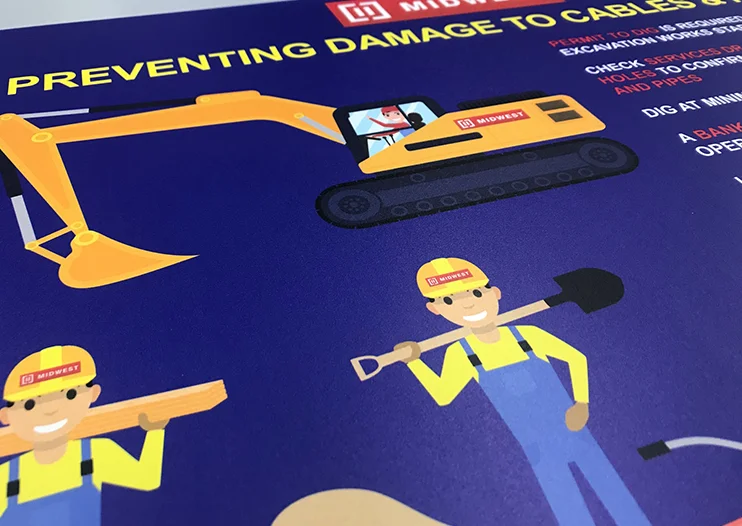
Hoarding is the face the public sees. Construction signage is everything that operates inside and around the site to keep it running safely, legally, and efficiently.
The two serve entirely different audiences — but both matter, and both need to be treated as part of a coherent system rather than sourced piecemeal as afterthoughts. When construction signage is non-compliant, inconsistent, or incorrectly specified, it frequently triggers HSE improvement notices and, in more severe instances, serves as a contributing factor in on-site accidents.
Understanding the Four Essential Safety Sign Categories
Health and safety legislation in the UK identifies four distinct classes of safety signage. To remain compliant, each category must strictly follow its designated color scheme:
- Prohibition (Red): Indicates forbidden actions, such as unauthorized entry or smoking. These feature a red circle and diagonal bar over a white background.
- Warning (Yellow/Amber): Highlights potential hazards like slipping risks or overhead loads using a yellow triangle on a white background.
- Mandatory (Blue): Specifies required actions, including the use of hi-vis gear or hard hats, displayed as white symbols on a blue circle.
- Emergency (Green): Marks first aid stations and fire escape routes with white icons on a green background.
UK health and safety law defines four categories of safety signs, each with a standardised colour code that must be observed:
- Prohibition signs (red): Actions that must not be taken. No unauthorised entry, no smoking, no mobile phones near machinery. Red circle and crossbar on a white background.
- Warning signs (yellow/amber): Hazards that require attention. Overhead loads, slipping risks, plant machinery operating nearby. Yellow triangle on a white background.
- Mandatory signs (blue): Actions that must be taken. Hard hats, hi-vis, steel-toecap boots, safety glasses. White symbol on a blue circle.
- Emergency indicators (green): Used to identify the placement of first aid kits, emergency gear, and fire escape routes. These feature a white icon set against a green backdrop.
These specific colour protocols are codified under the Health and Safety (Safety Signs and Signals) Regulations 1996. These regulations incorporate EU-derived standards that remain in effect across Great Britain following Brexit, and failing to adhere to them — even due to a supplier’s error — results in a lack of compliance.Using non-standard colours — even unintentionally, because a sign was printed by a supplier unfamiliar with the regulations — constitutes non-compliance.
Beyond safety: the operational signage layer
Construction signage covers far more than the mandatory safety notices. A well-managed site uses signage to direct deliveries, guide visitors to the site office, separate live construction zones from occupied areas, and communicate project information to the local community. None of this is legally required in the way that safety signs are — but all of it affects how efficiently the site operates and how it is perceived by everyone who interacts with it.
Site entrance boards are among the most visible operational signs — displaying the developer, principal contractor, architect, planning reference, and emergency contact details. These are standard expectations on any commercial project, and their absence is the kind of detail that visiting stakeholders and local authority inspectors notice.
Project information boards for the public, typically installed behind a viewing window in the hoarding or at the site entrance, communicate timeline, development description, and community contact details. In London boroughs with active planning departments, proactive community communication is increasingly expected as part of maintaining good relations and reducing complaints.
✓ Practical note: Specify all site signage from a single supplier where possible. Consistent fonts, colours, and formats across all printed materials — from the entrance board to the mandatory safety notices — creates a professional, coherent site presentation that reflects well on every party involved.
Conclusion
A construction site has two audiences: the public walking past it every day, and the people working inside it. The first impression it makes on both groups is shaped by the quality of the signage surrounding it. Getting that right is part of running a professional project — not an optional extra. Sign Company London handles everything from compliance-driven site safety signs to large-format branded hoarding installations, giving developers and contractors a single, experienced partner from survey to installation.
Disclaimer: This article is for informational purposes only. Planning regulations and compliance requirements vary by local authority and site type. Always consult your local planning authority and a qualified health and safety professional before installing hoarding or site signage. Regulatory details referenced reflect UK law as of the date of publication
Author Bio: Nimesh KeraiNimesh Kerai serves as the Printing Head at the Sign Company in London. Utilising his technical aptitude and the trait of keeping up with the latest technological advancements, he has been able to deliver top-notch quality prints and signage to sou customers consistently. This has cemented the Sign Company as one of the most sought-after signage companies in London. He consistently shares his insights with the masses by means of useful and intriguing blogs..