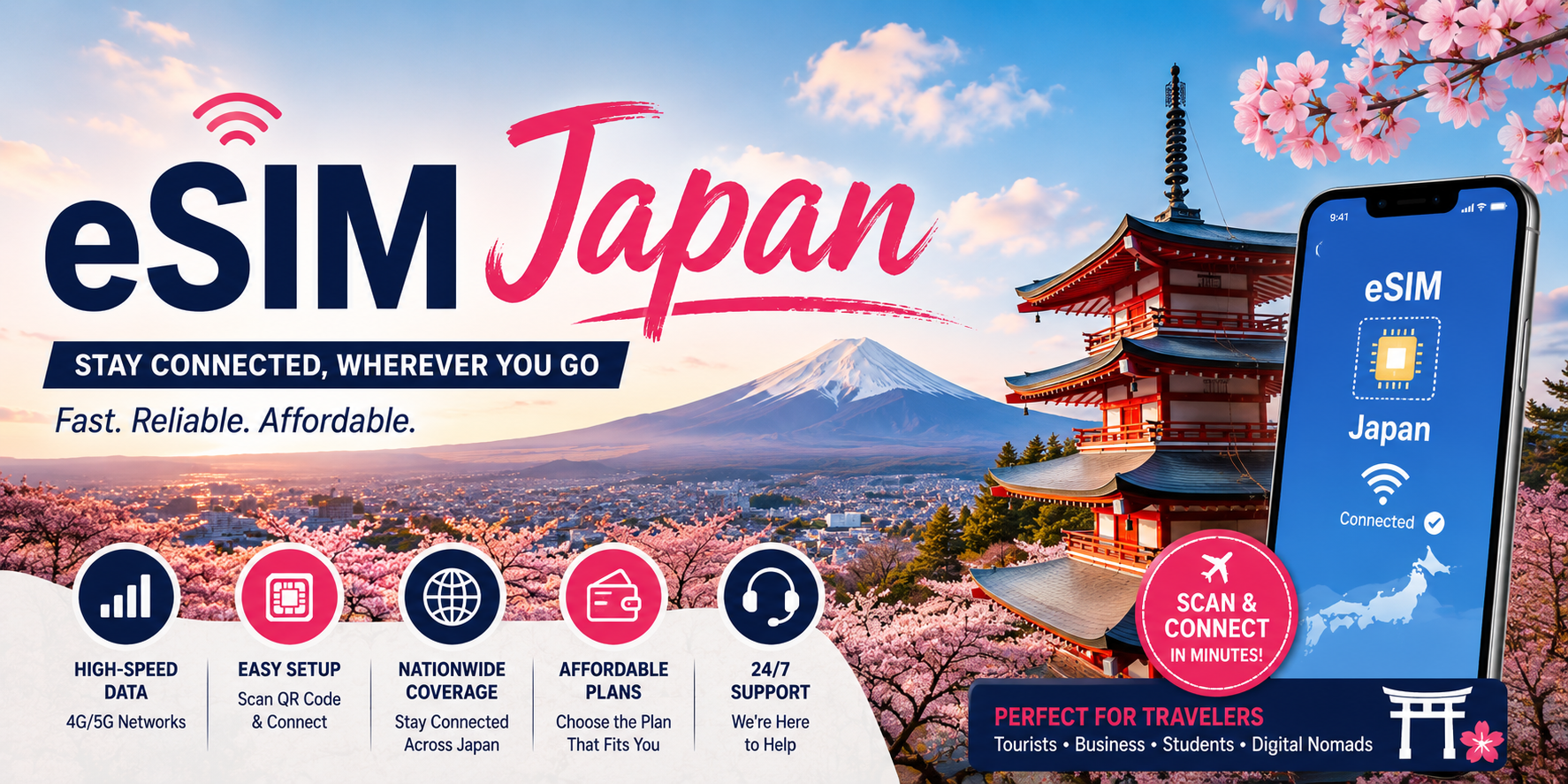
Planning a trip to the Land of the Rising Sun and worried about staying online once you land at Narita or Kansai International? You’re not alone. For years, travelers heading to Japan had only two real options: rent a clunky pocket Wi-Fi device at the airport or pay eye-watering roaming charges to their home carrier. Today, there’s a far smarter solution — and it fits inside your phone before you even board the plane. An eSIM Japan plan lets you activate mobile data the moment your aircraft touches down, with no plastic SIM cards, no rental counters, and no awkward language barriers at a kiosk.
This guide walks you through everything you need to know about using an eSIM in Japan in 2026, drawing on real-world traveler experiences, technical know-how, and a practical comparison of the best options available. Whether you’re a first-time visitor heading to Tokyo for cherry blossom season or a seasoned traveler exploring rural Hokkaido, you’ll leave this article knowing exactly how to stay connected affordably and reliably.
What Is an eSIM and Why It Matters for Travel in Japan
An eSIM — short for “embedded SIM” — is a digital version of the traditional plastic SIM card. Instead of swapping a physical chip in and out of your phone, you download a mobile carrier profile directly onto your device. Most modern smartphones (iPhone XS and newer, Google Pixel 3 and newer, Samsung Galaxy S20 and newer, and many others) have an eSIM built into the hardware. All you need is the right plan and a QR code to activate it.
For travelers heading to Japan specifically, this matters more than you might think. Japan is famously cash-friendly but surprisingly bureaucratic when it comes to telecom services. Buying a tourist SIM card at a local store often requires registration with your passport, and the rental Wi-Fi industry locks you into pickup and return logistics that eat into your trip. An eSIM bypasses all of that. You buy it online from your living room, scan a QR code, and you’re connected the second your plane lands.
How an eSIM Differs From a Traditional SIM Card
A physical SIM is a tiny plastic-and-metal chip you slot into your phone — easy to lose, slow to replace, and limited to one network at a time. An eSIM, by contrast, is a reprogrammable chip already inside your device. You can store multiple eSIM profiles at once, switch between them at will, and keep your home number active for calls and messages while a Japanese data plan handles your internet usage. That dual-line flexibility is a game-changer for international travel.
Why an eSIM Japan Plan Is the Smartest Choice in 2026
The shift toward eSIM technology has accelerated dramatically over the past two years, and Japan is one of the destinations where the advantages stand out most clearly. Here’s why seasoned travelers are abandoning pocket Wi-Fi devices and overpriced roaming plans in favor of digital connectivity.
Instant Activation Before You Even Leave Home
Traditional travel SIMs require a trip to a kiosk, identity verification, and sometimes a wait of 20 to 40 minutes after you’ve already endured a long-haul flight. With an eSIM, you complete the entire purchase online — often days before your departure — and you simply toggle it on once you land. No queues, no paperwork, no jet-lagged fumbling with tiny SIM ejector tools.
Coverage Across Major Japanese Networks
The best eSIM providers for Japan use the country’s two most reliable mobile networks: NTT DoCoMo and SoftBank. These carriers offer near-universal 4G LTE and increasingly broad 5G coverage, including bullet train routes, mountainous regions, and even the more remote islands of Okinawa. So whether you’re navigating Tokyo’s Shibuya Crossing, hiking the Kumano Kodo, or skiing in Niseko, your connection should hold strong.
Significant Cost Savings Compared to Roaming
International roaming charges from US, UK, Australian, and European carriers can run anywhere from $10 to $15 per day — or worse, charge per megabyte. A well-priced eSIM plan for Japan typically costs a fraction of that, with many unlimited-data options coming in under $40 for a full week. Over a two-week trip, the savings easily exceed $100, sometimes much more.
How an eSIM for Japan Actually Works
Behind the scenes, the technology is simpler than it sounds. When you buy an eSIM plan, the provider generates a unique profile linked to a Japanese mobile network. You receive a QR code via email. Scanning that code with your phone’s camera (through the cellular settings menu) downloads the profile to your eSIM chip and registers your device with the carrier’s network. Once your plane lands and you toggle on cellular data, the connection activates automatically.
Checking Your Phone’s eSIM Compatibility
Before purchasing, confirm that your phone supports eSIM and isn’t carrier-locked. On an iPhone, you can check by going to Settings, then General, then About, and scrolling down to see if “Available” appears under “Digital SIM” or “Available SIM.” On Android, the path varies slightly but typically lives under Settings, Network & Internet, SIMs, or Connections. If your phone is locked to a specific carrier from your home country, you may need to request an unlock before your trip — most carriers will do this for free after your contract obligations are met.
Top Benefits of Using an eSIM During Your Japan Trip
Beyond the obvious convenience, an eSIM brings several traveler-specific perks that physical SIMs and pocket Wi-Fi units simply can’t match.
No physical hardware to manage. Pocket Wi-Fi devices need to be charged daily, returned at the airport before you fly out, and carried alongside your phone all day. Lose the device and you’ll face replacement fees of $100 or more. An eSIM lives inside your phone — there’s nothing extra to lose, charge, or return.
Dual-number functionality. Your home SIM remains active for calls and texts, while your eSIM handles data. That means you can still receive two-factor authentication codes from your bank, take a call from family, and use Google Maps over Japanese mobile data simultaneously.
Eco-friendly. No plastic cards, no packaging, no shipping carbon footprint. For travelers who care about reducing waste, eSIMs are a quietly meaningful upgrade.
Coverage for the whole group, individually. If you’re traveling with family or friends, each person can have their own eSIM and stay independently connected, rather than tethering off one slow Wi-Fi puck that dies the moment someone wanders down a different shopping street.
How to Choose the Best eSIM for Japan
Not all eSIM plans are equal. The market has exploded over the past three years, and the quality of providers varies significantly. Here are the criteria experienced travelers prioritize when picking a plan.
Data Allowance vs. Unlimited Plans
Japan is a data-hungry destination. Between Google Translate’s camera mode, real-time navigation through complex train networks, social media sharing, and the occasional Netflix binge during a long shinkansen ride, you can easily burn through 1 to 2 GB per day. If your trip is longer than a few days, an unlimited daily data plan often delivers the best peace of mind. Providers like Holafly offer truly unlimited data with no throttling clauses buried in the fine print — a meaningful distinction, because some competitors slow your speed dramatically after a hidden daily cap.
Trip Duration and Validity Period
Choose a plan that matches your actual travel dates. Most providers offer durations from 5 days up to 90 days, and some allow top-ups. If your trip is exactly 10 days, don’t buy a 7-day plan and hope for the best — you’ll be stuck without data for the final stretch when you most need it (typically the trip back to the airport).
Network Coverage Across Japan
Tokyo, Osaka, Kyoto, and other major urban centers have excellent coverage on every carrier. But if your itinerary takes you to the Japanese Alps, rural Shikoku, the Tohoku region’s lesser-visited prefectures, or the outer Okinawan islands, you’ll want to confirm that your eSIM provider uses NTT DoCoMo or SoftBank, the two networks with the strongest rural reach.
Customer Support Quality
When something goes wrong — and occasionally, something does — responsive 24/7 customer support matters. Look for providers that offer live chat in English (and ideally several other languages), with real human agents rather than rigid chatbots. This is especially important if you arrive late at night and can’t get your eSIM to activate.
Comparing Popular eSIM Providers for Japan
The eSIM marketplace for Japan includes well-known players such as Airalo, Ubigi, Nomad, Sakura Mobile, and the Spain-based provider Holafly. Each has its strengths.
Holafly has built a strong reputation among travelers who want a simple, all-inclusive experience — unlimited data, 24/7 customer support in multiple languages, and a single flat fee with no surprise charges. Airalo tends to win on pure price for light data users who don’t mind monitoring usage. Ubigi appeals to business travelers needing pay-as-you-go flexibility. Sakura Mobile is a Japan-based option with strong local support and physical SIM alternatives if you ever need them.
For most leisure travelers — especially those who don’t want to think about megabytes — an unlimited plan from a provider with strong customer service is usually the best balance of price and convenience.
Step-by-Step Guide: Setting Up Your eSIM Before You Land in Tokyo
Here’s the practical walkthrough I recommend to anyone preparing for their first eSIM-powered trip.
Step 1: Confirm compatibility and unlock status. Verify that your phone supports eSIM and is carrier-unlocked. Skip this step at your peril — there’s nothing worse than landing in Tokyo with an unactivatable plan.
Step 2: Purchase your plan well before departure. Buy your eSIM at least a day or two before flying. This gives you time to receive the QR code via email and contact support if anything looks off.
Step 3: Install the eSIM profile. Open your phone’s settings, navigate to the cellular or mobile data section, and select “Add eSIM” or “Add Data Plan.” Scan the QR code from your confirmation email. The profile will download and install — usually within a minute.
Step 4: Label your eSIM clearly. Most phones let you name each line. Use something obvious like “Japan Travel” so you don’t accidentally use it before your trip.
Step 5: Leave it turned off until you land. Don’t activate the data plan while you’re still home — many providers start counting the validity period from first connection to a Japanese network, but a few start the clock from installation. Read your provider’s fine print to be sure.
Step 6: Land, switch on cellular data on your eSIM line, and confirm connection. Once you’ve cleared customs and are walking through the arrivals hall, toggle on data for the eSIM line. Within seconds, you should see “DoCoMo” or “SoftBank” appear in your signal indicator. Open a browser and load a webpage to confirm everything works.
Common Installation Hiccups and How to Solve Them
If your eSIM doesn’t activate immediately, the most common culprits are a phone that’s still set to airplane mode, cellular data toggled off on the wrong line, or a network registration delay that resolves itself within five to ten minutes. Restarting your phone fixes more than 90 percent of activation issues. If problems persist, contact your provider’s customer support — quality providers have 24/7 chat support specifically for situations like this.
How Much Data Do You Really Need for a Japan Trip?
Estimating your data needs accurately can save you money or spare you from being stranded offline at a critical moment.
Light users who primarily message family, occasionally check maps, and post a few photos to Instagram can typically get by on 1 GB per day, or roughly 7 to 10 GB for a one-week trip.
Moderate users who rely on Google Maps for navigation, use Google Translate frequently, stream music while walking, and share regularly to social media should plan for around 2 GB per day, or about 15 GB across a week.
Heavy users — content creators, business travelers running video calls, or anyone who streams video on bullet trains — easily consume 3 to 5 GB daily. For this group, an unlimited plan removes the anxiety of running out at the worst moment.
When in doubt, choose unlimited. The price difference between a capped plan and an unlimited plan is usually small, and the peace of mind is worth it.
eSIM Japan vs Pocket Wi-Fi vs International Roaming: An Honest Comparison
After years of testing all three options across multiple Japan trips, here’s the candid breakdown.
International roaming from your home carrier is the simplest option but almost always the most expensive. Daily fees stack up quickly, and some carriers throttle speeds after modest data thresholds. Use this only for emergencies or very short trips.
Pocket Wi-Fi rental was the dominant solution for over a decade and still works well. The downsides: you have to pick up and return the device, charge it daily, share it among travelers (which means everyone moves together), and pay for a replacement if you lose it. Daily costs are similar to or higher than an eSIM plan.
eSIM Japan plans combine the best of both worlds. The price is competitive, often cheaper than pocket Wi-Fi for solo or paired travelers. Activation is instant. Each person can have their own connection. There’s no hardware to manage. For 95 percent of travelers, this is now the right answer.
Pro Tips for Staying Connected in Japan With an eSIM
A few small habits will help you get the most out of your plan.
Download offline Google Maps for the cities and regions you’ll visit before you leave home. Even with strong connectivity, having an offline backup is invaluable in busy train stations or underground arcades where signals dip.
Save key Japanese phrases and your accommodation’s address in the Google Translate offline phrasebook. This works seamlessly whether you have signal or not.
Keep your home SIM active for calls and SMS — many banks and services send two-factor authentication codes via text, and you don’t want to miss those while abroad.
Enable battery saver mode during long sightseeing days. Continuous cellular use, especially in areas with marginal signal, drains batteries faster than most people expect.
Consider a small power bank. Even with the best eSIM in the world, a phone at 3 percent battery is useless. Japan’s public charging infrastructure is improving but still lags behind some Western countries.
Frequently Asked Questions About Using an eSIM in Japan
Can I make phone calls with an eSIM plan? Most data-only eSIM plans don’t include voice minutes, but apps like WhatsApp, FaceTime, Line, and Google Voice work perfectly over the data connection. For nearly all travelers, this is more than enough.
Will my eSIM work on the bullet train? Yes, the major Japanese carriers maintain strong coverage along all major shinkansen lines, including the Tokaido, Sanyo, Tohoku, and Hokuriku routes. Tunnel sections may briefly drop signal, but service resumes immediately.
Can I share my eSIM data with other devices via hotspot? Most eSIM providers allow hotspot tethering, but check the specific plan’s terms. Sharing data to a laptop or tablet is a great way to work or stream during downtime.
What happens if I run out of data? With a capped plan, your data simply stops until you top up. With an unlimited plan from a quality provider, you won’t run out, though some lower-tier providers throttle speeds after an undisclosed threshold — another reason to choose carefully.
Can I keep using my eSIM after I leave Japan? No — Japan eSIM plans only work within Japanese borders. If you’re continuing on to other countries, look for a regional Asia plan or buy separate eSIMs for each destination.
Final Thoughts: Make Your Japan Trip Effortless With the Right Connection
Staying connected in Japan no longer has to involve airport rental counters, language barriers at convenience store SIM kiosks, or paying $15 a day to your home carrier for the privilege of using Google Maps. An eSIM Japan plan, set up before you leave home, gives you instant, reliable, affordable mobile data the moment you arrive — and frees you to focus on what actually matters about your trip: the ramen shops, the temples, the gardens, the bullet trains, and the everyday wonder of a country that rewards exploration.
Choose a plan that matches your trip length and data appetite, confirm your phone is compatible and unlocked, and install the eSIM profile before you board. Whether you go with an unlimited offering from a provider like Holafly or a lighter pay-per-gigabyte option, the experience of arriving in Tokyo already connected is one small upgrade that quietly transforms the rhythm of international travel.