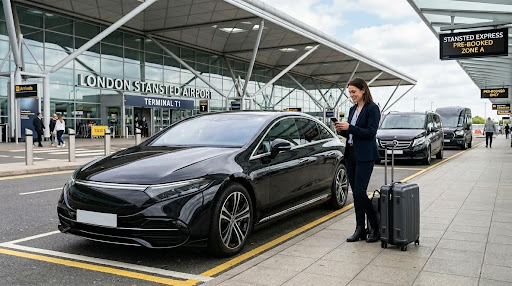
The Stansted airport taxi business of 2026 barely resembles the one that operated a decade ago. What was once a phone-and-dispatcher industry has become a software-driven ecosystem of real-time tracking, automated booking, electric fleets, AI-assisted customer service, and integrated travel platforms. The transformation isn’t a far-future projection — it’s already arrived, and the operators who haven’t kept pace are visibly struggling against those who have.
This article examines how digital-first thinking is reshaping the Stansted airport taxi market: what’s changed, what’s changing now, and what travellers can reasonably expect over the next few years. The focus is on practical developments that affect the actual booking experience — not buzzword-driven speculation about technologies that may never reach the airport transfer industry.
The Shift from Phone Dispatch to Software Dispatch
Traditional taxi operators ran on call-centre dispatch: a phone rings, a controller looks at a screen, and a driver is allocated based on proximity and availability. That model still exists, but it’s no longer competitive on its own. Today’s leading Stansted airport taxi operators have replaced or supplemented it with automated dispatch software that handles matching, route optimisation, and customer communications with minimal human intervention.
The practical benefits flow to travellers. Bookings confirm in seconds. Driver allocation accounts for real-time traffic data. Customer-facing communications (confirmation emails, SMS updates, driver photos) happen automatically. The dispatcher’s role has shifted from logistics manager to exception handler — intervening only when the software needs human judgement.
Real-Time Flight Tracking as Industry Standard
Five years ago, flight tracking was a premium add-on. In 2026, it’s table stakes. Any Stansted airport taxi operator worth booking with monitors your flight status automatically and adjusts pickup time to match the actual landing, not the scheduled one. The technology behind this — API connections to flight data providers, automated dispatch recalculation, driver-side notifications — has become reliable and inexpensive enough that smaller operators can deploy it as standard.
What this means for travellers: the long-standing anxiety about arriving from a delayed flight to find an absent or impatient driver has largely disappeared, at least for travellers using reputable operators. If you book a return Stansted transfer and your flight lands two hours late, the driver knows before you do and adjusts accordingly. This is no longer remarkable; it’s the baseline expectation.
Electric and Hybrid Fleets Entering the Mainstream
Electric and hybrid vehicles are no longer experimental in the Stansted airport taxi market. They’re increasingly common across both standard and premium fleets, driven by a combination of operator economics (lower fuel and maintenance costs), environmental commitments, and increasing customer preference.
Why EVs Make Sense for Airport Taxi Work
Airport routes are predictable, mileage is high, and journeys are typically long enough to make electric running costs significantly lower than petrol. The major obstacle — charging infrastructure — has improved rapidly around the M11 and M25 corridors, and Stansted itself has expanded its operator vehicle charging facilities. The economic case for electric airport taxis has shifted from “in a few years” to “now.”
What Travellers Notice
Riders typically describe EV airport transfers as quieter, smoother, and noticeably more modern in interior feel than equivalent-class petrol vehicles. Some travellers actively prefer EVs and request them; others are indifferent. Operators offering EV options publish this on their websites and at the booking stage.
AI-Assisted Booking and Customer Service
Artificial intelligence has reached the Stansted airport taxi industry, though in less dramatic forms than tech-industry coverage often suggests. The current applications are practical rather than revolutionary, but they meaningfully improve the booking experience.
Chatbots for Common Enquiries
Many operators now deploy AI chatbots on their websites for initial enquiries: vehicle availability, fare estimates, route information, and standard booking questions. The chatbot handles routine queries; human staff handle complex bookings or anything sensitive. A reputable Stansted airport taxi service will offer both routes — automated for speed, human for nuance — rather than forcing all enquiries through a single channel.
Predictive Pricing and Demand Forecasting
Operators increasingly use predictive analytics to anticipate demand spikes — Friday afternoons, school holiday weekends, severe weather — and adjust fleet deployment accordingly. The result is fewer no-availability outcomes during peak periods, which has long been a structural weakness of smaller operators.
Voice Booking via Smart Assistants
Voice booking through smart speakers and phone assistants has entered the market more slowly than predicted, partly because airport taxi bookings involve specific information (precise pickup addresses, exact flight numbers, particular vehicle requirements) that voice interfaces handle awkwardly. Most travellers continue to book online or by phone, and that pattern looks likely to persist for the foreseeable future.
Where voice has gained traction is in post-booking interactions: asking a smart assistant to confirm pickup time, locate the booking reference, or set a wake-up alarm aligned with the driver’s expected arrival. These low-friction queries fit voice naturally. Full booking flows, with all their conditional decisions, remain better suited to visual interfaces — at least until conversational AI catches up with the demands of structured commercial transactions.
The Mobile-First Booking Experience
Most Stansted airport taxi bookings now originate on mobile devices. This has driven a wholesale rebuild of operator websites and booking flows around mobile-first design: instant quote tools that work without scrolling, calendar pickers that respond to touch, payment systems that integrate Apple Pay and Google Pay, and confirmation flows that hand off seamlessly between web, email, and SMS.
Travellers under 40 increasingly expect this. They abandon clunky websites within seconds, judge operators by booking-flow quality, and recommend operators based partly on how easy the digital experience felt. The competitive bar is significantly higher than it was even three years ago, and operators that haven’t kept up are being filtered out by user behaviour.
WhatsApp Booking and Multi-Channel Support
WhatsApp has emerged as a major booking channel for Stansted airport taxis, particularly among international travellers and frequent flyers. It combines the immediacy of phone contact with the documentation of email — useful for confirming details, sharing flight changes, and resolving issues.
Multi-channel support is now the norm. A traveller might check fares on the website, book through WhatsApp, receive confirmation by email, get reminder SMS, and contact the driver by phone — all within the same booking. The technology stack making this possible is invisible to the user, which is exactly as it should be.
Sustainability and Carbon Reporting
Corporate travel buyers increasingly require carbon reporting from their taxi suppliers. Leading Stansted operators now provide annual CO₂ statements to corporate accounts, and some offer real-time per-journey carbon estimates. Carbon offsetting features are appearing at the booking stage on some operator websites — opt-in fees that fund verified offset projects.
Whether sustainability features matter to individual travellers is a personal question. Whether they matter to corporate procurement teams reviewing supplier panels is now mostly answered: yes, increasingly. Operators without sustainability stories are losing corporate contracts to those who have them.
Integration with Wider Travel Platforms
Airport taxi services are increasingly integrated with broader travel platforms — airline booking flows, hotel reservation systems, corporate travel management tools, and travel insurance products. A 2026 traveller might book a flight and have an airport taxi suggested as a single-click add-on, with the transfer details automatically synchronised to the flight schedule.
For frequent travellers, this integration genuinely changes behaviour. When the taxi appears alongside the flight at booking, the friction of arranging ground transport separately disappears. Hotel websites increasingly offer airport transfer add-ons at checkout. Corporate travel platforms include taxi suppliers in pre-negotiated supplier panels, with bookings flowing through unified expense systems.
This integration benefits travellers (less duplication of effort) and operators (warmer leads, automated coordination). It also raises the stakes for service quality — a taxi failure in an integrated booking damages multiple supplier relationships, not just the taxi operator’s reputation. The operators earning these integration partnerships are those with demonstrably reliable service and modern API infrastructure to plug into partner systems.
What Won’t Change
Despite the digital transformation, certain elements of the Stansted airport taxi business remain stubbornly traditional — and arguably should. Drivers still need to know the airport layout, handle luggage, drive safely, and engage politely with passengers. Vehicles still need to be maintained, insured, and licensed. Dispatchers still need to handle the edge cases that automated systems can’t.
The technologies described above are tools that augment good fundamentals; they don’t replace them. An operator with brilliant software but poor drivers will lose to one with adequate software and excellent drivers. The human element of airport taxi service hasn’t been digitised away, and probably won’t be.
What Travellers Should Watch For
Several developments are worth tracking over the next few years. None are predictions; all are reasonable expectations based on current direction of travel:
- Universal EV fleets — likely within five years for premium operators, within ten for standard fleets
- Open booking APIs — allowing third-party platforms to book directly with airport operators
- Driver-side AI tools — helping drivers navigate complex pickups and language barriers more effectively
- Tiered service standards — visible service-level promises with refund guarantees on missed standards
- Subscription pricing for frequent users — discounted bulk rates for monthly or annual commitments
- Greater transparency tools — real-time vehicle tracking visible to the passenger, similar to delivery apps
Travellers don’t need to wait for any of these to choose well today. The fundamental factors — fixed pricing, reliable dispatch, licensed drivers, transparent operations — are already available from well-run Stansted operators. The digital improvements add convenience and consistency without changing the basic choice.
Frequently Asked Questions
How are AI tools changing the Stansted airport taxi booking process?
AI tools currently handle routine enquiries, predictive demand forecasting, and automated dispatch matching. Human staff still manage complex bookings, exception handling, and customer service issues requiring judgement. The combination is faster and more accurate than either approach alone, but the fundamental booking experience remains conversational and human-centred.
Will electric vehicles cost more for Stansted airport transfers?
Not significantly. Some operators offer EVs at a slight premium as a premium-class option; others include them in their standard fleet at no additional cost. As EV adoption increases across the industry, pricing differences are levelling out, with operators absorbing the lower running costs into competitive standard fares.
Are app-based bookings replacing phone bookings entirely?
No. While most bookings now happen online or via apps, phone booking remains important for complex itineraries, special requirements, last-minute adjustments, and travellers less comfortable with digital interfaces. Quality Stansted airport taxi operators maintain both channels — and route calls to real human dispatchers rather than chatbots.
How does flight tracking actually work?
Operators connect to commercial flight data APIs that provide real-time flight status — scheduled time, actual departure, current position, projected arrival. When you book, your flight number is registered with the dispatch system, which monitors progress and adjusts driver dispatch automatically if the schedule changes by more than a defined threshold.
Where can travellers see the digital transformation most clearly?
The booking experience itself is the clearest indicator. A modern Stansted operator’s online booking interface provides instant fixed-fare quotes, vehicle selection, confirmation in seconds, automatic SMS updates, and integrated payment — all without phone contact. An operator still using a booking-form-plus-callback model is several generations behind the current standard.
Conclusion
The Stansted airport taxi industry’s transformation isn’t a future event waiting to happen. It’s happening now, driven by software, electric vehicles, and travel-platform integration. Operators that have adopted these technologies offer measurably better experiences: faster booking, more accurate dispatch, cleaner vehicles, and tighter integration with the rest of the travel journey.
For travellers, the practical implication is simple: choose operators that have moved with the industry. The fixed-fare promise, flight tracking, mobile-first booking, and multi-channel support that define modern airport transfers aren’t luxuries; they’re the new baseline. Operators offering these as standard are the ones worth booking — and the ones likely to be operating five years from now.