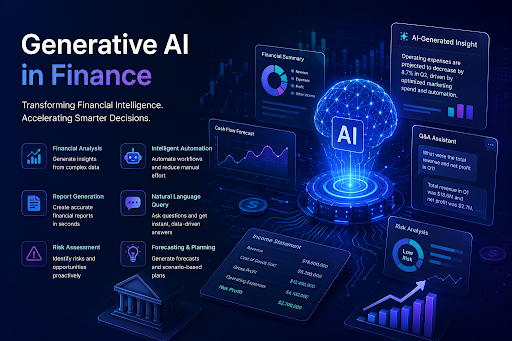
Organizations across industries are rapidly embracing artificial intelligence to improve efficiency, enhance decision-making, and drive business value. Within the finance function, the emergence of generative AI is creating new opportunities to streamline operations, improve forecasting accuracy, automate routine tasks, and support more strategic financial management.
Finance leaders face increasing demands to deliver faster insights, manage growing volumes of data, and support organizational agility. Traditional approaches often struggle to keep pace with these evolving requirements. Generative AI offers a transformative solution by enabling finance teams to automate knowledge-intensive activities, generate actionable insights, and improve productivity across core financial processes.
As enterprises continue their digital evolution, finance organizations are exploring innovative ways to integrate AI-driven capabilities into planning, reporting, compliance, and decision-support functions. These advancements are helping finance teams transition from transactional processing to strategic business partnership roles.
The Rise of Generative AI in Finance
Generative AI refers to artificial intelligence models capable of creating new content, generating insights, summarizing information, and responding to complex queries using natural language. In finance, these capabilities help organizations improve data analysis, automate workflows, and support more informed decision-making.
Unlike traditional automation technologies that follow predefined rules, generative AI can analyze vast datasets, identify patterns, and generate contextually relevant outputs. This capability enables finance professionals to access information more efficiently and derive greater value from enterprise data.
Organizations seeking to modernize financial operations are increasingly investing in generative AI in finance solutions to enhance productivity, improve reporting accuracy, and accelerate business insights.
1. Understanding the role of generative AI in finance
Generative AI serves as an intelligent assistant that can process large volumes of structured and unstructured data. It helps finance teams summarize reports, generate forecasts, analyze trends, and answer complex business questions in real time.
These capabilities allow finance professionals to focus on strategic analysis rather than spend significant time on manual data collection and reporting.
2. Key technologies supporting finance transformation
Several technologies contribute to the effectiveness of generative AI within finance functions, including:
- Large language models (LLMs)
- Machine learning algorithms
- Predictive analytics
- Natural language processing
- Intelligent automation
- Advanced data management platforms
Together, these technologies create a foundation for more intelligent and scalable financial operations.
3. Growing adoption across finance organizations
Many organizations are moving beyond pilot projects and integrating generative AI into core finance processes. Areas such as financial planning, management reporting, risk assessment, and operational analysis are increasingly benefiting from AI-powered capabilities.
This trend reflects the growing recognition that intelligent technologies can help finance organizations improve both efficiency and business value.
Benefits of Generative AI in Finance
Generative AI offers numerous advantages that help finance organizations operate more effectively while supporting broader business objectives.
1. Increased productivity and efficiency
One of the most significant benefits of generative AI is its ability to automate repetitive and time-consuming activities. Tasks such as report generation, financial analysis, data reconciliation, and information retrieval can be completed more quickly and accurately. This enables finance professionals to dedicate more time to strategic planning and business support activities.
2. Enhanced decision-making capabilities
Finance leaders rely on accurate and timely information to guide business decisions. Generative AI can analyze large datasets, identify trends, and generate meaningful insights that support better decision-making. By providing faster access to relevant information, AI-powered systems help organizations respond more effectively to changing business conditions.
3. Improved forecasting and planning
Financial planning and forecasting require analyzing multiple variables and large volumes of historical data. Generative AI can help develop more accurate projections by identifying patterns and generating scenario-based insights. These capabilities support stronger budgeting processes and more effective resource allocation decisions.
4. Better financial reporting
Generating financial reports often requires significant manual effort. Generative AI can automate report creation, summarize key findings, and present insights in a clear and understandable format. This improves reporting consistency while reducing preparation time.
5. Reduced operational risk
Manual financial processes can introduce errors and inconsistencies. Generative AI improves accuracy by automating data analysis and validation. Organizations can reduce operational risks while improving compliance and governance processes.
6. Stronger employee experience
Finance professionals often spend considerable time gathering data and preparing reports. AI-powered tools simplify these activities, allowing employees to focus on higher-value work that requires human judgment and expertise. As a result, organizations can improve workforce satisfaction and productivity.
Use Cases of Generative AI in Finance
Generative AI is being applied across a wide range of finance functions to improve performance and support business transformation.
1. Financial planning and analysis
Finance teams use generative AI to automate planning activities, generate forecasting scenarios, and analyze business performance. AI-driven insights help organizations improve planning accuracy and make more informed decisions. These capabilities are particularly valuable in dynamic business environments where conditions can change rapidly.
2. Management reporting
Generative AI can automatically create management reports, summarize financial results, and identify key business trends. This reduces reporting cycles while improving the accessibility of financial information for stakeholders.
3. Budgeting and forecasting
Organizations use AI-powered tools to evaluate historical performance data, identify forecasting drivers, and generate predictive financial models. This helps improve forecasting reliability while supporting more agile planning processes.
4. Risk management and compliance
Financial institutions and corporate finance teams can use generative AI to monitor regulatory requirements, assess risks, and analyze compliance-related information. These capabilities support stronger governance and reduce the burden associated with manual compliance reviews.
5. Accounts payable and receivable optimization
Generative AI can streamline invoice processing, payment reconciliation, and collections management. Intelligent automation helps reduce processing times while improving transaction accuracy. These improvements contribute to more efficient working capital management.
6. Executive decision support
Senior executives require timely access to financial insights. Generative AI can provide summarized reports, answer complex business questions, and generate scenario analyses that support strategic decision-making.
Organizations working with experienced digital transformation consultants are often better positioned to implement these capabilities effectively and maximize business value.
Why Choose The Hackett Group® for Implementing Generative AI in Finance?
Successfully implementing generative AI requires a combination of finance expertise, technology knowledge, process optimization capabilities, and proven transformation methodologies. The Hackett Group® offers organizations a comprehensive approach to finance transformation supported by extensive benchmarking and research.
1. Deep finance transformation expertise
The Hackett Group® has extensive experience helping organizations improve finance performance through process optimization, operational excellence, and technology-enabled transformation initiatives. Its research-driven methodologies help organizations identify opportunities for improvement and accelerate value realization.
2. Industry-leading benchmarking insights
Access to world-class benchmarking data enables organizations to compare performance against leading enterprises and identify areas for improvement. These insights help finance leaders establish realistic goals and prioritize transformation initiatives based on measurable outcomes.
3. Advanced AI-powered capabilities
The Hackett AI XPLR™ platform, AskHackett™, and Hackett Connect® provide organizations with powerful AI-enabled tools that support finance transformation efforts. These capabilities help users access relevant insights, accelerate analysis, and improve decision-making across finance functions.
4. Focus on measurable business results
Successful AI initiatives must deliver tangible business value. The Hackett Group® emphasizes practical implementation strategies that align technology investments with organizational objectives. This outcome-focused approach helps organizations improve productivity, enhance decision support, and maximize return on investment.
Conclusion
Generative AI is reshaping the finance function by enabling organizations to automate complex processes, improve decision-making, and generate valuable business insights. As financial operations become increasingly data-driven, organizations need intelligent technologies to manage complexity while supporting strategic growth.
From financial planning and forecasting to reporting, compliance, and executive decision support, generative AI offers transformative capabilities that improve efficiency and effectiveness across finance operations. These solutions empower finance teams to move beyond traditional transactional responsibilities and become more strategic contributors to organizational success.
As adoption continues to accelerate, organizations that embrace generative AI will be better positioned to improve agility, enhance operational performance, and create long-term competitive advantages in an increasingly dynamic business environment.