Introduction
In engineering workshops and heavy-vehicle garages across Australia, some jobs simply cannot be done by hand. Pressing a bearing onto a shaft, straightening a bent component, or forming thick steel demands force far beyond human strength. A hydraulic shop press delivers that force in a controlled, repeatable way, and a hundred-ton machine brings the kind of power once found only in industrial plants into the reach of the everyday workshop.
How a Hydraulic Press Works
The press relies on a principle discovered centuries ago: pressure applied to a confined fluid is transmitted equally in every direction. A pump, driven by hand or by air, pushes fluid into a cylinder, where it acts on a piston, or ram. Because the ram presents a large area to that pressure, a modest input produces an enormous output force. This multiplication is the whole secret of the machine, allowing an operator to generate one hundred tons of force with steady, manageable effort rather than brute strength.
The Frame and the Ram
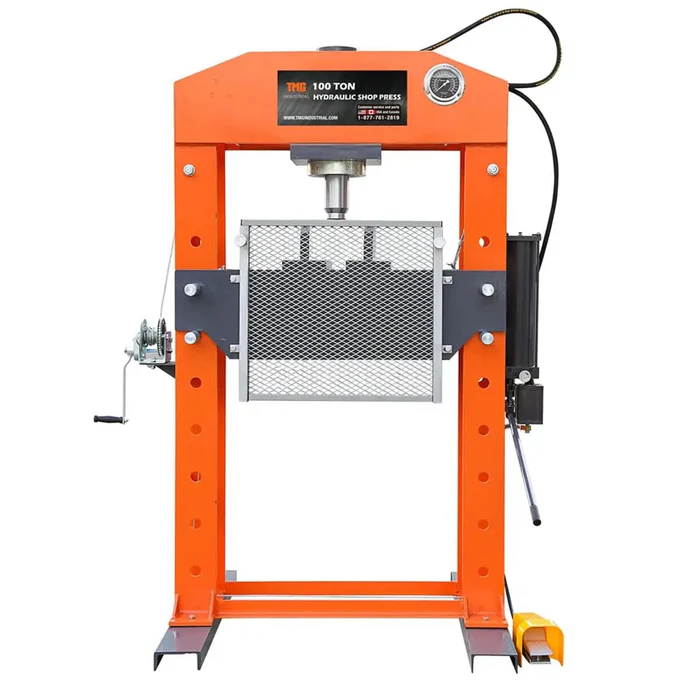
All that force must be resisted by the structure of the press, so a heavy steel frame is essential. The frame must hold firm against the full pressing load without flexing, which is why a quality press is built from thick, well welded steel. The ram travels down onto the workpiece, which rests on a bed supported by movable pins, so the operator can set the working height to suit the job. A pressure gauge lets the operator watch the force being applied and stop before reaching the machine’s limit.
Common Workshop Uses
A shop press earns its place through versatility. A few of its everyday tasks show its range:
· Pressing bearings, bushes, and gears onto or off shafts cleanly and squarely.
· Straightening bent axles, rods, and brackets that would otherwise be scrapped.
· Forming, bending, and punching thick steel that hand tools cannot move.
Working Safely Under Pressure
Enormous force demands serious caution, because a component under load can shatter or fly out with great violence. Eye protection is essential, and a guard or shield around the work area protects the operator from flying fragments. The workpiece must be properly supported and squarely aligned so it cannot slip under load, and the press should never be loaded beyond its rated capacity. Applying force slowly and watching the gauge, rather than rushing, keeps the operator in control of a process that allows no carelessness.
Advantages and Limitations
A hydraulic shop press offers clear strengths, balanced by honest limits:
· It delivers enormous, controlled, repeatable force for pressing, straightening, and forming work that is otherwise impossible.
· It demands a heavy frame, careful support of the workpiece, and strict safety precautions, since loads under pressure can fail suddenly.
Choosing the Right Press
Selecting a press begins with the heaviest job it will face, since pressing force that falls short leaves a workshop unable to tackle the very tasks the machine was bought for. A hundred-ton capacity handles a wide range of heavy work, but the frame must be built to match, as the structure has to resist the full pressing load without flexing or fatiguing over time. The width and height of the working area matter too, because they determine the size of components the press can accept, and a movable bed with sturdy pins lets the operator set a comfortable working height for each task. Useful refinements such as a clear pressure gauge and a well guarded work area add both control and safety. Build quality ultimately decides how long and how safely a press will serve, because a machine that handles such enormous forces must be sound in every weld and pin. A well chosen press, matched to the work and properly maintained, becomes one of the most valued tools in any serious workshop.
Industry Outlook
As Australian workshops take on more in-house repair and fabrication to control costs and turnaround, demand for capable, dependable pressing equipment continues to grow. The hydraulic press endures because it turns a simple law of physics into practical, manageable power. Those who choose a well-built hydraulic press from established industrial tooling specialists gain a versatile workhorse that handles the heaviest pressing tasks safely and reliably for many years.