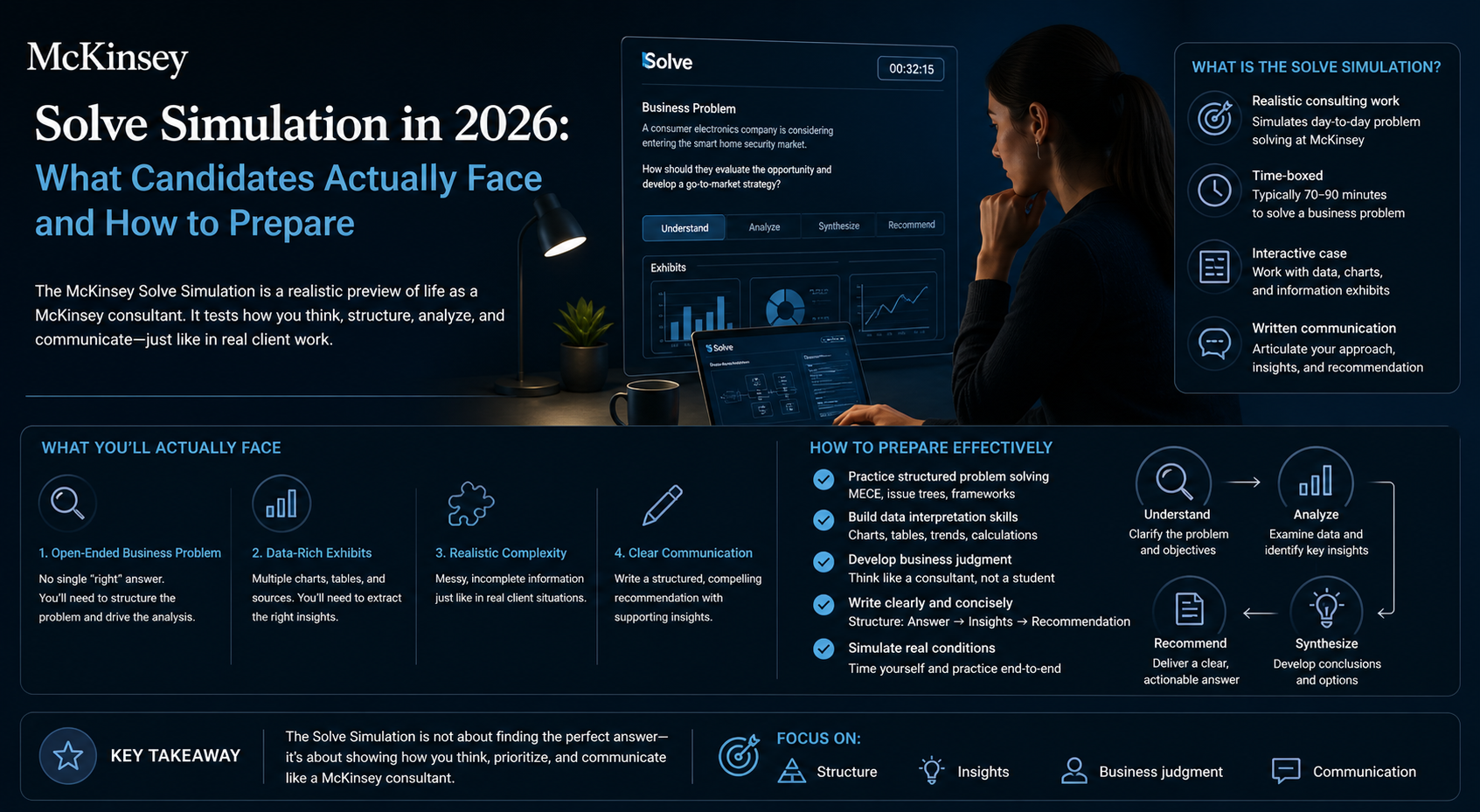
The McKinsey Solve simulation has become one of the most important early screening steps for many consulting candidates. McKinsey describes Solve as a gamified assessment designed to showcase problem-solving ability, with results considered alongside the rest of a candidate’s application and any other assessment results.
Unlike a traditional written test, the McKinsey Solve simulation places candidates inside interactive scenarios where they must analyze information, make decisions, manage constraints, and think through consequences. McKinsey states that no previous business knowledge or gaming experience is required, and candidates receive a tutorial at the start of each task.
Still, candidates often benefit from understanding the format before test day. A strong preparation plan helps reduce uncertainty, build pacing, and improve the way candidates approach unfamiliar scenarios. For a deeper walkthrough of the current format, candidates can use a complete McKinsey Solve Simulation guide to understand the core modules and practice strategy in one place.
The Evolving Nature of the McKinsey Solve Assessment
The McKinsey Solve simulation is not a static exam. It has changed over time, and candidates may encounter different versions depending on region, role, and recruiting cycle. That means preparation should focus less on memorizing answers and more on developing a flexible problem-solving process.
The assessment is built to evaluate how candidates think. It rewards structured reasoning, careful reading, logical trade-offs, and the ability to make decisions under time pressure. In other words, the test is less about knowing consulting jargon and more about showing how you handle complexity.
What Candidates May Face in 2026
Preparation resources for the 2026 McKinsey Solve format commonly describe three major modules: Sea Wolf, Red Rock Study, and Sustainable Future Lab. SolvePrep’s 2026 overview says its platform covers all three games and describes each as testing a different part of the candidate’s problem-solving toolkit.
Each module has a distinct feel. One may emphasize data and calculations. Another may focus on optimization and constraints. A newer style of module may test judgment, prioritization, and team-based decision-making.
The key is not to treat the assessment as one giant puzzle. Candidates should prepare for each module separately, then practice combining them under realistic time pressure.
Key Components of the McKinsey Solve Simulation
Red Rock Study: Calculation and Chart Reading
The Red Rock Study module is often described as a data-heavy task. Candidates may need to review information, interpret charts, extract relevant numbers, and answer quantitative questions under time pressure. SolvePrep describes Red Rock as a geoscience-style study involving research, highlighted values, quantitative answers, and a written report component.
This module tests whether you can work quickly without becoming sloppy. Success depends on reading carefully, identifying the right data, and performing calculations with precision.
Candidates should prepare by practicing:
- Chart and table interpretation
- Basic arithmetic under time limits
- Percentage and ratio calculations
- Filtering relevant information from extra detail
- Writing or selecting conclusions based on evidence
Red Rock is not about advanced math. It is about clean, focused numerical reasoning.
Sea Wolf: Optimization and Constraint Management
Sea Wolf is commonly described as an ecosystem-building or optimization-style module. SolvePrep describes it as a task where candidates build a sustainable marine ecosystem by selecting species with compatible food chains, caloric needs, and environmental traits.
This module tests your ability to balance multiple constraints at once. You may need to compare options, eliminate poor fits, and build a solution that works as a system.
The challenge is that one good choice does not guarantee a successful overall solution. Every decision interacts with the next. Candidates need to think in chains, not fragments.
Strong preparation should focus on:
- Constraint filtering
- Trade-off analysis
- Systems thinking
- Prioritizing essential variables
- Avoiding overcomplicated solutions
Sea Wolf rewards candidates who can stay organized while juggling several moving parts.
Sustainable Future Lab: Judgment Under Uncertainty
Sustainable Future Lab is often described as a situational judgment-style module. SolvePrep describes it as a 20-minute module involving adaptive team scenarios, priority ranking, and consistency scoring.
This module is less about calculations and more about judgment. Candidates may need to evaluate a workplace-style scenario, weigh stakeholder needs, and choose a response that shows sound decision-making.
The strongest answers usually show:
- Clear prioritization
- Practical judgment
- Team awareness
- Consistency across decisions
- Calm handling of incomplete information
This module reflects a common consulting reality: you rarely have perfect information, but you still need to make a sensible next move.
Navigating the Interface and Progress Tracking
McKinsey notes that candidates are provided with tutorials at the start of each Solve task, which helps them understand what to do and how to navigate the assessment.
That tutorial matters. Candidates should use it carefully instead of rushing through it. The interface may include timers, progress indicators, information panels, charts, scenario text, or decision screens. Becoming comfortable with the flow can reduce stress once the timed section begins.
A good test-day rhythm looks like this:
- Read the tutorial carefully.
- Identify the objective of the module.
- Watch the timer without panicking.
- Use a consistent process for each decision.
- Move forward when enough evidence supports your answer.
The interface is part of the challenge. Candidates who understand where to look and how to move through the task can spend more energy solving the actual problem.
Strategic Preparation for the McKinsey Solve Simulation
Phase 1: Understand the Format
The first step is format familiarization. Candidates should learn what each module is trying to measure and what kind of decisions they may need to make.
At this stage, the goal is not perfection. It is orientation. Candidates should understand the difference between a calculation-heavy task, an optimization task, and a judgment-based scenario.
This helps prevent the biggest early mistake: treating every module the same way.
Phase 2: Build Module-Specific Skills
Once candidates understand the format, they should practice the skills each module demands.
For Red Rock, that means calculations, chart reading, and evidence-based conclusions.
For Sea Wolf, that means constraints, compatibility, and systems thinking.
For Sustainable Future Lab, that means prioritization, stakeholder awareness, and consistent judgment.
This phase should feel like sharpening three different blades. Each tool has its own purpose.
Phase 3: Practice Under Realistic Time Pressure
The final stage is simulation practice. SolvePrep says its simulations are built to mirror the real format, timing, and difficulty of the McKinsey Solve assessment.
Timed practice helps candidates learn how to stay calm when the clock starts acting like a tiny desk tyrant. It also reveals habits that are easy to miss during relaxed study, such as rereading too much, checking calculations too slowly, or hesitating between similar answer choices.
The goal is not just to get better answers. The goal is to build a reliable process under pressure.
Common Mistakes Candidates Should Avoid
Many candidates prepare inefficiently because they misunderstand what the McKinsey Solve simulation is testing.
Common mistakes include:
- Memorizing old scenarios instead of practicing adaptable thinking
- Practicing only one module and ignoring the others
- Spending too long on a single decision
- Treating Sea Wolf like a guessing game instead of a constraint problem
- Treating Sustainable Future Lab like a personality quiz instead of a judgment test
- Ignoring the tutorial and losing time during the actual task
- Practicing without a timer
The assessment is designed to measure how candidates think, not whether they have seen the exact same question before. That is why realistic practice matters more than answer memorization.
Mastering Decision-Making Under Pressure
Manage the Clock Without Rushing
Time pressure is one of the defining features of the McKinsey Solve simulation. Candidates need to move efficiently, but speed should not come at the expense of accuracy.
A useful rule is to make the best decision once the evidence is strong enough. Waiting for perfect certainty can waste valuable time, especially in judgment-based scenarios.
Use a Methodical Problem-Solving Process
When a scenario feels complex, candidates should slow down for a few seconds and structure the problem.
A simple process works well:
- Identify the main objective.
- Separate relevant information from background detail.
- List the constraints or decision criteria.
- Compare the available options.
- Choose the option that best fits the goal.
This kind of methodical thinking is especially useful in Sea Wolf and Sustainable Future Lab, where several choices may seem reasonable at first glance.
Make Decisions With Incomplete Information
The McKinsey Solve simulation often asks candidates to act without perfect certainty. That reflects real consulting work, where teams must make recommendations using the best available evidence.
Strong candidates do not freeze when information is incomplete. They identify what matters most, make a proportionate decision, and stay consistent with the logic of the scenario.
Key Skills Assessed in the McKinsey Solve Simulation
Systems Thinking
Systems thinking means understanding how one decision affects the rest of the scenario. In Sea Wolf, this may involve ecosystem balance. In business-style judgment scenarios, it may involve team morale, stakeholder trust, or project outcomes.
Candidates should always ask: “What happens next if I choose this?”
Logical Information Processing
Candidates need to process information quickly and accurately. This includes reading dense text, interpreting charts, identifying constraints, and applying facts to the decision at hand.
The best candidates do not get distracted by every detail. They find the details that actually change the answer.
Structured Problem-Solving
McKinsey looks for candidates who can break complex problems into smaller parts. That habit is useful across every module.
A structured candidate does not simply react. They define the task, organize the information, compare choices, and make a reasoned decision.
Judgment and Prioritization
Sustainable Future Lab places special weight on judgment. Candidates must decide what matters most when several priorities compete.
The strongest answer is usually practical, balanced, and aligned with the scenario’s goal. It should show that the candidate can handle ambiguity without becoming impulsive.
Test-Day Integrity and Practical Setup
McKinsey’s official Solve FAQ states that candidates are not allowed to use applications, websites, AI tools, or pre-prepared notes during the assessment, except where a disability accommodation has been approved in writing. It also says candidates must complete the assessment alone and must not record or capture screenshots of the assessment.
That means all preparation should happen before test day. Once the assessment begins, candidates should rely on their own reasoning.
Before starting, candidates should also complete the tech check, use a stable internet connection, and choose a quiet environment. McKinsey’s FAQ notes that candidates are taken through a tech check before starting Solve.
How to Prepare for Each Module
Preparing for Red Rock Study
Practice reading charts and extracting the right data quickly. Focus on accuracy, not flashy math. Candidates should review percentages, averages, ratios, and basic data interpretation.
Red Rock preparation should include timed drills because the real challenge is often the pace.
Preparing for Sea Wolf
Practice thinking in constraints. Candidates should get comfortable comparing options and eliminating choices that do not fit the system.
The best Sea Wolf practice builds the habit of checking compatibility before committing to a decision.
Preparing for Sustainable Future Lab
Practice situational judgment scenarios that involve teams, stakeholders, trade-offs, and incomplete information. Candidates should focus on consistency.
A good response should usually be calm, practical, and aligned with the broader goal of the scenario.
Wrapping Up Your McKinsey Solve Prep
The McKinsey Solve simulation in 2026 is not a simple aptitude test. It is an interactive assessment of how candidates think, decide, and adapt under pressure.
Candidates may face modules such as Red Rock Study, Sea Wolf, and Sustainable Future Lab, each testing a different mix of skills. Red Rock emphasizes data interpretation and calculation. Sea Wolf focuses on systems thinking and constraints. Sustainable Future Lab tests judgment, prioritization, and decision-making under uncertainty.
The best preparation is structured and realistic. Candidates should learn the format, practice each module separately, and complete timed simulations that mirror the pressure of the real assessment.
McKinsey says no business knowledge or gaming experience is required, but that does not mean candidates should go in blind. Preparation helps candidates reduce uncertainty, build confidence, and develop a clear process for solving unfamiliar problems.
The goal is not to memorize the game. The goal is to walk in with a sharper mind, steadier pacing, and a problem-solving process that holds up when the timer starts.