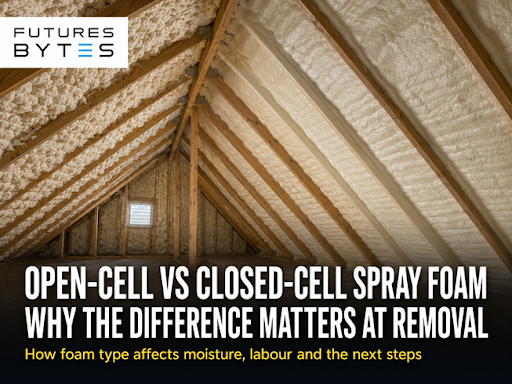
Not all spray foam behaves the same way at removal. Homeowners often hear the terms open-cell and closed-cell, but the difference matters far beyond technical jargon. Foam type can influence how the insulation interacts with moisture, how labour-intensive removal becomes and what may need checking once the roof structure is exposed.
Open-cell and closed-cell: the practical difference
Open-cell foam is usually softer and more porous. It can be easier to cut back and peel away, although that does not make every installation simple. Closed-cell foam is denser, firmer and often more strongly bonded, which can make removal slower and more physical.
For a homeowner, the takeaway is straightforward: two lofts that look similar at first glance may involve very different removal methods and labour times simply because the material is different.
Why moisture and roof build-up still matter
The type of foam is only part of the picture. The real issue is how it has been used in the roof. Was it applied over sound timbers? Has it restricted ventilation? Has moisture been trapped? Was it sprayed directly onto a membrane or felt that now needs closer assessment?
Those questions are why owners considering removing spray foam insulation should not rely on the foam label alone. The roof build-up and condition underneath matter just as much.
What removal teams look for
· How firmly the foam is bonded to rafters and adjacent surfaces.
· Whether timbers are dry and structurally sound once exposed.
· Whether the foam has obscured damage, staining or ventilation issues.
· How much cleanup and finishing will be needed after the bulk removal.
The next step after removal
Once the foam is removed, homeowners can make better decisions about repairs, re-insulation and documentation. A starting point for understanding scope and pricing is the Spray Foam Helpline cost guide, which helps put the removal process in context.
In short, open-cell versus closed-cell is not just a technical distinction. It can shape the whole removal project, from moisture risk and labour time to what happens next in the roof space.