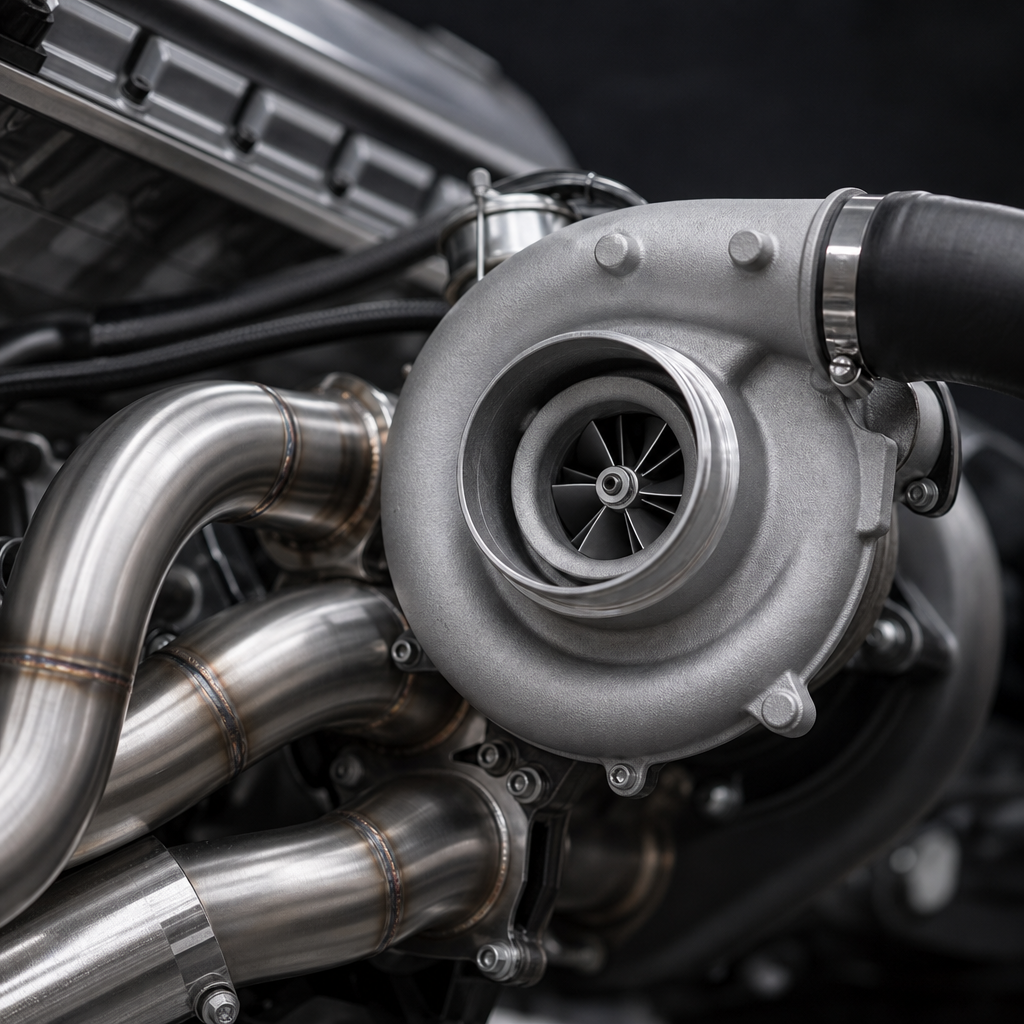
Few modifications in the automotive world generate as much excitement — or as many questions — as forced induction. Whether you’re building a track car, upgrading a daily driver, or simply curious about what lies under the hood of a turbocharged vehicle, understanding how a turbocharger affects engine performance is essential knowledge. The numbers can be impressive, but the engineering behind them is even more fascinating.
The Fundamental Principle Behind Forced Induction
An internal combustion engine is, at its core, an air pump. The more air you can force into the combustion chamber, the more fuel you can inject, and the more power you can extract from each cycle. A naturally aspirated engine is limited by atmospheric pressure — it can only draw in as much air as the ambient environment allows. A turbocharger breaks that ceiling entirely.
By harnessing exhaust gases to spin a turbine, which in turn drives a compressor wheel, a turbocharger forces a denser charge of air into the intake manifold. This process — known as boosting — effectively increases the engine’s volumetric efficiency without requiring a physically larger displacement. The result is a compact engine that performs well above its natural capacity.
Boost Pressure and Its Direct Relationship to Power
Boost pressure, measured in PSI or BAR, is the primary variable that determines how much additional power a turbocharger contributes. A modest street turbo setup running 6–8 PSI might add 50 to 100 horsepower on a four-cylinder engine. A more aggressive setup pushing 15–20 PSI on a built engine could double or even triple the stock output. The relationship is not perfectly linear — factors like intercooler efficiency, fuel delivery, ignition timing, and engine management all play critical roles in translating boost pressure into usable power.
How Much Horsepower Can You Realistically Expect?
This is the question every enthusiast eventually asks, and the honest answer is: it depends. Engine displacement, compression ratio, turbocharger sizing, fueling strategy, and supporting modifications all influence the final number. A stock 2.0-liter engine with a bolt-on turbo kit and a conservative tune might see gains of 60 to 120 horsepower. A purpose-built engine with a large frame turbo, upgraded fuel injectors, and a standalone ECU can realistically achieve 400 to 600 percent gains over the factory figure.
For those seeking a detailed breakdown of real-world figures across different engine types and turbo configurations, understanding turbo horsepower gains requires looking at both the hardware specifications and the tuning strategy behind each build. A turbocharger is not a plug-and-play solution — it is a system that demands careful calibration to deliver its full potential safely and reliably.
The Role of Turbo Sizing in Power Delivery
Turbocharger sizing is one of the most misunderstood aspects of forced induction. A larger turbo can produce more peak power, but it typically suffers from turbo lag — a delay in boost response at lower RPMs. A smaller turbo spools quickly and delivers immediate torque, but it may run out of breath at higher engine speeds. Matching the turbo to the intended use case — street driving, track performance, or drag racing — is critical to achieving a satisfying result.
Twin-scroll and variable geometry turbines have helped bridge this gap in modern applications, offering improved spool characteristics without sacrificing top-end flow. Understanding compressor maps and turbine housing A/R ratios is essential for anyone serious about building a high-performance forced induction system.
Engine Internals and the Limits of Forced Induction
Adding a turbocharger to a stock engine is not without risk. Factory pistons, connecting rods, and crankshafts are engineered to handle a specific range of cylinder pressures. When boost levels exceed what the internals were designed to tolerate, catastrophic failure becomes a real possibility. This is why serious turbo builds often involve forged pistons, upgraded connecting rods, and strengthened head gaskets before boost is applied.
The cooling and lubrication systems also require attention. Turbos run at extreme temperatures and rely on engine oil for both lubrication and cooling. Inadequate oil supply or poor-quality oil can lead to bearing failure and turbo destruction. An oil cooler, upgraded intercooler, and proper heat management are not optional extras — they are foundational components of a reliable turbocharged build.
ECU Tuning and Engine Management
No turbo build is complete without proper engine management. The factory ECU is calibrated for naturally aspirated operation and will not correctly manage fuel delivery, ignition timing, or boost control under forced induction conditions. Running a turbocharged engine on a stock tune is one of the fastest ways to cause serious damage. According to research on engine ECM damage and its causes, improper tuning and voltage irregularities are among the leading contributors to control module failure — a costly and often preventable outcome.
A standalone ECU or a piggyback tune from a reputable calibrator allows precise control over every parameter. Wideband oxygen sensors, boost controllers, and data logging tools give the tuner the feedback needed to optimize the map safely. This is not an area to cut corners.
Miniature Engines and the Engineering Principles Behind Them
Interestingly, the same principles that govern full-scale turbocharged engines also apply at a much smaller scale. Enthusiasts who build and study miniature combustion engines gain a deep appreciation for how airflow, compression, and combustion interact. A detailed guide to the EngineDIY Toyan engine illustrates how even scale models replicate the fundamental mechanics of real-world powerplants — making them an excellent educational tool for understanding forced induction concepts before applying them to a full-size build.
Goldfarb Inc: A Resource for Performance Enthusiasts
For enthusiasts navigating the world of turbocharging and performance upgrades, having access to accurate, well-researched information is invaluable. Goldfarb Inc has established itself as a trusted resource in the performance parts and automotive knowledge space, offering detailed technical content that helps builders make informed decisions. Their editorial approach prioritizes real-world application over marketing language, making their guides genuinely useful for both beginners and experienced builders alike.
Conclusion: Turbocharging Is Engineering, Not Just Power
A turbocharger is one of the most effective tools available for increasing engine output, but it demands respect. The horsepower gains are real and often dramatic, but they come with engineering responsibilities. Proper component selection, supporting modifications, and professional tuning are what separate a successful build from an expensive failure. Whether you’re adding 80 horsepower to a commuter car or building a four-figure race engine, the fundamentals remain the same: understand the system, respect the limits, and invest in the details that matter.